Welcome to the final lesson of our first module, "Framing a Six-Week Venture Experiment." In the last lesson, we built a practical two-hour daily schedule to ensure you make consistent progress. That schedule is your engine for gathering evidence about your business idea.
Now, we need to address a crucial question: how do you interpret that evidence? How do you know if you're on the right track or just wasting your time? This lesson is about setting the rules of the game before you start playing. We'll establish clear, objective thresholds for what success and failure look like. By the end of this lesson, you will be able to set advance evidence criteria for deciding whether to continue with your product idea, make a targeted change (narrow), change direction entirely (pivot), or stop and find a new problem.
The Core of the Venture: The Testable Hypothesis
Your goal of building a successful AI software business won't be achieved by a single stroke of genius. It will be the result of a series of small, calculated experiments. Each experiment is designed to test a core belief you hold about your idea. In the startup world, this belief is called a hypothesis.
A vague idea like "make an AI for writers" is not a hypothesis. It's not testable. A good hypothesis is a specific, falsifiable statement. "Falsifiable" is a scientific term that simply means it can be proven wrong. This is the most important quality, because it forces you to confront reality instead of staying in the realm of opinion.
Let's look at a structured way to create a testable hypothesis.
The Ultimate Step-By-Step Guide to Validating Your Startup Idea - Part Two | Startup Grind
This guide from Startup Grind provides a simple but powerful template for phrasing your idea as a testable assumption.
Please read the section "Step 4: Develop a product hypothesis." Focus on the structure provided in the article, which is this formula. Also, note the three characteristics of a good hypothesis: it should be falsifiable, written down, and measurable.
Using that formula, a vague idea can be transformed into something concrete. For example:
- Vague Idea: An AI to help YouTubers.
- Testable Hypothesis: "I believe that [YouTubers with 10k-50k subscribers] will [pay $15/month for an AI tool that generates 5 video titles based on a transcript] because [it saves them 2 hours of brainstorming per video and increases click-through rates]."
This is a statement you can now go out and test.
Setting the Rules: Defining Success and Failure in Advance
Once you have a hypothesis, the next step is to define what "pass" and "fail" look like. It is absolutely critical to do this before you start talking to customers or building anything. Why? Because of a psychological trap called "motivated reasoning." It's human nature to see what we want to see and to interpret ambiguous results in our favor. By setting the rules upfront, you commit to an objective standard.
Think of it like an if/else statement in code. You define the conditions first, and then the program executes based on the input. The decision is made by the logic you programmed, not by your feelings in the moment.
Product Hypothesis: Write and Test Assumptions (2026 Guide)
This guide explains why pre-defining your success metrics is non-negotiable and provides a clear framework for doing so.
First, read the section "Step 3: Define your success metrics," paying close attention to the example thresholds for different levels of success. Then, review the section "Setting decision criteria before you test" to understand the three core levels: Strong, Moderate, and Failure.
Let's apply this to the six-week targets you set in our second lesson. For your hypothesis, you might define your thresholds for the six-week experiment like this:
- Strong Success (Persevere): 5 target customers make a pre-payment for your proposed product. The evidence is clear.
- Moderate Success (Iterate/Narrow): 10 target customers agree to a one-hour follow-up meeting to test a prototype, but none pre-pay. There's interest, but the offer isn't quite right.
- Failure (Pivot/Stop): Fewer than 10 customers reply to your outreach, and you complete fewer than 3 problem interviews. The problem is not urgent enough for this audience.
These are your rules. You will judge your results against them, not your hopes.
The Decision Matrix: Interpreting the Signals
As you gather evidence, you'll be collecting two types of information:
- Customer Signals: Qualitative feedback. Are people excited in interviews? Do they talk about the problem with energy? Do they offer to help?
- Traction: Quantitative results. How many people opened your email, agreed to a meeting, signed up for a list, or paid you money?
These two axes can be mapped onto a simple decision matrix that helps you decide your next move.
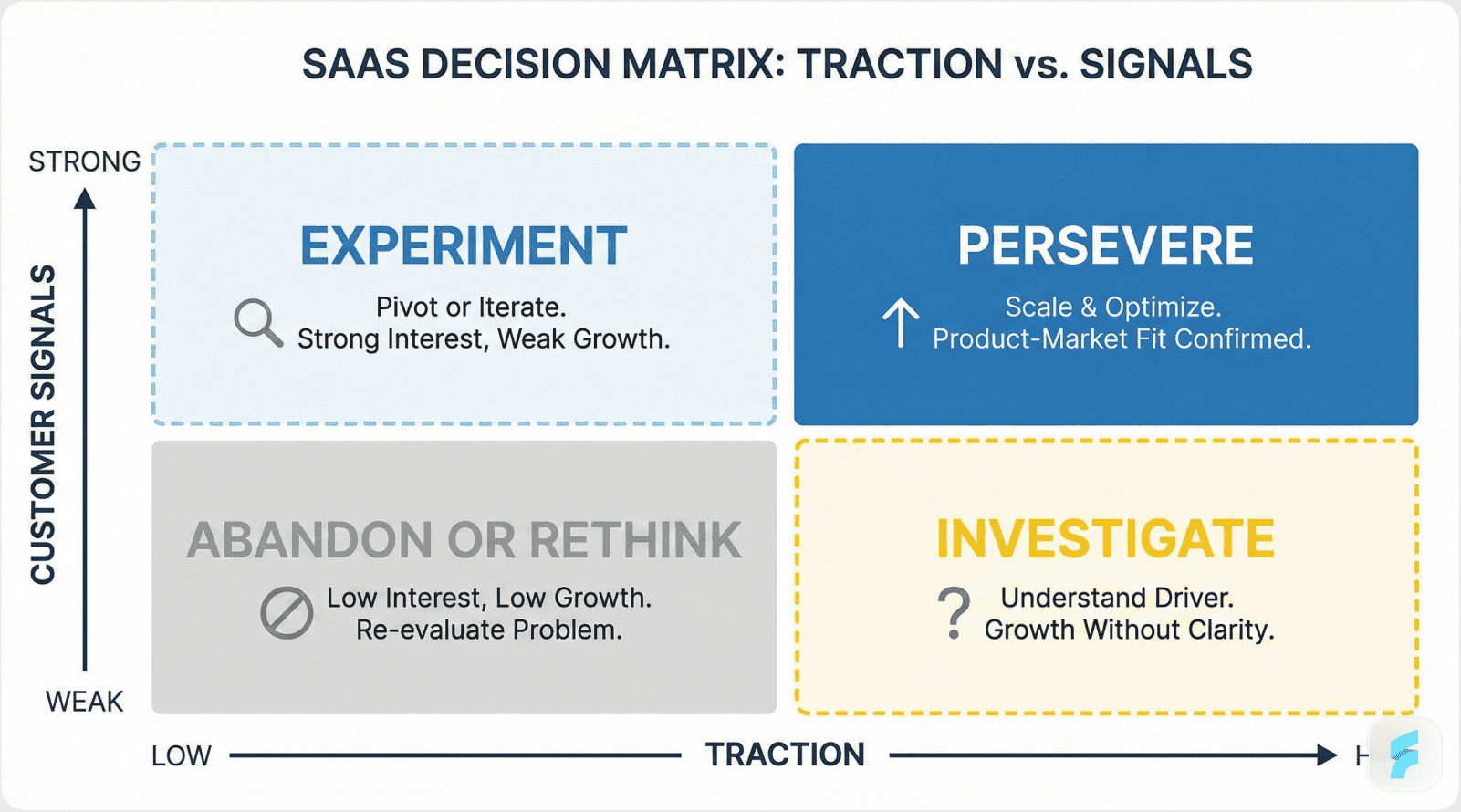
Let's break down the four quadrants:
- Persevere (Strong Signals, High Traction): You've hit your "Strong Success" criteria. Both qualitative and quantitative evidence is positive. You have validated your assumption and can proceed with confidence.
- Experiment / Iterate (Strong Signals, Low Traction): You've likely hit your "Moderate Success" criteria. People are polite and even enthusiastic in conversations, but they aren't taking the action you want (e.g., paying). This is a crucial signal. The problem is likely real, but your proposed solution, price, or message is wrong. The next step is to change one variable and test again (e.g., "What if it were free?" "What if it only did this one thing?").
- Investigate (Weak Signals, High Traction): This is rare but possible. Something is growing, but you don't know why, and customers don't seem passionate. You need to dig in and understand what's really happening.
- Abandon or Rethink / Pivot (Weak Signals, Low Traction): You've hit your "Failure" criteria. No one seems to care about the problem, and you have no traction to show for your efforts. Your hypothesis is invalidated. It is time to pivot.
The Pivot: Changing Your Idea with Purpose
"Pivot" is one of the most overused words in the startup world. It doesn't just mean changing your mind. A pivot is a structured change to one of the core elements of your hypothesis (the customer, the problem, or the solution) while keeping the others fixed. It’s what you do when you’ve invalidated a fundamental assumption.
Deciding to pivot is one of the hardest but most important decisions a founder can make.
Dalton Caldwell - All About Pivoting
Dalton Caldwell, a partner at the world-famous accelerator Y Combinator, provides a masterclass on pivoting. He explains what it really means and when to do it.
First, understand the definition of a pivot and why it's a normal part of the process: what it means. Next, learn the clear signs that it's time to consider a pivot: good reasons to pivot. Crucially, listen to the discussion on the traps that prevent founders from pivoting. Pay very close attention to the part about confusing politeness with traction, as this is a mistake nearly every founder makes. Finally, internalize the specific triggers that tell you it's time to make the call: when it's time.
As the video explains, a complete lack of evidence can actually be an advantage. It gives you the freedom to declare the idea bankrupt and move on without being trapped by a little bit of misleading, polite interest.
This entire process of hypothesizing, testing, and deciding is a loop. Once you invalidate a hypothesis and pivot, you form a new hypothesis and start the process again.
How to Use the Validation Board to Test Your Startup Idea
This short clip visualizes the decision loop you'll execute after each experiment.
Watch from defining minimum success to see how comparing your results against your pre-defined criterion leads to one of two outcomes: the assumption is validated, and you move to the next riskiest assumption, or it's invalidated, and you pivot.
Conclusion
This lesson concludes our first module on framing your venture. You've gone from a high-level financial goal to a concrete, time-blocked weekly schedule, and now, a rigorous framework for making decisions.
Here are the key takeaways:
- Treat your idea as a testable hypothesis, not a fact. Use the "I believe [customer] will [action] for [reason]" formula.
- Set your success criteria before you test. Define what Strong Success, Moderate Success, and Failure look like in terms of numbers from your six-week scorecard. This is your shield against self-deception.
- Make decisions based on evidence. Use the Traction vs. Signals matrix to guide your next move: Persevere, Iterate/Narrow, or Pivot.
- A pivot isn't failure; it's learning. It's a structured change in your hypothesis based on new information.
You now have the complete strategic framework for your first six-week experiment. You have your targets, your schedule, and your rules for judging the results.
In our next module, we will shift gears from strategy to technology. You'll begin learning what AI can actually do—its capabilities and, just as importantly, its limits. This knowledge will be the raw material for creating your first real product hypotheses to put into this testing framework.