Introduction
Welcome to our fourth lesson in the "Psychoacoustics and Sonic Perception" module. In our previous lesson, we examined how the auditory system localizes individual sounds in 3D space using binaural cues like Interaural Time and Level Differences (ITD/ILD) and monaural spectral cues (HRTFs). We established that spatial location is a powerful tool for separating one sound from another.
However, a real-world soundscape—and especially a film soundscape—is rarely just one sound. It's a complex mixture of dialogue, music, ambient sounds, and effects, all overlapping and competing for our attention. This leads to a fundamental question: Once our brain has the raw data of loudness, pitch, and location, how does it solve the complex puzzle of grouping all these components into meaningful, distinct sources?
Today's lesson addresses this very question. Our learning outcome is to explain how the human auditory system organizes complex soundscapes into perceptual streams. We will explore the foundational theory of Auditory Scene Analysis (ASA) and its principles of perceptual grouping. To conclude, we will analyze how filmmakers can masterfully exploit—and subvert—these principles for profound aesthetic effect.
1. Auditory Scene Analysis and Perceptual Streams
When you listen to an orchestra, your ears receive a single, complex pressure wave. Yet, you don't perceive a chaotic wall of sound. Instead, you perceive the distinct lines of the violins, the cellos, the brass, and the percussion. Your brain has performed an incredible feat of reverse-engineering, taking the combined signal and decomposing it back into its constituent sources.
This process is known as Auditory Scene Analysis (ASA), a term and framework developed by psychologist Albert S. Bregman. The goal of ASA is to organize the auditory scene into perceptual streams.
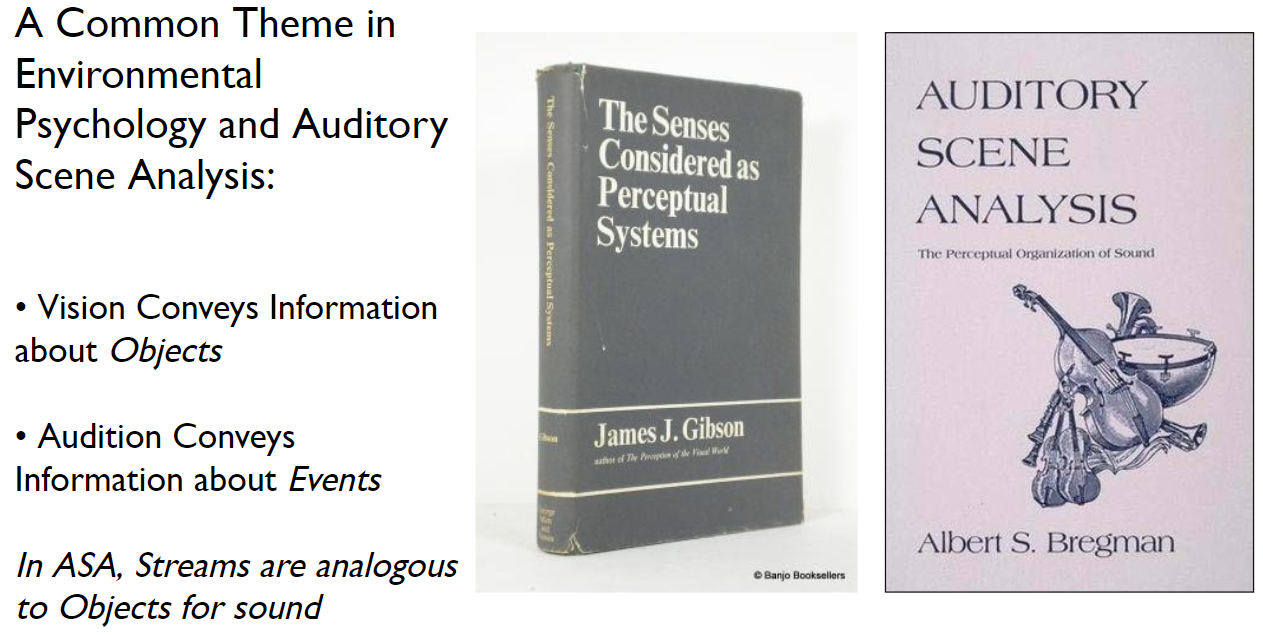
So, how does the brain decide which bits of sound to group together into a stream? It uses a set of powerful, largely unconscious heuristics, or rules of thumb, that are deeply related to the Gestalt principles of visual perception.
2. The Gestalt Principles of Auditory Grouping
The Gestalt psychologists of the early 20th century proposed that our minds tend to perceive organized wholes and patterns rather than a collection of separate parts. These same principles that group visual elements into shapes also group auditory elements into streams.

To see how these principles work in practice, let's turn to a video explanation by psychologist Steven Pinker, who discusses his early work in Albert Bregman's lab.
How The Brain Makes Sense Of The Auditory World (S1EP2)
In this video, 'How The Brain Makes Sense Of The Auditory World,' Steven Pinker provides an accessible but scientifically rich overview of Auditory Scene Analysis, explaining the core principles and illustrating them with auditory and musical examples.
Please watch the following segments: Introduction to ASA (00:09 - 01:47): This introduces the core problem of ASA and its connection to Gestalt laws. Sequential Grouping (01:47 - 02:24): Pay attention to how the brain groups tones over time based on pitch proximity to form a 'stream' or 'melody'. Simultaneous Grouping (02:24 - 03:45): This explains how the brain 'glues together' simultaneous frequency components (harmonics) to perceive a single sound with a rich timbre. Musical Examples (04:49 - 06:22): This fantastic section demonstrates the principles with 'virtual polyphony' (one instrument splitting into two perceived streams) and 'fusion' (two instruments merging into one perceived stream).
As the video demonstrates, the brain applies two main types of grouping:
-
Simultaneous Grouping (or Fusion): This is how we group frequencies that occur at the same time to hear a single, complex sound. The main cue is harmonicity. Frequencies that are integer multiples of a fundamental frequency are fused into one percept with a distinct timbre (e.g., a note from a saxophone). Another powerful cue is common onset/offset; frequencies that start and end together are almost always grouped.
-
Sequential Grouping (or Streaming): This is how we connect sound events over time to form a continuous stream. The primary cues are:
- Proximity in Pitch and Time: Sounds that are close to each other in pitch and occur close in time tend to be grouped into a single stream.
- Timbral Similarity: A sequence of sounds with the same timbre (e.g., a specific person's voice) will be perceived as a single stream.
- Good Continuation: The brain prefers to follow smooth trajectories. A series of notes that form a smooth melodic contour will be grouped, even if they cross the path of another melody.
- Common Fate: Sounds that change together (e.g., modulate in loudness or frequency at the same rate) are grouped. This is why you can distinguish a single violin from the rest of the string section by its unique vibrato.
3. Formalizing the Framework
Having explored the principles intuitively, let's ground them in a more formal academic definition. The following text provides a concise summary of Bregman's ASA model.
[PDF] An ode to listening: sound diegesis and the perception of space in ...
The following text, from the thesis 'An ode to listening,' offers a clear, academic summary of Auditory Scene Analysis. It will help consolidate the concepts from the video and introduce key terminology.
Please read section 2.2 Auditory scene analysis. Focus on the distinction between 'integration' and 'segregation,' the role of Gestalt principles, and the use of learned patterns or 'schemas' in organizing sound.
This reading reinforces that ASA is a two-part process:
- Integration: Fusing components into a single stream.
- Segregation: Separating different streams from each other.
A successful sound mix for a film, for instance, must allow the audience to segregate the dialogue stream from the music and effects streams, while also allowing the various effects to integrate into a believable ambient background.
4. Application in Film: The "Malick Illusion"
As a sound designer, you intuitively use these principles every day. When you EQ a sound to separate it from another, you are manipulating frequency cues. When you layer multiple sounds to create a single, massive explosion, you are relying on common onset to fuse them together.
But what happens when these principles are intentionally subverted? This is where psychoacoustics becomes a powerful tool for aesthetic expression. Director Terrence Malick is a master of this, creating complex soundscapes that challenge our perceptual grouping mechanisms. The following article analyzes a specific technique, dubbed the "Malick Illusion," in his film The Thin Red Line (1998).
The Malick Illusion: Perceptual segmentation in The Thin Red Line
This scholarly article, 'The Malick Illusion,' analyzes how Terrence Malick manipulates the viewer's perceptual processes. It's a perfect case study of how the theoretical principles of ASA can be applied to advanced film analysis.
Please read the introduction and the sections titled 'Perceptual segmentation', 'The Malick Illusion', and the detailed analysis of the film examples that follows (up to 'Perceptual segmentation in film'). Focus on how Malick creates ambiguity between a character's internal monologue (a non-diegetic stream) and their dialogue (a diegetic stream) by exploiting the brain's tendency to group synchronous visual and auditory cues (lip movements and voiceover).
The article reveals a masterful manipulation of perceptual streaming. Malick presents the viewer with a character's moving lips (a strong visual cue for a diegetic sound source) at the same time as a voiceover (a separate, non-diegetic stream). For a few crucial milliseconds, the brain's automatic grouping mechanisms, driven by synchrony and proximity, attempt to fuse the voiceover stream with the character's image.
The result is a profound ambiguity. Is this character speaking? Is it their thoughts? Is it another character's thoughts? By frustrating the process of perceptual segmentation (the successful outcome of ASA), Malick blurs individual identities and creates a "polyphonic chorus" or a collective stream of consciousness. This is not a technical flaw but a deliberate aesthetic strategy that forces the viewer to become aware of their own perceptual process, a key theme in Malick's work.
Conclusion
Today, we have delved into the cognitive mechanics of how we make sense of complex sonic environments. We've moved from the raw sensory data of the previous lesson to the organized, meaningful world of perceptual experience.
Key Takeaways:
- The brain organizes complex soundscapes through Auditory Scene Analysis (ASA), grouping sound components into perceptual streams.
- This grouping process relies on heuristics analogous to visual Gestalt principles, including proximity (in time and pitch), similarity (of timbre), good continuation, and common fate.
- ASA involves both simultaneous grouping (fusing harmonics into a single timbre) and sequential grouping (linking sounds over time into a continuous stream).
- In film, sound designers constantly manipulate these principles to either ensure clarity (segregating dialogue) or create complex, integrated sound effects.
- Advanced filmmakers like Terrence Malick intentionally subvert these principles, creating perceptual ambiguity to achieve specific aesthetic and philosophical goals, such as blurring the boundaries between individual consciousnesses.
Preview of the Next Lesson:
We have now explored how we perceive the fundamental attributes of sound and how our brains organize them into meaningful streams. Our next lesson, "Explain the concept of embodied cognition and its role in the perception of film sound," will take a significant step further. We will move beyond a purely cognitive model to explore how the perception of sound is deeply intertwined with our physical, bodily experience of the world, setting the stage for our later discussions of immersion and phenomenology.