Introduction
Welcome back. In our last lesson, we explored Auditory Scene Analysis (ASA), a framework that explains how our brain sorts a complex mix of sounds into distinct, meaningful perceptual streams. We treated this as a largely cognitive task—a form of auditory puzzle-solving based on principles like pitch, timbre, and timing. This model, while powerful, implicitly treats the mind as a kind of central processor that analyzes data sent by the ears.
Today, we will challenge that separation of mind and body. Our learning outcome is to explain the concept of embodied cognition and its role in the perception of film sound. This lesson marks a shift from a purely cognitive model to one where perception, thought, and feeling are fundamentally grounded in our physical, bodily existence. We'll discover that we don't just hear a film's soundscape; we feel it through a web of bodily associations, sensory-motor simulations, and deeply ingrained metaphors.
1. What is Embodied Cognition?
At its core, the theory of embodied cognition proposes that the mind is not an abstract entity separate from the body. Instead, our cognitive processes—including perception, memory, and language—are profoundly shaped by the fact that we have bodies with specific sensory and motor capabilities that interact with a physical environment.
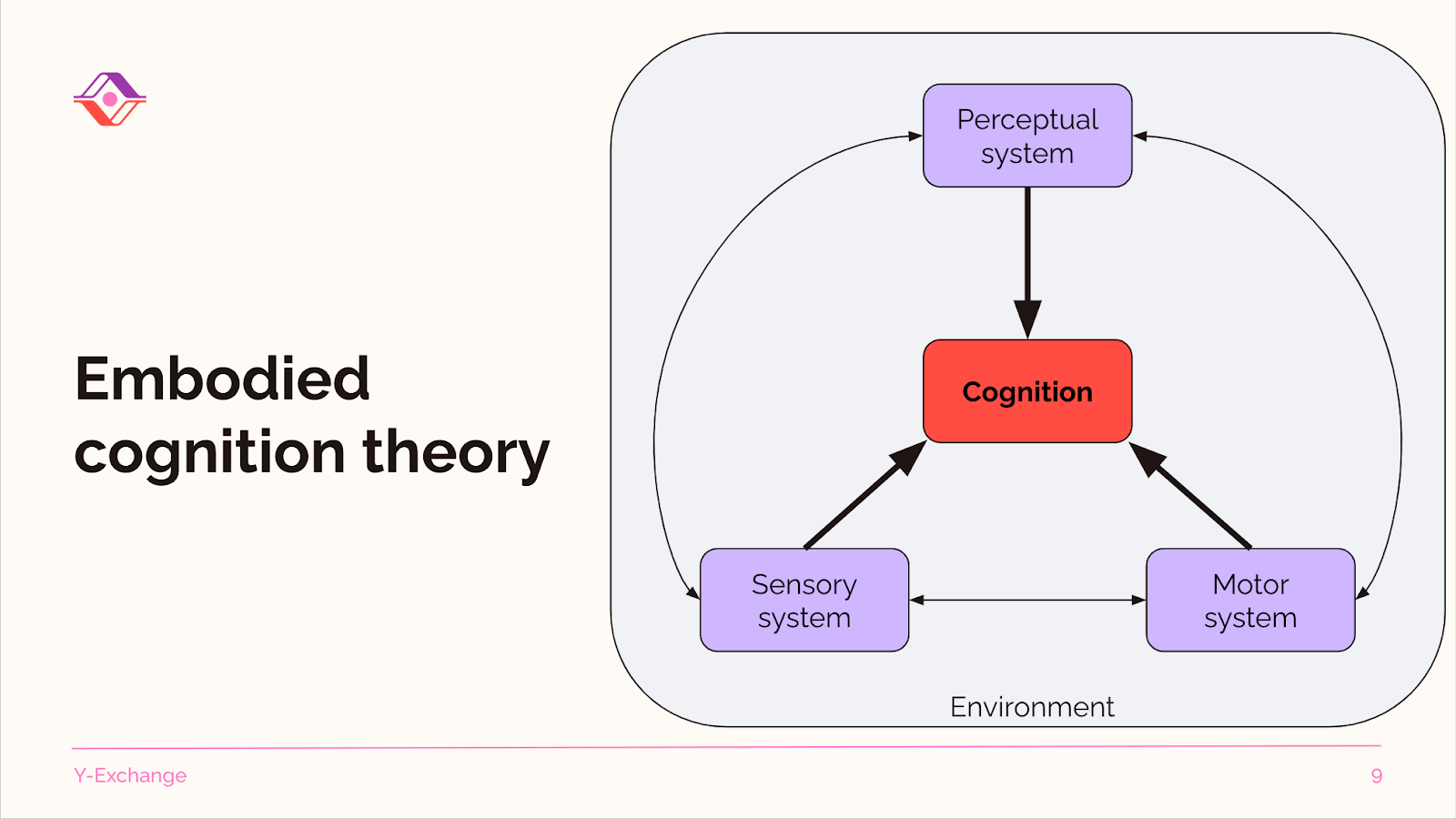
This idea has deep roots in phenomenology, a philosophical tradition that studies lived experience. Let's watch a short video that introduces some key phenomenological concepts that are foundational to embodied cognition.
Intro to Phenomenology and Vivian Sobchack's Film Theory
The video 'Intro to Phenomenology and Vivian Sobchack's Film Theory' will introduce us to concepts like pre-reflective bodily knowledge and the intermingling of the senses—ideas that are central to understanding embodied perception.
Please watch the following two segments: Pre-Reflective Bodily Responsiveness (12:23 - 16:42): Focus on the distinction between reflective thought (like doing mental math) and pre-reflective, embodied knowledge (like knowing how to catch a ball or play an instrument). Pay attention to the concept of 'knowledge in the hands'. Intermingling of the Senses (16:42 - 19:04): This section challenges the idea of five discrete senses. Notice the argument that we can 'feel with our eyes,' perceiving qualities like texture or temperature visually, based on our past bodily experiences.
The video highlights two critical ideas:
- Pre-reflective Knowledge: Much of what we "know" is not conscious, symbolic information but is instead stored as bodily skills and dispositions. Your experience as a sound mixer involves this constantly—the feel of a fader, the intuitive adjustment of EQ, are forms of "knowledge in the hands."
- Cross-modal Perception: Our senses are not isolated. What we see informs what we hear and touch, and vice-versa. We perceive a single, unified reality through a fusion of sensory inputs, a concept you'll recognize as related to Chion's idea of synchresis.
2. Image Schemas and Conceptual Metaphors
Building on these phenomenological roots, cognitive scientists like George Lakoff developed a more detailed model of how the body shapes the mind. They argue that we make sense of the world, especially abstract concepts like time, emotion, and logic, by mapping them onto basic, embodied experiences.
To understand this mechanism, let's watch a lecture by Lakoff himself.
George Lakoff on Embodied Cognition and Language
In 'George Lakoff on Embodied Cognition and Language,' Lakoff explains how fundamental concepts are built from embodied experiences. This will give us the key building blocks for understanding how sound creates meaning.
Please watch the following segments: Foundations of Embodiment (02:00 - 10:12): This part introduces the core evidence for embodied cognition, focusing on how our understanding of space is built from pre-conceptual structures called image schemas (e.g., CONTAINMENT, SOURCE-PATH-GOAL). Conceptual Metaphor (38:48 - 45:25): This is the crucial step. Lakoff explains how we understand abstract ideas by metaphorically structuring them in terms of these embodied image schemas. Listen for the example of 'Affection is Warmth' and how these metaphors are not just linguistic quirks but fundamental neural circuits.
From Lakoff's presentation, we can extract two essential concepts for our purposes:
- Image Schemas: These are recurring, dynamic patterns of our bodily experience. They are not rich, detailed images but are more like abstract skeletons of experience, such as
CONTAINMENT(in/out),BALANCE,FORCE(compulsion, blockage), andVERTICALITY(up/down). - Conceptual Metaphors: These are the cognitive mechanisms we use to understand an abstract concept (the target domain) in terms of a more concrete, embodied one (the source domain). For example:
- ANGER IS HEATED FLUID IN A CONTAINER: We understand the abstract emotion of anger through our physical experience with boiling liquids.
- MORE IS UP / LESS IS DOWN: We understand quantity through the physical experience of adding to a pile (it gets higher) or draining a container (the level drops).
This framework provides a powerful tool for sound analysis. A sound's rising pitch might metaphorically signify increasing tension (TENSION IS UP). A sudden, loud sound might be perceived through the FORCE schema, giving it a physical impact.
3. Audiovisual Metaphors in Film Sound
Now we can connect this theory directly to film sound. Film sound designers and composers intuitively leverage these embodied metaphors to shape our physical and emotional experience of a film. The following reading provides an excellent academic framework for this.
[PDF] Audiovisual Metaphors in the Sound Design of Narrative Films
The article 'Emotions in Sound: Audiovisual Metaphors in the Sound Design of Narrative Films' by Kathrin Fahlenbrach directly applies the theory of conceptual metaphor and embodied image schemata to the analysis of film sound.
Please read the following sections: Start on the second page, reading the two paragraphs under the heading 'Emotions in Sound: Audiovisual Metaphors in the Sound Design of Narrative Films' (starts with "Every time we perceive persons..."). This introduces the core thesis. Read the section 'Emotion Metaphors' (starts on page 88). Focus on how abstract emotions are conceptualized using physically rooted image schemata, particularly the force-schema. Read the section 'Audiovisual Metaphors: Emotion Metaphors in Audiovisual Media' (page 90). This explains why audiovisual media are so effective at communicating these embodied metaphors. Finally, read the analysis of The Shining's stair sequence in the section 'Emotional Aesthetics' (page 92). This provides a concrete example of how sound helps realize the conceptual metaphor 'fear is an opponent in a struggle'.
Fahlenbrach’s analysis shows that film sound doesn't just symbolize emotion; it enacts the physical, embodied experience of that emotion. In The Shining example, the high frequency of Wendy’s voice, the dissonant music, and the contrast with Jack's slow, menacing movements all work together to create an audiovisual gestalt that we experience through the embodied FORCE schema—we feel the pressure, the struggle, the threat on a bodily level.
4. A Sound Designer's Toolkit for Embodied Metaphor
Let's bring this down to the level of production and mixing, connecting it to your own professional experience. The next resource examines how specific sound design choices, particularly the manipulation of dynamics, function as tools for creating embodied metaphorical meaning.
[PDF] EMBODIED METAPHORS IN FILM SOUND: THE CASE OF AURAL ...
The article 'EMBODIED METAPHORS IN FILM SOUND' by Tarun Madupu and Maarten Coëgnarts is written from the perspective of a sound designer. It provides a practical classification of how aural dynamics are used to create embodied narrative meaning.
Please read the following sections: 1. Introduction: This section grounds the discussion in embodied cognition and conceptual metaphor theory, setting up the paper's focus on aural dynamics. 3.1 Contrasting dynamic range: Notice how abrupt shifts in loudness are used to create meaning. The analysis of the 'Holdo Maneuver' in Star Wars is an excellent example of the metaphor 'Narrative Impact is Sonic Impact'. 3.2 Relative loudness and silence: This section explores how the relative amplitude of sounds and the use of silence can metaphorically represent a character's psychological state. The 'psychological tension is loudness' metaphor from The Godfather is a classic example.
This article frames your practical work as a mixer within a powerful theoretical context. When you increase the loudness of a train to reflect a character's inner turmoil, you are deploying the "psychological tension is loudness" metaphor. When you create a vast, reverberant space for a character's dream, you are using the CONTAINER schema to metaphorically represent the expansiveness of their mind. These are not just technical choices; they are acts of creating embodied meaning that an audience understands on a pre-reflective, physical level.
Conclusion
Today we have journeyed from the brain's cognitive processing to the body's lived experience. We've seen that the perception of film sound is not a passive reception of information but an active, embodied process.
Key Takeaways:
- Embodied cognition argues that our minds are inseparable from our bodies. Our perception and thought are grounded in our physical, sensory-motor interactions with the world.
- We understand abstract concepts like emotion through conceptual metaphors, which map them onto concrete, embodied image schemas (e.g., FORCE, CONTAINER, VERTICALITY).
- Film sound is exceptionally powerful at triggering these embodied responses. Sound design choices regarding dynamics, frequency, and spatiality can activate these schemas and metaphors, allowing us to feel a character's emotional state or the narrative's tension on a physical level.
- Sound practitioners, whether consciously or intuitively, use this "bodily language" of sound to guide the audience's perception and create meaning that resonates far deeper than conscious interpretation.
Preview of the Next Lesson:
We've established that sound perception is both a cognitive and an embodied process, and we've touched on its role in creating emotion. In our next lesson, we will focus more explicitly on this emotional dimension. The learning outcome will be to discuss how cognitive and affective processes interact in the perception of film soundscapes. We will explore how our rational understanding and our immediate emotional responses are constantly in dialogue as we experience a film's world of sound.