Introduction
Welcome to the third lesson in our module on "Psychoacoustics and Sonic Perception." In our previous lesson, we explored Auditory Scene Analysis (ASA), the process by which the brain segregates complex sound mixtures into distinct sources. We identified several cues the brain uses for this task, including one we'll focus on today: spatial location. A sound's origin in space is a powerful cue that helps us group its components together and separate it from other sounds.
This lesson addresses the question: How does the auditory system determine a sound's location? Our learning outcome is to describe the primary psychoacoustic cues for spatial hearing (e.g., ITD, ILD) and their use in creating cinematic space.
We will dissect the fundamental binaural (two-eared) mechanisms that allow us to localize sounds on the horizontal plane: the Interaural Time Difference (ITD) and the Interaural Level Difference (ILD). We will also touch upon the monaural (one-eared) spectral cues responsible for localizing sounds in the vertical plane. Finally, we will connect this psychoacoustic knowledge directly to sound design, exploring how filmmakers and mixers manipulate these very cues to build immersive and meaningful cinematic worlds.
1. The Building Blocks of Spatial Hearing: ITD and ILD
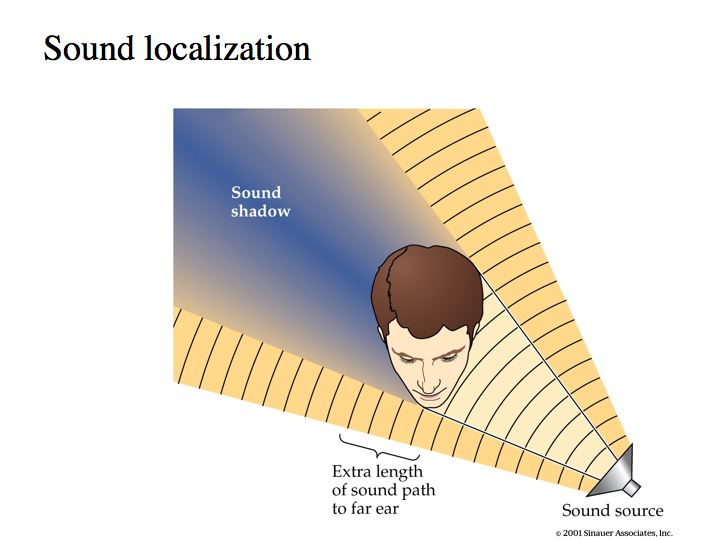
Our ability to perceive the direction of a sound source is fundamentally a geometric calculation performed by our brain, made possible by the fact that our two ears are separated by our head. This separation creates two primary differences in the sound that arrives at each ear.
To build a formal understanding of these cues, let's turn to a comprehensive academic review of auditory localization.
Auditory localization: a comprehensive practical review - PMC
The following article, 'Auditory localization: a comprehensive practical review,' provides precise, scholarly definitions of the key binaural cues. We will use it as our foundational text for this section.
Please read the following sections from this paper: Start with 2.2. Main characteristics of localization for an overview of the Duplex Theory. Then, read section 3. Auditory cues for sound source localization and the detailed explanations in 3.1. ITD and IPD and 3.2. ILD. Focus on how each cue works and, crucially, the range of frequencies for which each is most effective.
Let's consolidate what you've just read:
-
Interaural Time Difference (ITD): A sound originating from one side reaches the nearer ear first, arriving at the farther ear slightly later. The brain measures this time difference—which can be as small as a few microseconds ()—to calculate the sound's angle.
- Effective for: Low frequencies (below ~1500 Hz). At low frequencies, the wavelength is long compared to the size of the head, allowing the phase of the wave to be compared unambiguously between the two ears.
-
Interaural Level Difference (ILD): The head casts a "sound shadow," blocking and absorbing some of the sound energy before it reaches the far ear. This makes the sound quieter at the far ear compared to the near ear.
- Effective for: High frequencies (above ~4000 Hz). High-frequency sounds have short wavelengths that are easily blocked by the head, creating a significant level difference. Low-frequency sounds, with their long wavelengths, simply "wrap around" the head with little attenuation, making ILD an ineffective cue.
This complementary relationship is known as the Duplex Theory of Sound Localization, first proposed by Lord Rayleigh in 1907. It states that our brain uses ITD to place low-frequency sounds and ILD to place high-frequency sounds. This also implies that we are less accurate at localizing sounds in the mid-frequency range (approx. 1500-4000 Hz), where neither cue is optimally effective.
2. Ambiguity, Elevation, and the HRTF
The Duplex Theory provides a powerful model for localization in the horizontal plane (azimuth), but it has limitations.
The Cone of Confusion
For any given ITD and ILD, there is not a single point in space but a whole cone-shaped surface of possible locations that would produce the exact same values. For example, a sound directly in front of you, directly behind you, or directly above you all produce an ITD and ILD of zero. This ambiguity is known as the cone of confusion.

How does the brain solve this? One way is through small head movements, which change the ITD and ILD values and resolve the ambiguity. Another, more crucial mechanism involves spectral cues.
Elevation and the Head-Related Transfer Function (HRTF)
While ITD and ILD are excellent for left-right localization, they provide almost no information about a sound's height (elevation). This is where monaural cues (perceptible with just one ear) come into play.
The folds and shape of your outer ear (the pinna), along with your head and shoulders, act as a complex filter. They reflect and diffract sound waves, causing subtle boosts and cuts in the sound's frequency spectrum before it enters your ear canal. Crucially, these spectral changes are different depending on the elevation of the sound source.
This filtering effect is described by a Head-Related Transfer Function (HRTF). Your brain learns to associate these unique spectral "fingerprints" with specific elevations, allowing you to distinguish between a sound coming from above, below, or in front of you.
Let's return to the review paper to formalize this concept.
Auditory localization: a comprehensive practical review - PMC
This section of the paper details the limitations of binaural cues and introduces the role of HRTFs in resolving ambiguity and perceiving elevation.
Please read sections 3.3. ITD and ILD are complementary mechanisms (which discusses the cone of confusion) and 3.4. Head-related transfer function (HRTF). Focus on how HRTFs provide the necessary information to overcome the cone of confusion and enable 3D hearing.
In summary, a complete picture of 3D hearing involves:
- Binaural Cues (ITD & ILD) for the horizontal plane (azimuth).
- Monaural Cues (HRTF) for the vertical plane (elevation) and resolving front-back ambiguity.
3. A Deeper Look at the Data
Given your goal of achieving a rigorous academic understanding, it's valuable to see the psychophysical data that underpins these theories. The following lecture from MIT OpenCourseWare presents the experimental measurements of ITD and ILD and quantifies human performance in localization tasks.
20. Sound localization 1: Psychophysics and neural circuits
The video 'Sound localization 1: Psychophysics and neural circuits' provides a graduate-level analysis of the physical cues for sound localization. It offers a quantitative look at the data, which will deepen your theoretical foundation.
This is an optional but highly recommended viewing. Please watch these two segments: Experimental Data of ITD & ILD (15:36 - 26:34): The professor analyzes graphs showing how ITD and ILD change with sound source angle and frequency. Pay attention to the maximum ITD (around 600 microseconds) and how ILD is negligible at low frequencies but substantial (up to 20 dB) at high frequencies. Human Localization Performance (29:39 - 36:21): This segment discusses the 'minimum audible angle'—the smallest change in sound source position we can detect. Note how performance is best at low and high frequencies (around 1-2 degrees), corresponding to the effective ranges of ITD and ILD, and how this links back to our just-noticeable-difference for time (10µs) and level (1 dB).
Watching these segments reinforces the Duplex Theory with concrete numbers and demonstrates the remarkable precision of the human auditory system.
4. Application: From Psychoacoustics to Cinematic Space
As a sound mixer and designer, you constantly manipulate these very cues. Panning a sound in a stereo mix is, at its most basic, a manipulation of ILD—you are simply making the sound louder in one speaker than the other. More advanced spatial audio and surround sound technologies (like Dolby Atmos) also incorporate sophisticated algorithms to manipulate ITD and simulate HRTFs, creating a more convincing three-dimensional auditory experience.
Let's now explicitly connect this to film theory. The following resource discusses how the "binaural effect" is used as an expressive tool in cinema.
[PDF] The Impact of Auditory Effects on the Expressive Power of Sound Art ...
The paper 'The Impact of Auditory Effects on the Expressive Power of Sound Art' examines how psychoacoustic phenomena are applied in film. We will focus on its discussion of the binaural effect as a tool for shaping cinematic space.
Please read section 3. The impact of the binaural effect on cinematic sound art expression (this includes subsections 3.1, 3.2, and 3.3). Focus on how the paper categorizes the spatial functions of sound in film (environmental, perspective, directional sense) and how binaural hearing is used to expand space beyond the frame.
This paper provides an excellent framework for analyzing the narrative function of spatial sound. By manipulating ITD and ILD through panning and mixing, a sound designer can:
-
Shape the Sense of Space: The paper identifies three key aspects you can control:
- Environmental Sense: Using reverb and ambient sound placement to convey the size and nature of a space (e.g., an echoey cathedral vs. a dry, small room).
- Perspective Sense: Altering a sound's level and frequency content (simulating the head shadow and air absorption) to indicate its distance from the listener's point-of-audition.
- Directional Sense: Precisely placing sounds off-screen to direct the audience's attention and create a sense of a world existing beyond the visual frame.
-
Drive the Narrative: The example from Madaari shows how characters (and by extension, the audience) can use directional sound cues to locate off-screen threats or points of interest. This makes spatial hearing an active part of the storytelling.
-
Expand Space Beyond the Frame: Off-screen sounds are a fundamental cinematic technique for making the world feel larger and more alive. Your brain's ability to instantly localize these sounds via ITD and ILD is what makes this technique so effective. The placement of non-diegetic music in surround channels similarly expands the psychological space of the film.
Conclusion
In this lesson, we have deconstructed the complex process of spatial hearing into its core psychoacoustic components. You are now equipped to describe not only what these cues are but also how they function and why they are fundamental to the art of cinematic sound design.
Key Takeaways:
- Spatial hearing on the horizontal plane is governed by the Duplex Theory, which posits that we use Interaural Time Differences (ITDs) for low frequencies and Interaural Level Differences (ILDs) for high frequencies.
- These binaural cues alone can be ambiguous, creating a cone of confusion. This ambiguity is resolved by head movements and, most importantly, by monaural spectral cues for elevation.
- The filtering effect of the outer ear, head, and torso is captured by the Head-Related Transfer Function (HRTF), which provides the primary cues for elevation and front-back localization.
- In cinema, sound designers manipulate these cues through panning, mixing, and spatial audio technology to shape the audience's perception of environmental, perspective, and directional space, thereby driving the narrative and expanding the world beyond the frame.
Preview of the Next Lesson:
Now that we have established the three primary attributes of sound perception—loudness, pitch, and spatial location—we can delve into more complex cognitive phenomena. Our next lesson is titled, "Explain how the human auditory system organizes complex soundscapes into perceptual streams." While our lesson on Auditory Scene Analysis introduced the basic principles of segregation, our next session will explore how the brain maintains the identity of these perceptual streams over time, even as they move and change, allowing us to follow a single conversation, a melodic line, or a character's footsteps through a dense and evolving soundscape.