Introduction
In our last lesson, we focused on what companies say about themselves through their social media channels. We learned to analyze their content strategy to understand their intended message and audience engagement. Today, we turn the tables and focus on what their customers are saying about them. This is where you find the ground truth about a product or service.
This lesson is designed to teach you how to gather and analyze customer reviews to identify a competitor's strengths and weaknesses. For a freelance data researcher, this is a core competency. It allows you to move beyond a company's marketing and provide your clients with raw, unfiltered intelligence about customer satisfaction, product flaws, and market opportunities. This skill helps you answer the crucial question: "What do people actually think?"
The Strategic Value of Customer Reviews
Before diving into the "how," let's establish the "why." Analyzing customer feedback is not just about collecting complaints; it's about uncovering strategic insights that can inform business decisions, from product development to marketing messaging.
7 Easy Steps on How to Perform a Competitor Analysis
The video "7 Easy Steps on How to Perform a Competitor Analysis" from LYFE Marketing provides a great overview of why this process is so valuable.
First, watch the introduction from 00:48 to 01:56 to understand the key reasons for performing a competitor analysis. Notice the emphasis on identifying what competitors are doing right and wrong, and understanding what customers are saying about them. Next, jump to the section on analyzing reviews from 06:29 to 07:10. This part highlights how reading reviews gives you a "front row seat" to customer complaints and questions, which can directly inform your client's strategy.
As the video explains, reviews reveal customer pain points and desires. A consistent complaint about a competitor is a clear market opportunity for your client. Conversely, consistent praise highlights a strength that your client will need to compete against.
A Systematic Process for Review Analysis
To turn a mountain of comments into clear insights, you need a structured process. Simply reading reviews randomly is inefficient. A systematic approach ensures you capture data consistently and can identify meaningful patterns.
The process can be broken down into three main stages:
- Gather: Find and collect reviews from relevant sources.
- Organize: Structure the raw data in a spreadsheet.
- Analyze: Categorize the feedback and identify recurring themes.
The following article outlines a fantastic framework for this, explaining where to find reviews and how to begin making sense of them.
Analyze Your Competitors' Customers: A Step-by-Step Tutorial for ...
This guide from Xnova International provides a practical approach to analyzing competitor customer feedback.
First, read the section on the benefits. This reinforces the strategic value we just discussed. Then, carefully study the section on reviews and testimonials. This part is crucial as it lists common platforms to search for reviews (Google Reviews, Yelp, Amazon, G2, etc.) and explicitly states the goal: to discover strengths ("aspects customers most appreciate"), weaknesses, and "unmet expectations."
Organizing Your Findings
As a freelance researcher, your output needs to be clear and organized. A spreadsheet is the perfect tool for this task. For each review you collect, you should capture several key pieces of information. This organized data becomes the foundation for your analysis.
The article "How to Create a Customer Feedback Analysis Report?" provides an excellent, simple structure for your spreadsheet.
How to Create a Customer Feedback Analysis Report? + ... - Faqprime
This article by Faqprime offers a practical template for organizing feedback, which we can adapt for competitor reviews.
Read the section on organizing feedback. Pay close attention to the suggested columns for a spreadsheet. For our purposes, a good structure would be: Source: Where you found the review (e.g., Amazon, G2, Twitter). Review Text: The full text of the customer's comment. Sentiment: Your classification (Positive, Negative, Neutral). Key Theme: The main topic of the review (e.g., "Customer Support," "Product Quality," "Pricing," "Ease of Use"). Strength/Weakness: A brief summary of the specific strength or weakness mentioned.
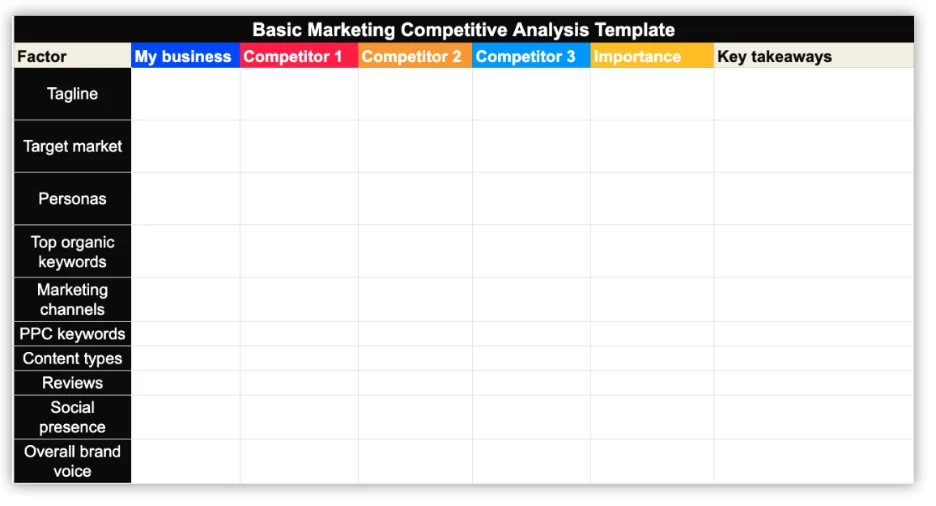
Your final analysis will slot into a broader competitor research report, like the templates shown below. The "Key takeaways" or "Notes" section is where you would summarize your findings from the review analysis.

Practical Application: From Raw Data to Insight
Now, let's look at how this process works in practice. We'll explore a modern, automated approach to gathering and summarizing reviews. While the tools may seem advanced, the underlying concepts—scraping data and summarizing it—are exactly what you would do manually.
The following video demonstrates scraping Amazon reviews into a Google Sheet and then using an AI function to analyze them. This is a great example of a high-efficiency workflow you can aspire to as a freelancer.
How to Use ChatGPT in Google Sheets (Full Tutorial)
This tutorial from Bardeen, while focused on using ChatGPT in Google Sheets, contains an excellent demonstration of gathering and analyzing product reviews.
Gathering the Data: Watch from 07:47 to 08:40. This segment shows how a browser extension can scrape dozens of customer reviews from an Amazon product page and import them directly into a Google Sheet. This automates the "Gather" and "Organize" steps of our process. Analyzing the Data: Now, watch from 09:00 to 10:09. Here, the presenter uses a function to analyze each review. The prompt he uses is key: "Give me a one-sentence summary giving an advantage or disadvantage of the product". This directly extracts the strength or weakness from each piece of feedback, automating the "Analyze" step.
Your Turn: The Manual Method
The automated method is powerful, but you can achieve the same result manually. This is a great way to practice your analytical skills.
Here is your hands-on task:
- Pick a product or service from a competitor you've researched previously.
- Find 10-15 reviews for it on a site like Amazon, G2, Capterra, or even in the comments section of their social media.
- Create a new Google Sheet with the columns we defined earlier:
Source,Review Text,Sentiment,Key Theme, andStrength/Weakness. - Copy and paste each review into your sheet and fill out the other columns.
- Once you're done, look for patterns. Are there themes that appear repeatedly in the "Negative" reviews? Those are your competitor's key weaknesses. Are there features that are consistently praised in "Positive" reviews? Those are their key strengths.
This manual exercise is the foundational skill. Once you master this, you can explore tools to make the process faster.
Conclusion
You've now learned how to tap into one of the most valuable sources of market intelligence: the customer's voice. By moving beyond a company's polished marketing and analyzing what real users are saying, you can provide clients with powerful, evidence-based insights.
Here are your key takeaways:
- Listen to the Customer: Customer reviews offer unfiltered feedback on a competitor's true strengths and weaknesses.
- Follow a Process: A systematic approach of gathering, organizing, and analyzing reviews is crucial for extracting meaningful insights.
- Structure Your Data: Use a spreadsheet to log reviews and categorize them by source, sentiment, and theme. This turns unstructured comments into analyzable data.
- Identify Patterns: The ultimate goal is to find recurring themes that point to systemic strengths (e.g., "excellent customer service") or weaknesses (e.g., "buggy software").
In our next lesson, we will continue our competitive analysis by investigating another critical data point: pricing. You'll learn how to find, extract, and organize competitor pricing information to help your clients position themselves effectively in the market.