Introduction
In our last lesson, we focused on deconstructing a competitor's website to understand its core value proposition and target audience. We treated the website as a formal, carefully constructed statement of purpose. Today, we shift our focus from this static presentation to the dynamic, real-time conversation of social media. This is where you'll see a company's personality, how they interact with their community, and which of their messages truly resonate.
This lesson will equip you with a systematic process to analyze a competitor's social media presence and assess their content strategy. For a freelance researcher, this is a vital skill. It allows you to provide a comprehensive view of a competitor's marketing efforts, uncovering what they're doing well, where they're falling short, and what opportunities exist for your client.
A Framework for Social Media Analysis
Just like with website analysis, we need a structured approach to avoid aimless scrolling. A simple yet effective way to organize your research is to answer four key questions:
- Where are they active? Which social media platforms do they use?
- How often do they post? What is their posting frequency?
- What do they post? What are their main content themes and formats (e.g., videos, images, articles, promotions)?
- How well is it working? How does their audience respond? What is their engagement like?
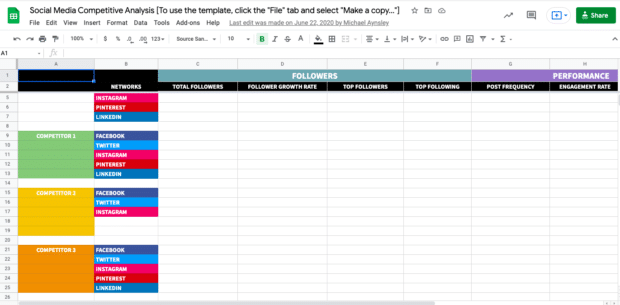
As a freelancer, your client will expect you to deliver your findings in a clear, organized format. A spreadsheet is the perfect tool for this. As you work through this lesson, imagine populating a simple table for each competitor, with columns for each of the questions above.
Here are a couple of examples of how such a competitive analysis template might look. This is the kind of deliverable you would create for a client.

Why Bother with Competitor Analysis?
Before we dive into the "how," it's important to understand the "why." Knowing what your competitors are doing on social media is not about copying them. It's about gaining strategic intelligence.
Competition Check – Intro to Social Media - OPEN OKSTATE
This article from Oklahoma State University's "Intro to Social Media" course provides a great overview of the strategic value of this type of research.
Read the section Why Perform Competitor Analysis. As you read, focus on the key benefits: setting relevant benchmarks, identifying threats, and, most importantly, recognizing market gaps that your client could fill.
How to Analyze a Competitor's Content Strategy
Now, let's get practical. We will use a detailed video walkthrough to learn the step-by-step process of analyzing a competitor's social media activity, from their general presence to their best and worst-performing content.
Marketing Competitor Analysis - full digital marketing analysis for 2022
The video "Marketing Competitor Analysis" from The Fastnet Agency provides an excellent, structured guide that mirrors a real-world freelance task. We'll watch it in segments to break down the process.
Analyze their presence: Watch from 03:55 to 05:46. The presenter explains what to look for on platforms like Facebook and Instagram, including follower counts, post frequency, and content formats. He also mentions Social Blade, a free tool for checking engagement rates. Investigate their advertising: Next, watch 05:46 to 06:29. This part introduces a powerful and completely free tool: the Facebook (Meta) Ad Library. This allows you to see the exact ads a competitor is currently running. Identify what works (and what doesn't): This is the most crucial part of the analysis. Watch from 09:16 to 11:16. Here, you'll learn how to identify a competitor's best- and worst-performing posts based on engagement. This is the core of assessing their content strategy. Find the patterns: Finally, watch from 11:16 to 12:02. The presenter explains how to analyze the posts you've identified to find themes, content types that work, and gaps your client can exploit.
Using Tools to Streamline Your Work
The manual process you just learned is fundamental. However, as a freelancer, your time is valuable. There are tools that can help automate data collection. Many have free tiers that are perfect for getting started.
The video below demonstrates how to use a tool called Metricool. While the tool itself is just one example, the process it demonstrates—analyzing follower growth, engagement rates, and top-performing posts across multiple competitors—is universal.
How to Do a Competitor Analysis on Social Media
This video, "How to Do a Competitor Analysis on Social Media" by social media manager Latasha James, shows how a dedicated tool can speed up your research.
Watch from 03:57 to 08:40. Pay attention to how the dashboard quickly surfaces key information like follower counts, engagement rates, and a list of the most and least engaging posts from all competitors at once. This automates the "best and worst posts" research we discussed earlier.
A Special Focus: Analyzing Competitors on LinkedIn
Since you have a specific interest in LinkedIn for professional research, let's focus on a powerful feature that is built right into the platform. LinkedIn provides its own free competitor analytics tool for company pages.
LinkedIn Competitor Analytics: How to Research and Beat Other ...
This article from Social Media Examiner is a step-by-step guide to using LinkedIn's native analytics.
Follow these practical steps outlined in the article: Find the dashboard: Read the instructions to learn how to access the Competitors panel from your own company page's analytics tab. Add competitors: Add a few competitors you've been tracking to your list. Don't worry, this is completely private. Compare key metrics: Read the sections on audience comparison and content comparison. This will show you how to track follower growth and total engagement (reactions, comments) against your competitors directly within LinkedIn.
This built-in tool is an excellent starting point for any B2B market research project.
Synthesizing Your Findings with a SWOT Analysis
After gathering all this data, you need to turn it into actionable insight for your client. A SWOT analysis (Strengths, Weaknesses, Opportunities, Threats) is a simple and effective framework for this.
Competition Check – Intro to Social Media - OPEN OKSTATE
Let's return to the OKSTATE resource to learn about this classic business analysis framework.
Read the section on SWOT Analysis.
Based on your social media research, you can now fill this out for a competitor:
- Strengths: What content themes or formats are consistently getting high engagement for them? (e.g., Their "how-to" video tutorials perform very well.)
- Weaknesses: Where are they failing? What content gets no response? Are they inconsistent? (e.g., Their purely promotional posts get almost no engagement.)
- Opportunities: What are they missing? Is there a platform they're ignoring? A content format (like Instagram Reels) they haven't tried? (e.g., None of the competitors are using short-form video, creating an opening.)
- Threats: What are they doing so well that it could be a major challenge for your client? (e.g., They have a highly engaged community that answers questions before the company can, making them the go-to resource in the space.)
Conclusion
You now have a complete workflow for analyzing a competitor's social media presence. This process moves you from simple observation to strategic analysis—a skill that is highly valuable to any client seeking to understand their market.
Here are your key takeaways from this lesson:
- Use a Structured Framework: Analyze where competitors post, how often, what content they share, and how well it performs.
- Focus on Performance: The real insight comes from identifying the best and worst-performing content to understand what resonates with their audience.
- Leverage Free Tools: Use the Meta Ad Library and LinkedIn's native analytics to gather crucial data efficiently.
- Synthesize Your Findings: A SWOT analysis is a powerful tool to transform your raw data into strategic recommendations for your client.
In our next lesson, we will continue our journey into market research by shifting our focus again. We've heard what companies say about themselves on their websites and social media; next, we will learn how to gather and analyze what their customers are saying about them in reviews.