Introduction
In our last lesson, you mastered the value discovery conversation—the art of guiding a client to quantify the financial opportunity locked behind their UX problems. You now have a script to anchor your work to a six- or seven-figure business impact.
This lesson takes that abstract value and makes it concrete and buyable. We're moving from "what this is worth" to "what you can buy." Your goal is to create a tiered pricing matrix for your audit services at the $3k, $5k, and $8k price points.
This isn't about plucking numbers from the air. It's about "productizing" your expertise into clear, distinct packages. This strategy puts the client in the driver's seat, changing their decision from "should I hire you?" to " how should I hire you?". By the end of this lesson, you will have a reusable pricing matrix in Figma—a core asset for your sales process.
1. The Productized Service Model: From Custom Proposals to Clear Packages
Instead of creating a new, custom proposal for every lead, high-earning consultants package their services like SaaS products. This creates predictability for you and clarity for the client.
A productized service has a fixed price, a defined scope, and a standardized workflow. Think of it as creating a "menu" of your services.
Take a look at how this is done in practice. The first image is for a productized design service, and the second is a pricing table for a SaaS product—the very type you'll be auditing.

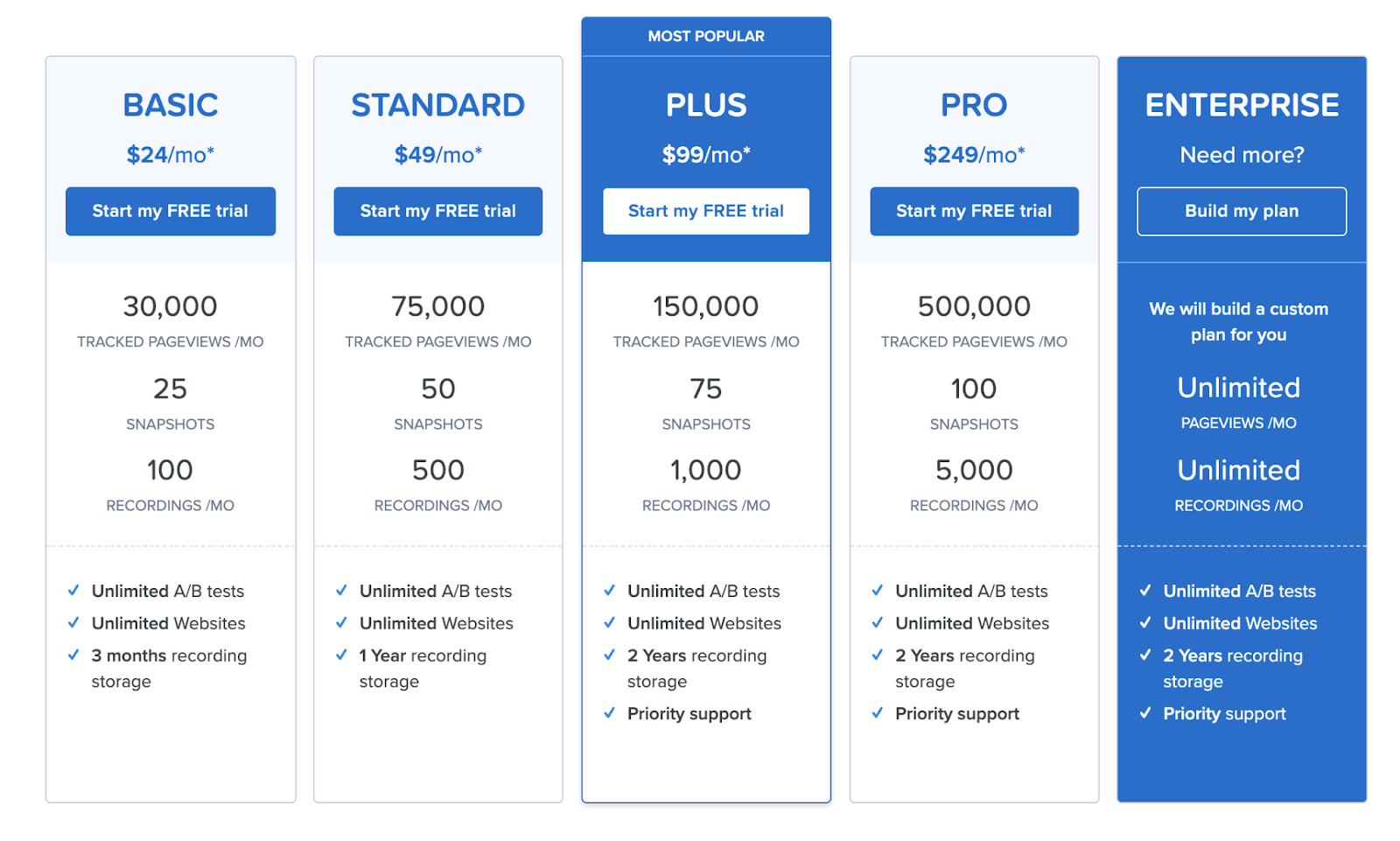
To build your own packages, you first need to understand the underlying principles of productization and pricing. The following resource provides an excellent framework.
The complete guide to productized services (2025 edition)
The article 'The complete guide to productized services' from Assembly offers a tactical breakdown of how to package and price your expertise. We'll focus on the sections that guide you through creating your tiers.
Read the following sections: 'What is a productized service?': Read from the beginning until 'Why productization matters today'. This will solidify the core concept and its advantages over traditional freelancing. 'Set pricing and packages': Focus on the subheading 'The 4-point pricing research framework' and 'The "Goldilocks test"'. This provides a practical method for structuring your three tiers (Starter, Professional, Premium), which we will adapt for your audit service.
2. The Architecture of Your $3k, $5k, and $8k Tiers
Your pricing tiers are not arbitrary. They are designed to offer different levels of depth, certainty, and strategic involvement. Each tier must provide a clear return on investment, but the higher tiers should de-risk the client's investment and accelerate their path to results.
The key is to connect your fee to the value you uncovered in the discovery conversation. As a rule of thumb, your fee should represent a 3-10x ROI for the client. The article below provides a step-by-step method for calculating this and presenting it as three options.
Consulting Fees Guide: How Much To Charge For Consulting (3 ...
The 'Consulting Fees Guide' from Consulting Success provides a formulaic approach to value-based pricing and structuring tiered options. It's the mathematical foundation for your pricing matrix.
Read the section 'The Value-Based Method For Setting Your Consulting Fee'. Pay close attention to Step 4: Use The ROI Formula and Step 5: Offer 3 Pricing Options. This will show you how to derive your prices from the client's stated value and how to scope each option.
Here is a ready-to-use structure for your three audit tiers. This is your starting point.
| Tier | Price | Title | Core Proposition | Key Deliverables |
|---|---|---|---|---|
| Tier 1 | $3,000 | Audit Diagnostic | "I'll find the problems." | • Heuristic Evaluation (using a SaaS-specific checklist) • Analytics review (Clarity/Hotjar) • Report with 10-15 prioritized usability issues • Annotated screenshots |
| Tier 2 | $5,000 | Audit & Blueprint | "I'll find the problems and prove the solutions." | • Everything in Tier 1 • PLUS: Quantitative analysis (GA4/Mixpanel funnel review) • PLUS: 5 "guerrilla" usability tests to validate key findings • PLUS: "Quick win" redesigns for the top 3 issues (Figma wireframes) |
| Tier 3 | $8,000 | Audit & Partnership | "I'll drive the implementation of the solutions." | • Everything in Tier 2 • PLUS: 90-min workshop to present findings to stakeholders • PLUS: Dev-ready tickets for the top 3 issues (e.g., in Jira/Linear) • PLUS: 30-day post-audit consulting call to review implementation |
Why this structure works:
- The $3k "Foot-in-the-Door": This is an easy "yes" for a client who is interested but cautious. It proves your value by uncovering problems they didn't know they had.
- The $5k "No-Brainer": This is your target. You should frame it as the most popular and highest-value option. It not only identifies problems but also provides a clear, user-validated path to fixing them, significantly de-risking the client's next move.
- The $8k "Upsell": This positions you as a strategic partner, not just a consultant. It's for clients who want results fast and value your help in bridging the gap between recommendation and execution. It also serves as a price anchor, making the $5k option look even more reasonable.
3. The Power of Questions in Pricing
Before you can offer a price, you must understand the client's problem. This involves asking strategic questions to determine the value of a solution. While we covered this in the previous lesson, it is worth revisiting how this diagnostic process directly leads to value-based pricing.
How To Charge For Design—Value Based Pricing
This video, 'How To Charge For Design—Value Based Pricing' by The Futur, reinforces the critical link between asking questions and establishing value. Watch it to refresh your understanding of how to set the stage for your pricing tiers.
Watch these two key segments: 11:04 - 16:26: Observe how asking 'why' questions uncovers the client's real business problems (decreasing sales, competition) and helps quantify the desired future state ($40k/month increase). This is the 'value' you will price against. 16:26 - 18:05: See how Chris Do anchors a $40k fee to the $480k annual value the client themselves just stated. This demonstrates how your $3k-$8k fee becomes a small, logical investment when anchored against a much larger potential gain.
Your tiered matrix is the direct output of this conversation. When the client agrees that solving their problem is worth $500k, offering them a solution for $5k becomes an easy decision.
4. Your Deliverable: The Reusable Pricing Matrix Component
Now, you will build this pricing structure as a reusable component in Figma. This is not just an exercise; it's a critical sales asset you will use with actual clients.
Task: Create Your Pricing Matrix in Figma
-
Set Up Your Component:
- Create a new frame in Figma.
- Using auto-layout, create three columns for your tiers: "Audit Diagnostic," "Audit & Blueprint," and "Audit & Partnership."
- Make the middle column ("Audit & Blueprint") visually distinct—use a different color or add a "Most Popular" badge. This is a common psychological tactic to guide choice.
-
Populate the Tiers:
- For each tier, add the price ($3,000, $5,000, $8,000).
- Below the price, create a list of the key deliverables for that tier using the table from Section 2 as your guide. Use icons (like checkmarks) to show what's included.
-
Add a Call to Action:
- At the bottom of each column, add a button component like "Select Plan" or "Get Started."
-
Turn it into a Component:
- Convert your entire pricing table into a master component. This will allow you to quickly drop it into any proposal document and make minor tweaks without affecting the original.
This Figma component is now part of your "sales stack." You can include it directly in your proposals or on a dedicated page on your personal website.
Conclusion
You have now moved beyond simply justifying a price to strategically presenting it. By productizing your audit service into a tiered matrix, you give clients clarity and control, which accelerates the sales cycle and positions you as a sophisticated, business-savvy consultant.
Key Takeaways:
- Productize Your Service: Package your expertise into clear, fixed-scope tiers to eliminate custom proposals and increase profitability.
- Tiers Represent Value Levels: Your $3k, $5k, and $8k options correspond to different levels of depth, certainty, and strategic partnership.
- The "Goldilocks" Principle: Your middle tier should be positioned as the best value, making it the easiest choice for most clients.
- Your Pricing Matrix is a Sales Tool: A well-designed pricing page in Figma is a professional asset that anchors your value and simplifies the client's decision-making process.
Preview of the Next Lesson:
Once a client selects a tier, you need to formalize the agreement. In the next lesson, we will focus on the final step to closing the deal: writing a concise Statement of Work (SOW) that defines the exact scope, deliverables, timeline, and payment terms, ensuring there are no surprises for you or the client.