Introduction
In the last lesson, you transformed your Figma audit report from a static document into a persuasive, data-driven business case. By integrating dynamic ROI tables and compelling data visualizations, you've engineered a powerful tool to prove, unequivocally, that the UX issues you uncover have a real, quantifiable financial cost.
Now that you can prove the value, it's time to price it. This lesson tackles the single most important skill for a high-earning consultant: justifying your fee. We will move beyond charging for your time and into the realm of value-based pricing.
Your goal for this lesson is to learn how to apply value-based pricing principles to confidently justify a $3k–$8k project fee. We'll dismantle the idea that you're a "cost" and rebuild your positioning as a strategic "investment" with a clear, undeniable return. This isn't about picking a number out of thin air; it's about mastering the conversation that makes your fee a logical and compelling conclusion for the client.
1. The Mindset Shift: You Are an Investment, Not an Expense
The most common mistake designers make is pricing their services based on time (hourly rates) or deliverables (flat rates). Both models position you as a cost to be minimized and force you into conversations about "how long it will take" rather than "what results it will produce."
Value-based pricing fundamentally changes this dynamic. Your fee becomes a fraction of the value you generate for the client, aligning your incentives with theirs. To embrace this, you must first change how you approach the sales conversation.
Watch the following video from The Futur. Chris Do provides a powerful framework for shifting your role from a "vendor" who pitches to an "expert" who diagnoses.
How To Charge For Design—Value Based Pricing
This video, 'How To Charge For Design—Value Based Pricing,' is essential for understanding the psychology of a value-based sales conversation. Pay close attention to the distinction between 'amateurs who give advice' and 'professionals who diagnose.'
Watch the following three clips: 04:38 - 07:19: Focus on the core idea: stop making assumptions and start diagnosing problems with questions. 08:39 - 12:32: Observe how to pivot from being pitched to asking strategic questions. The rule is simple: whoever asks more questions is in control. 34:28 - 38:33: This is a crucial summary. Internalize the correct sequence: Desired Future State → Success Metrics → Value → Price. This is the inverse of how most designers operate.
The key takeaway is that you should not talk about price—or even the solution—until you have guided the client to articulate the value of solving their problem. Your job is to facilitate their understanding of the opportunity.
2. The Three Pillars of Design ROI
To have a value conversation, you need to speak the language of business leaders: Revenue, Costs, and Risk. Your UX audit doesn't just find "bad design"; it uncovers financial leaks and opportunities.
The following article provides a CFO-level guide to justifying design spend. This is the ammunition you'll use in your sales calls.
ROI of UX 2026: CFO Guide to Justifying Design Spend
The article 'ROI of UX 2026: CFO Guide to Justifying Design Spend' from Redlio Designs is your playbook for framing UX work in financial terms. We'll focus on the core ROI framework it presents.
Read the section titled '1. Moving Beyond the Surface: The Three Pillars of Design ROI'. Pay close attention to the three buckets: Revenue Growth (Conversion, LTV) Cost Reduction (Support Overhead, Development Speed) Risk Mitigation (Market Protection) These are the three levers your audit pulls to create value. Memorize them.
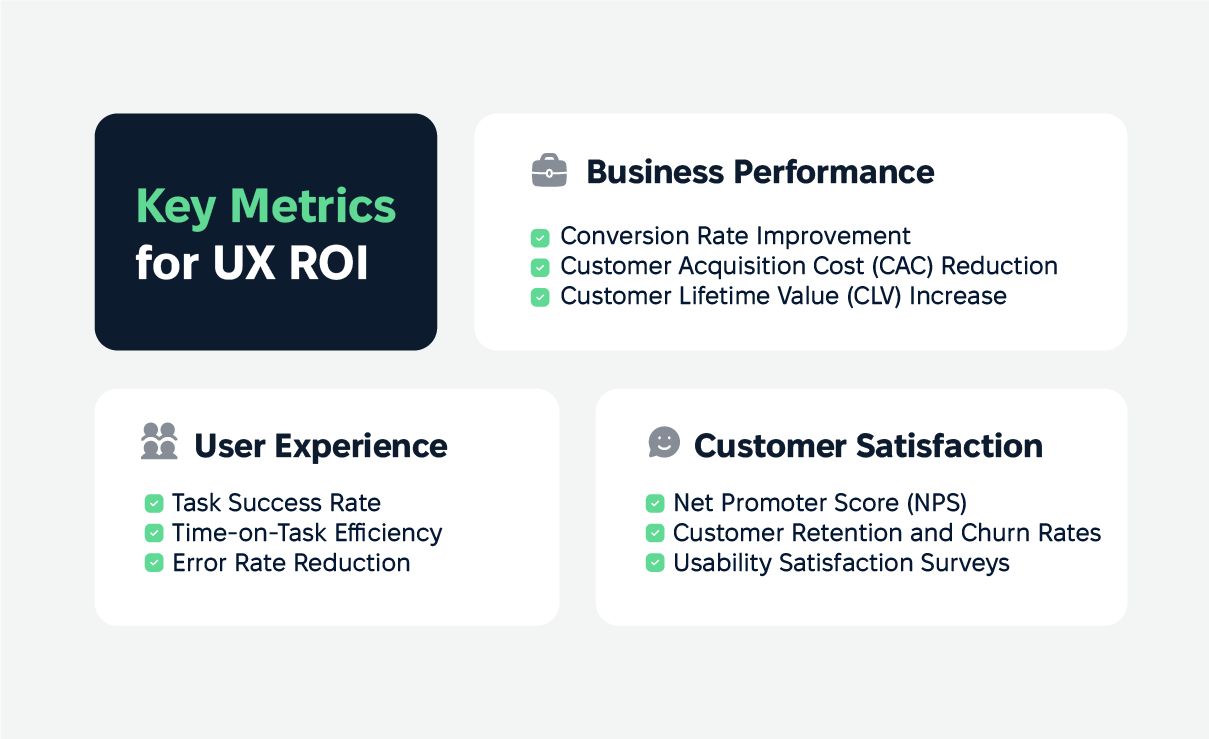
When you talk to a founder or product manager, every issue you identified in your audit should be framed within one of these three pillars.
- "Fixing the confusing checkout flow" becomes an opportunity for Revenue Growth via a conversion lift.
- "Simplifying the onboarding process" becomes an opportunity for Cost Reduction by lowering support tickets.
3. The Value Discovery Conversation: Your Script for Success
Knowing the theory is one thing; executing the conversation is another. The goal of this conversation is to get the client to state, in their own words, the monetary value of achieving their desired outcome.
The next video provides precise, tactical advice on how to navigate this conversation, especially when the client asks, "What's your rate?" upfront.
How To Price Like McKinsey - Raising Prices & Value-Based Pricing as a Freelancer with Sean McCabe
The video 'How To Price Like McKinsey' provides a clear, step-by-step guide to conducting a 'value discovery' process. This is the practical application of the mindset we discussed earlier.
Watch these two critical sections: 06:00 - 08:22: Master the script for deflecting the 'What's your rate?' question and pivoting to a conversation about their success. This positions you as an investment, not an expense. 08:22 - 11:04: This is the most important part. Learn how to ask questions that lead the client to calculate the value for you. Crucially, do not put numbers in their mouth. Make them do the math.
Example Value Discovery Flow:
- Client: "This looks interesting. So, what do you charge for an audit and redesign?"
- You (The Pivot): "That's a great question. Before we talk about the investment, I want to make sure I fully understand what success looks like for you. Can you tell me a bit more about what you're hoping to achieve with a better user experience?"
- Client: "We need to increase our conversion rate. It's too low."
- You (The Probing): "That makes sense. Right now, about how many users sign up for a trial each month? And what's your current trial-to-paid conversion rate?"
- Client: "We get about 1,000 trials, and maybe 5% convert."
- You (Quantification): "Okay, so that's 50 new customers a month. What's the ideal conversion rate you're targeting?"
- Client: "If we could get to 8%, that would be a huge win."
- You (Getting them to say the number): "An 8% conversion rate would be 80 new customers. What is the average lifetime value of a customer for you?"
- Client: "About $2,000."
- You (Locking in the value): "So, if I'm hearing you correctly, moving from 5% to 8% conversion means an extra 30 customers per month. At a $2,000 LTV, that's an additional $60,000 in revenue per month, or over $700k a year. Is that right?"
- Client: "Wow, yes. When you put it that way..."
You have now established the value. The conversation is no longer about your fee; it's about whether your fee is a reasonable investment to capture a $60,000/month opportunity.
4. Calculating Your Fee: The 10-20% Rule
Once the client has articulated the value, pricing becomes straightforward. A standard practice in value-based pricing is to charge 10-20% of the value you help create over a defined period (e.g., 6-12 months).

Using our example above:
- Value Created (12 months): $720,000
- Your Fee (10% of value): $72,000 for a full redesign.
For a smaller-scope UX audit aiming to identify these opportunities, you can anchor to a shorter timeframe.
- Value Created (1 month): $60,000
- Your Fee (approx. 10%): A $5,000 - $6,000 audit project becomes an incredibly easy decision for the client. They are investing ~$5k to unlock a potential $60k/month revenue stream. The ROI is massive.
This approach is validated by industry research.
UX Audit Tool: Evaluate Websites & Landing Pages - LEE DARIUS
To add external credibility to your pricing justification, you can reference well-known industry benchmarks. The 'UX Audit Tool' article from Lee Darius summarizes these nicely.
Read the section 'Why UX Audits Drive Growth' to find the Forrester statistic that every £1 invested in UX returns £100. Also, review the 'Why You Should Avoid Charging by the Hour' section to reinforce the core message.
When you present your proposal, you can now say: "My fee for this project is $5,000. Based on our conversation, we've identified a potential $60,000 monthly revenue lift. This represents a potential 12x return on your investment in the very first month."
5. Your Deliverable: The Value Discovery Script
To make this immediately actionable, your task is to create a reusable script in your notes that you can reference before any sales call. This is your game plan for controlling the conversation and anchoring your price to value.
Create a new note or document with the following sections:
-
The Opening:
- State the goal of the call: "To see if I can help you achieve [Client's Goal] and if we're a good fit."
-
The Pivot Script:
- Write down your go-to response for when a client asks "What's your price?" too early. Use the one from the StrategyU video as a template.
-
Core Probing Questions (Your Question Arsenal):
- List 5-7 questions designed to uncover the three pillars of ROI (Revenue, Cost, Risk).
- Example (Revenue): "What is the primary business goal of this platform?"
- Example (Cost): "How much time does your support team spend on 'how-to' questions about the current interface?"
- Example (Risk): "Have you seen any new competitors with a more modern user experience?"
-
Quantification Questions:
- List questions that force the client to do the math.
- "What is one new customer worth to you (LTV)?"
- "How many more of [X] would you need to hit your quarterly goal?"
- "What's the timeframe you're focused on for this goal (6 months, 12 months)?"
-
The Value Summary Statement:
- A template phrase to confirm the value you've uncovered.
- "So, to summarize, if we can [achieve specific outcome], that would result in approximately [$X] in [new revenue/cost savings] over the next [Y months]. Is that correct?"
This script is now a core asset in your consulting toolkit.
Conclusion
You have now learned the strategic framework for justifying a premium fee for your work. You are no longer just a designer selling hours; you are a business consultant selling outcomes.
Key Takeaways:
- Price on Value, Not Time: Your fee is determined by the financial impact you deliver, not the hours you work.
- Diagnose, Don't Prescribe: Use questions to guide the client through a process of self-discovery, allowing them to articulate the value of solving their problems.
- You are an Investment: Frame your services as an investment with a quantifiable return, making the decision to hire you a logical business choice, not an emotional one.
- The 10-20% Rule: Use the value the client has stated as an anchor, and price your services as a small fraction of that value.
Preview of the Next Lesson:
You've mastered the 'why' behind your price. In the next lesson, we will focus on the 'what' and 'how'. You will create a tiered pricing matrix for your audit services ($3k / $5k / $8k) and learn to structure a concise Statement of Work (SOW) that defines scope, deliverables, and payment terms to officially close the deal.