Introduction
In the last lesson, you built your productized pricing matrix—a powerful sales tool that frames your audit services as clear, high-value packages. Once a client agrees to a price tier, the next crucial step is to formalize the financial commitment. Simply agreeing on a price isn't enough; you need to define how and when you get paid.
This lesson is about structuring the financial architecture of your projects. Today, you will learn how to structure deposit terms and define clear payment milestones. This is a critical skill that protects your cash flow, filters for serious clients, and establishes a professional boundary from day one. You'll move from a simple price tag to a clear, enforceable payment schedule that de-risks the engagement for both you and your client.
1. The Non-Negotiable Deposit: Securing Commitment
For any project, especially short-term audits, an upfront deposit is non-negotiable. It accomplishes three critical business objectives:
- Filters for Commitment: A client willing to pay a deposit is financially and psychologically invested in the project's success.
- Secures Your Schedule: A non-refundable deposit compensates you for blocking out your calendar and turning away other potential work.
- Funds the Kickoff: It provides the cash flow needed to dedicate your initial time and resources to the project without working at a loss.
For projects under $10,000, the industry standard is a 50% upfront deposit. This is the model you will use for your $3k and $5k audit packages.
The following video explains why this is a standard practice for high-value creative professionals.
FULL client process for high ticket web design [STEP-BY-STEP]
In this clip from her video 'FULL client process for high ticket web design', Anna Hickman explains the standard payment schedule used by professional freelancers to secure projects.
Watch the segment from 00:11:41 to 00:12:14. Pay close attention to her justification for a 50% non-refundable deposit to secure the project in your calendar.
This 50/50 split—50% upfront to start, 50% on completion—is the simplest and most effective structure for your core audit offerings.
2. Milestone Payments: Tying Payment to Progress
While a 50/50 split works perfectly for a one-week audit, what about your $8k "Audit & Partnership" tier, which includes a 30-day support period? For longer engagements, tying payments to specific, verifiable deliverables (or "milestones") is a more robust approach.
Milestone payments are installments paid upon the completion of pre-defined project phases. This model reinforces the value-based principle: the client pays for delivered value, not for hours worked.
To understand the mechanics and rules of structuring milestones, the following article is an excellent tactical guide.
Milestone Payments (2025): Meaning, System, Templates & Playbook
This article, 'Milestone Payments' by Skydo, provides a clear framework for structuring payments throughout a project. We will focus on the core rules for designing a fair and effective milestone schedule.
Read the section titled 'How to design milestone payments (5 simple rules)'. Focus on Rule 1 ('Tie each milestone to a clear deliverable') and Rule 2 ('Front-load 30–50%'). These are the two most important principles for your consulting practice.
Here is a concrete example of how to apply these rules to your pricing tiers:
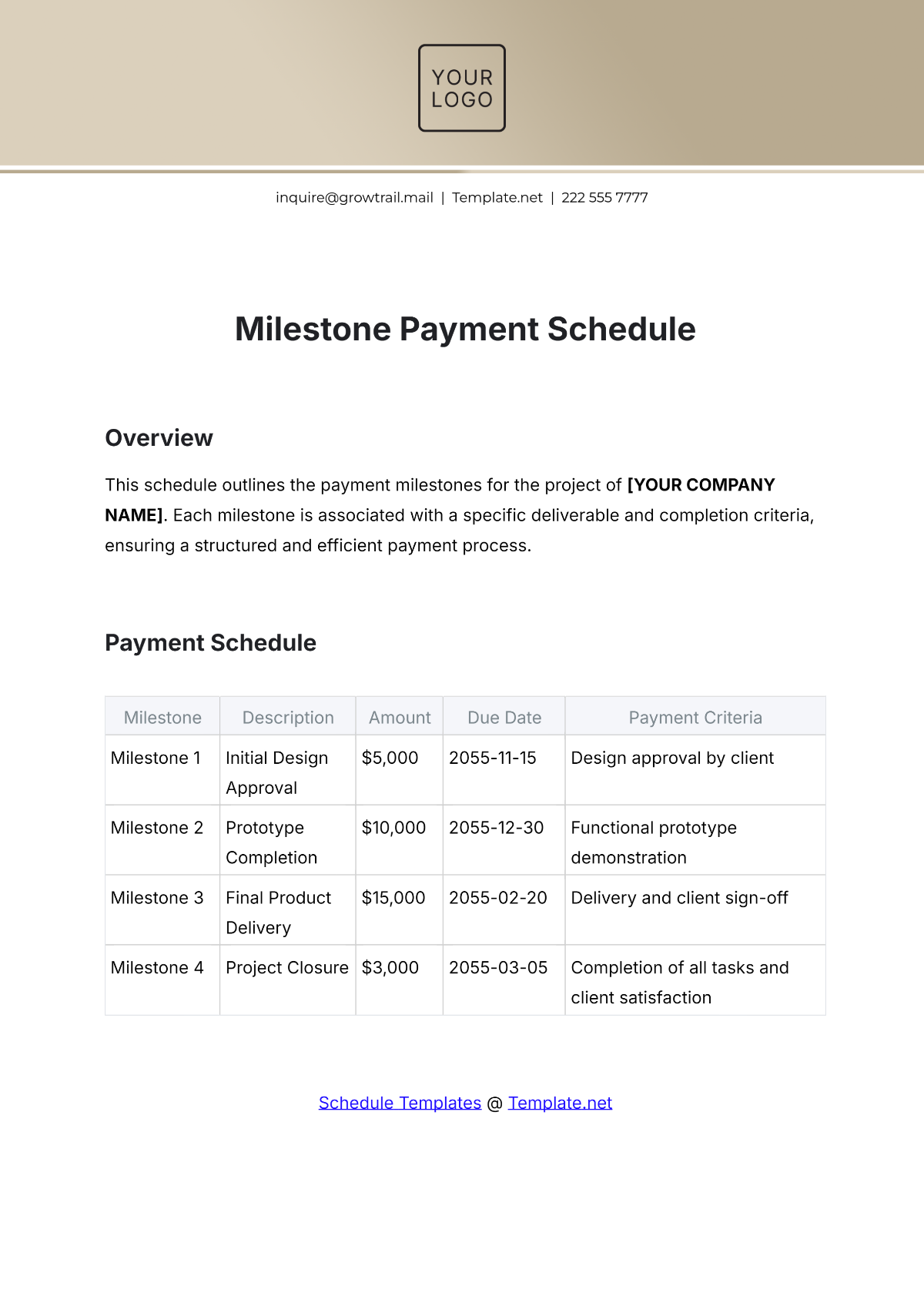
Payment Structures for Your Tiers
For your $3,000 and $5,000 Tiers (1-Week Audit):
A simple 50/50 split is ideal.
- Payment 1 (50% Deposit): Due upon signing the agreement. This triggers project kickoff and scheduling.
- Payment 2 (50% Final): Due upon delivery of the final audit report.
For your $8,000 Tier (Audit + 30-Day Partnership):
A three-milestone structure protects your time over the extended engagement.
- Milestone 1 (40% Deposit): $3,200 due upon signing. Covers the full audit process.
- Milestone 2 (40% Report Delivery): $3,200 due upon delivery of the final audit report and before the stakeholder workshop.
- Milestone 3 (20% Partnership Completion): $1,600 due at the end of the 30-day post-audit support period.
This structure ensures you are compensated for the initial heavy lifting of the audit and also maintains client engagement throughout the partnership phase.
3. Making It Bulletproof: Contract Language
Agreeing on a payment schedule is one thing; making it enforceable is another. These terms must be explicitly stated in your consulting agreement or Statement of Work (SOW). Vague terms lead to late payments and cash flow problems.
Your agreement must clearly define not just the amounts but also the rules of the financial engagement.
The Complete Guide to Consulting Agreements: Templates, Best ...
The article 'The Complete Guide to Consulting Agreements' from Consulting Success highlights common pitfalls and best practices. We'll look at the specific section on protecting your payments.
Read these two brief but critical sections: 'Fees and Payment Structure': Note the list of what to include: total investment, milestones, payment methods, and late payment penalties. 'Mistake #4: Weak Payment Protection': This reinforces the need for deposits, milestones, late payment penalties, and the right to suspend work.
Based on these principles, here are the four essential elements your payment terms must include:
- Payment Schedule: The exact milestones and amounts, as defined above.
- Payment Methods: How you accept payment (e.g., Stripe, Wise). This removes friction for the client.
- Due Dates: When payment is expected (e.g., "Due upon receipt," "Net 7"). For your services, "Due upon receipt" is standard.
- The "Teeth": Clauses that enforce the terms.
- Late Fee Clause: A penalty for overdue invoices (e.g., 1.5% interest per month).
- Pause-Work Clause: Your explicit right to suspend all work if an invoice is overdue by a specified period (e.g., 7 days). This is your primary leverage.
Your Deliverable: The Payment Terms Component
Your task is to create a reusable block of text in Figma that you can drop into your proposal or SOW template. This ensures you never forget these critical terms when closing a new client.
Task: Create Your "Payment Terms" Figma Component
- In your main proposal/SOW template file in Figma, create a new text block.
- Title it "Project Investment & Payment Terms."
- Copy and paste the following template, which is tailored for your target $5,000 "Audit & Blueprint" package.
- Style it professionally to match the rest of your document.
- Turn this styled text block into a component for easy reuse.
[Copy this into Figma]
Project Investment & Payment Terms
- Total Project Investment: $5,000 USD
- Payment Schedule:
- Payment 1 (50% Deposit): $2,500 due upon signing of this agreement to secure project scheduling and kickoff. This deposit is non-refundable.
- Payment 2 (50% Final): $2,500 due upon delivery of the final audit report, prior to the transfer of any design files or workshop delivery.
- Payment Methods: Invoices will be sent via email and can be paid online via Stripe (Credit Card) or Bank Transfer (Wise).
- Terms: All invoices are due upon receipt. A late fee of 1.5% per month will be applied to invoices more than 7 days overdue. The consultant reserves the right to pause all work on the project until payment is made on any overdue invoice.
Conclusion
You have now built another critical piece of your sales infrastructure. By defining clear, professional payment terms, you move the client relationship from a casual conversation to a formal business engagement. This protects you, demonstrates your professionalism, and sets the stage for a smooth project.
Key Takeaways:
- The 50/50 Split is your default: For short projects like your $3k-$5k audits, a 50% non-refundable deposit and 50% final payment is the gold standard.
- Milestones for Longer Engagements: For your $8k package, use a multi-milestone structure to link payments to the delivery of major components (audit, report, partnership completion).
- Your Contract Needs "Teeth": Always include clauses for late fees and the right to pause work. This is your leverage to ensure timely payment.
- Templatize Everything: Having a pre-written payment terms component in Figma saves time and ensures you never forget to include these protections.
Preview of the Next Lesson:
With your pricing matrix and payment terms defined, you are ready to assemble the final document that closes the deal. In the next lesson, you will learn how to write a concise Statement of Work (SOW) that integrates scope, deliverables, timeline, and payment terms into a single, bulletproof agreement.