Hello! In our last lesson, we built a comprehensive, classified list of keywords for a new product launch. You now have the raw material for a campaign—a mix of head terms and long-tails, spanning informational to transactional intent.
Today, we'll turn that raw list into a strategic action plan. A long list of keywords is potential; a prioritized list is power. This lesson focuses on the critical process of prioritizing your keywords based on specific business goals and budget constraints. Mastering this skill is essential for running efficient campaigns and is a core competency interviewers will probe to distinguish strategic marketers from tactical operators. By the end of our session, you'll be able to take any keyword list and confidently decide where to place your first dollar for maximum impact.
The 'Why': Intent and Goals Over Volume
The most common mistake in keyword selection is chasing high search volume. A keyword with 10,000 monthly searches seems more attractive than one with 200, but this is often a trap. The value of a keyword is not in its volume, but in its intent and its alignment with your business goals.
For a new product launch, the primary goal is usually to generate conversions quickly to validate the product and gather performance data. This means prioritizing users who are ready to buy, not those who are just starting their research.
The #1 Google Ads Keyword Research Strategy
The "Surfside PPC" channel offers a sharp analysis of why broad, high-volume keywords can be inefficient. The presenter uses the example of 'swimming pool cleaning' to illustrate this point perfectly.
Watch the segments explaining search intent and how Google's own search results can signal mixed intent. Notice how a broad term like 'swimming pool cleaning' triggers results for services, DIY guides, and products. This mixed intent means a significant portion of your ad spend would be wasted on clicks from people who have no intention of hiring a service. This is the core reason we must prioritize.
This principle directly applies to our Nykaa serum launch. Bidding on a broad term like skincare (high volume) would attract a mix of researchers, students, and DIY enthusiasts. In contrast, a specific term like buy Nykaa retinol serum (lower volume) targets users at the moment of purchase.
A Framework for Prioritization
To move from a raw list to an actionable one, we need a systematic framework. We'll evaluate each keyword through three strategic lenses:
- Goal Alignment: Does this keyword serve our primary objective (e.g., immediate sales)?
- Budget Efficiency: Can we afford to compete effectively for this keyword?
- Relevance: How precisely does this keyword match our product offering?
Let's break down how to apply each lens.
1. Goal Alignment: Prioritizing Decision-Stage Keywords
As established, for a product launch, conversions are paramount. This means we must prioritize keywords that signal a user is in the "decision" stage of their buying journey.
How To Pick Keywords For A New Product Launch Guide
This guide from KeywordMe.io provides a clear framework for mapping keywords to the buyer's journey and explains why this is crucial for a new launch.
Please read the section Map Keywords to Buyer Intent Stages. The author makes a critical point: "For a new product launch, prioritize decision-stage keywords heavily." This is because you need to validate your product and generate initial performance data quickly, which you can't afford to do with broad, top-of-funnel traffic. Pay attention to the high-intent modifiers listed (e.g., "vs," "pricing," "buy," "trial") as signals of decision-stage behavior.
This means that when you review the keyword list you created in the last lesson, you should immediately flag all keywords classified with Transactional and Commercial intent as your top-tier candidates.
2. Budget Efficiency: Analyzing Cost and Competition
Your budget is the ultimate constraint. A keyword might have perfect transactional intent, but if the Cost-Per-Click (CPC) is prohibitively high, it's not a viable option for an initial launch. Your experience with Google Keyword Planner is key here.
Google Ads Keyword Research: Step-by-Step Tutorial (2025)
The "Grow My Ads" video we reviewed previously starts with the two most important questions for any campaign. Let's revisit that and see how budget impacts our keyword selection.
First, re-watch the brief introduction from what is your goal and budget?. This sets the stage for our analysis. Next, watch the demonstration of the forecast tool. While the presenter correctly cautions against treating these forecasts as gospel, the tool is useful for one thing: understanding scale. By inputting your high-priority keywords, you can get a rough estimate of the daily budget required to be competitive. If the tool suggests a maxed-out budget of $500/day and you only have $50/day, it tells you that you can't afford to target all those keywords at once. This forces you to prioritize even further, likely by focusing on more specific, lower-cost long-tail keywords.
The key takeaway is that a limited budget naturally pushes your strategy towards long-tail keywords. They typically have lower search volume, but also less competition and lower CPCs, making them highly efficient for a new launch.
3. Relevance: Fine-Tuning with SERP Analysis
Even within a list of high-intent, affordable keywords, some are more relevant than others. A subtle difference in wording can signal a completely different need.
The #1 Google Ads Keyword Research Strategy
Let's return to the "Surfside PPC" video for a masterclass in checking for true relevance before you spend a dime.
Watch the example about water heater repair. The presenter shows that a keyword like water heater replacement seems relevant, but a quick Google search reveals suggestions like cost, Home Depot, and labor cost. The search engine results page (SERP) is full of retailers like Lowe's. This indicates many searchers are looking to buy a product, not hire an installation service. In contrast, a search for hot water heater repair near me shows only local service businesses. This quick SERP analysis is a powerful, free technique to validate that a keyword's true intent matches your offering.
Putting It All Together: Creating a Prioritized List
Now, let's make this practical. You'll take the spreadsheet from the last lesson and add a few columns to create a prioritization matrix.
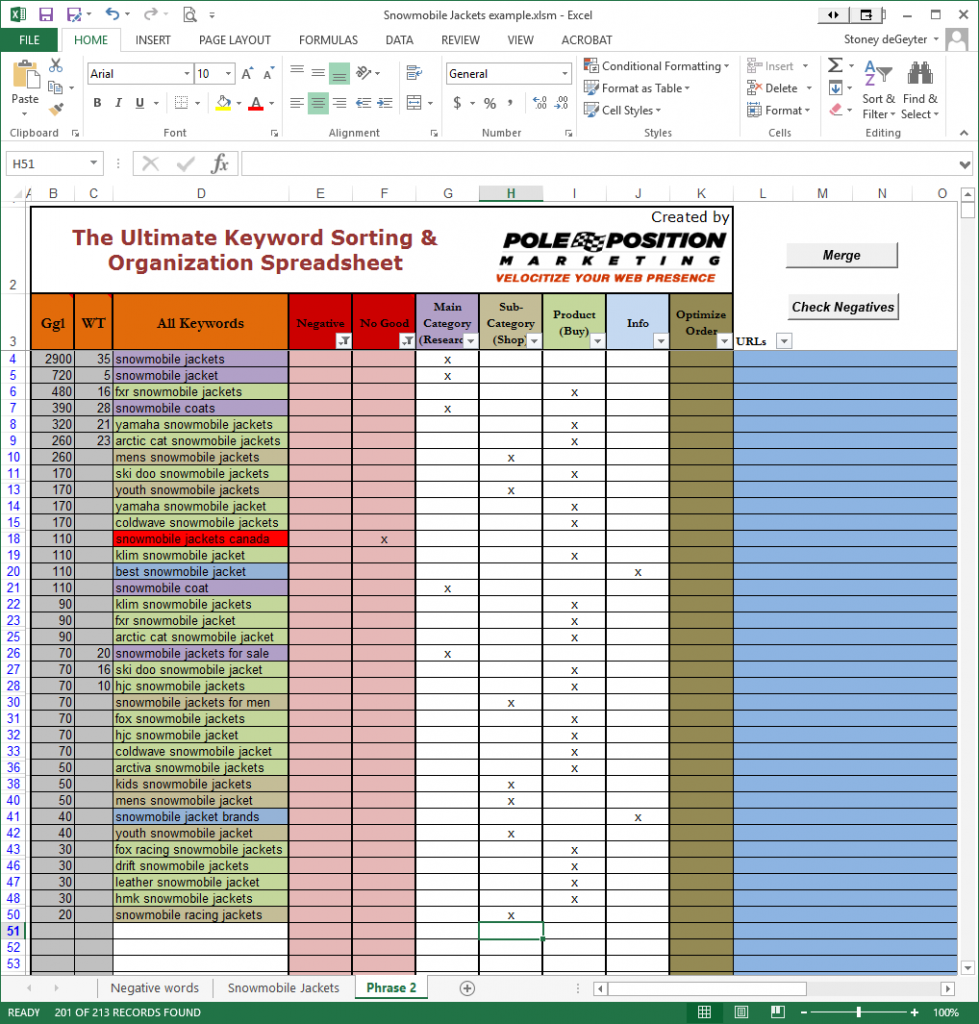
Your spreadsheet should have these columns:
- Keyword
- Type (Head/Mid/Long-Tail)
- Intent (Informational/Commercial/Transactional)
- Monthly Volume (from Keyword Planner)
- Competition (Low/Medium/High, from Keyword Planner)
- Est. Top of Page Bid (from Keyword Planner)
- Priority (High/Medium/Low)
Your task is to fill in the "Priority" column by applying our three-lens framework:
- High Priority: Keywords with Transactional or Commercial intent, manageable CPCs, and high relevance confirmed by a quick SERP check. These are your launch day targets.
- Example:
buy Nykaa retinol peptide serum,Nykaa anti aging serum price
- Example:
- Medium Priority: Keywords with Commercial or high-value Informational intent. They might be slightly broader, have higher competition, or target users a step before purchase. These are candidates for your first expansion.
- Example:
best anti aging serum for dry skin,Nykaa retinol serum review
- Example:
- Low Priority: Broad, informational keywords. These are generally not suited for a launch ad budget but are excellent for your SEO and content marketing strategy.
- Example:
what is retinol,how to build a skincare routine
- Example:
For a more quantitative approach, you can use the priority score method mentioned in the KeywordMe.io article you read. This can be especially useful for defending your choices in an interview setting.
From Prioritization to Action
This prioritized list directly informs your campaign structure.
- High Priority Keywords should be organized into tightly-themed ad groups in your primary launch campaign. You will allocate the majority of your budget here.
- Medium Priority Keywords can be placed in a separate "consideration" campaign with a smaller budget or kept on a "watch list" to be activated once your primary campaign is converting profitably.
- Low Priority Keywords are set aside for content creation, feeding your blog or YouTube channel.
This disciplined approach ensures your initial budget is focused squarely on the keywords most likely to drive immediate results, giving your new product the best possible chance of success.
Conclusion
You've now learned how to transform a simple list of keywords into a strategic asset. By filtering your list through the lenses of goal alignment, budget efficiency, and relevance, you can make data-informed decisions that maximize your return on ad spend from day one.
Key Takeaways:
- Prioritize Intent Over Volume: For a product launch, focus on transactional and commercial keywords that signal a user is ready to buy.
- Budget Dictates Scope: Use Keyword Planner's data and forecasting tool to understand what you can afford, which often means prioritizing long-tail keywords.
- Relevance is Key: Use SERP analysis to confirm a keyword's true intent before dedicating budget to it.
- Structure Follows Priority: Your prioritized list is the blueprint for your campaign structure, ensuring budget is allocated to the most promising keywords.
In our next lesson, we will address a crucial question that arises from this process: now that you've chosen your priority keywords, how do you control exactly which search queries trigger your ads? We'll dive deep into keyword match types—Broad, Phrase, and Exact—and the critical role of negative keywords.