Welcome to our next lesson. In our previous session, you learned how to prioritize a keyword list by balancing business goals, budget, and relevance. This gave you a strategic blueprint, identifying which keywords hold the most promise for a new campaign.
Now, we'll address the next crucial step in campaign execution: control. Having a prioritized keyword like "buy Nykaa retinol serum" is a great start, but how do you ensure your ad shows up for that specific query, and not for something vaguely related like skincare reviews? This lesson will introduce you to keyword match types, the primary tools Google gives you to control exactly which user searches can trigger your ads. Mastering these is fundamental to managing your budget effectively and maximizing relevance.
The Bridge Between Your Keyword and a User's Search
At the heart of search advertising is the relationship between two distinct things:
- Keywords: The words or phrases you add to your ad groups to tell Google who you want to reach.
- Search Terms (or Queries): The actual words a user types into the Google search bar.
Keyword match types are the rules that govern how closely a user's search term must match your keyword for your ad to be considered for the auction. Think of them as control levers, allowing you to choose between casting a wide net or using a precision tool. Each match type represents a different point on the spectrum of Reach vs. Relevance.
Let's look at a high-level overview.
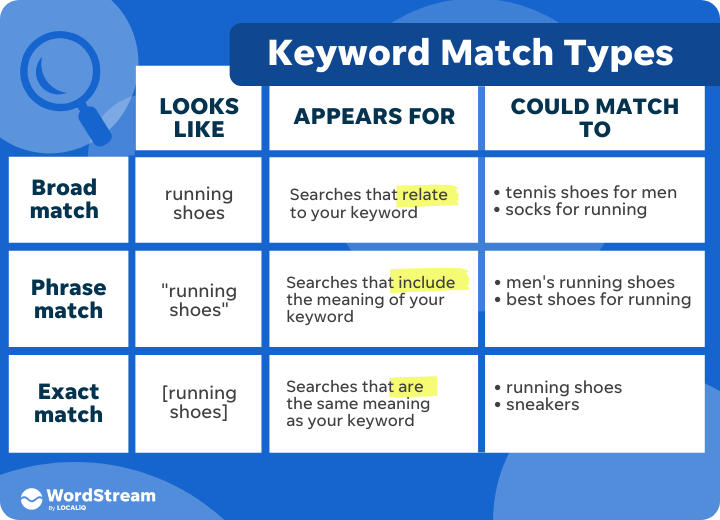
As you can see, the syntax—the use of no symbols, quotation marks, or brackets—is how you communicate your desired level of control to Google. Now, let's explore each of these in detail.
Understanding the Three Core Match Types
To get a solid grasp of the formal definitions and mechanics of each match type, we'll start with a foundational reading from Semrush, a tool you're already familiar with.
What Are Keyword Match Types? Examples + Best Practices
This article from Semrush provides clear, concise definitions for each match type and explains why they are so important for campaign performance.
Start by reading the introductory section What Are Keyword Match Types? for a quick definition. Then, read The Importance of Keyword Match Types to understand the strategic implications. Finally, focus on the section "How Keyword Match Types Work." Read the detailed explanations and examples for Broad Match, Phrase Match, and Exact Match. This will give you the official rules for how each type functions.
Let's solidify these concepts with another perspective.
UPDATE: Broad vs Phrase vs Exact Match
This video from Scott Redgate offers concise explanations and a memorable cautionary tale about the risks of Broad Match, which is especially useful for interview scenarios.
Watch the following three short segments for a breakdown of each match type: Broad Match: This segment not only defines broad match but also gives a powerful historical example of how it can lead to completely irrelevant ad placements—a great story to have in your back pocket. Phrase Match: Here, the presenter explains how phrase match has evolved to focus on the "meaning" of the keyword, offering a balance of control and flexibility. Exact Match: This final clip details the most restrictive match type and why it's so effective for targeting high-intent users with precision.
From Theory to Practice: Seeing Match Types in Action
Definitions are useful, but to truly understand the impact of match types, you need to see the different kinds of search terms they actually trigger. This is where your practical experience and analytical skills come into play. A Search Terms Report is the ultimate source of truth, and analyzing one reveals the power and peril of each match type.
The following video provides an excellent demonstration of this, using the keyword pool repair across all three match types and comparing the resulting search terms.
Search Intent and Google Ads Keyword Targeting
In this video, "Surfside PPC" does an exceptional job of showing, not just telling, the difference between match types by diving into a real Search Terms Report.
Please watch the detailed comparison from this section. Pay close attention to: The Broad Match search terms (pool supply store, cleanout pool filter, bead blasting pool tile). Notice the sheer volume of irrelevant queries that waste budget. The Phrase Match search terms (pool repair near me, pool repair companies near me). See how the queries stay highly relevant while still capturing valuable variations. The Exact Match search terms (pool maintenance near me, pool service near me). Note the high relevance but very limited number of triggered queries. This analysis is the essence of match type management and directly demonstrates how each type controls which searches trigger your ad.
The Strategic Trade-Off: A Summary
You can now see the clear trade-off. Your choice of match type is a strategic decision that balances several factors. The article from PostAffiliatePro provides a table that summarizes this perfectly. Here is a simplified version of that comparison:
| Aspect | Broad Match | Phrase Match | Exact Match |
|---|---|---|---|
| Control | Low | Medium | High |
| Reach | High (widest net) | Medium | Low (most targeted) |
| Relevance | Low to Medium | High | Highest |
| Wasted Spend Risk | High | Medium | Low |
| Keyword Discovery | High | Medium | Low/None |
| Typical Use Case | Awareness, research, new idea generation (with caution and automated bidding) | The default for most performance-focused campaigns | Targeting high-value, "money" keywords with proven performance |
Given your goal of preparing for interviews, being able to articulate this trade-off is crucial. A question like, "How do you decide which match type to use?" should be answered with a discussion of these factors, explaining that the choice depends on the campaign's goal (awareness vs. conversions), budget, and maturity. For a new product launch like Nykaa's serum, you would start with Phrase and Exact match on your highest-intent keywords to control costs and maximize relevance.
Conclusion
In this lesson, you've moved from having a list of target keywords to understanding the mechanisms that control how those keywords perform in the real world. You can now define Broad, Phrase, and Exact match and, most importantly, explain how each one controls the connection between your keywords and user search queries.
Key Takeaways:
- Match types are rules that determine how closely a user's search query must match your keyword to trigger an ad.
- The three core match types are Broad Match (loose matching), Phrase Match (meaning-based matching), and Exact Match (precise matching).
- The choice of match type involves a strategic trade-off between Reach and Relevance.
- For new campaigns focused on conversions, starting with the tighter control of Phrase and Exact Match is the most efficient and risk-averse strategy.
You now have the tools to control what you want to target. But what about all the irrelevant searches that can still slip through, even with Phrase match? Our next lesson will introduce the other side of targeting control: negative keywords. You'll learn how to use them to proactively prevent wasted ad spend and refine your targeting to an even higher degree of precision.