Hello! In our last session, we defined the three core keyword match types—Broad, Phrase, and Exact—and established them as the fundamental controls for managing which user searches can trigger your ads. We ended by introducing the core strategic dilemma you face as an advertiser: the constant balancing act between reach and relevance.
Today, we will dive deep into analyzing that trade-off. This lesson moves beyond simply knowing what match types are and focuses on why and when you would choose one over the other. Mastering this analysis is crucial for both effective campaign management and for confidently answering common interview questions about keyword strategy. You'll learn to articulate the risks and rewards of each match type, allowing you to justify your strategic decisions.
The Fundamental Trade-Off: Reach vs. Relevance
At the heart of match type selection is a simple, inverse relationship. As you give Google more freedom to interpret your keywords, you increase your potential reach (the number of impressions your ad can get) but decrease the average relevance of those impressions. Conversely, as you restrict Google's freedom, your relevance soars, but your potential reach shrinks.
This infographic provides a perfect visual summary of this concept.
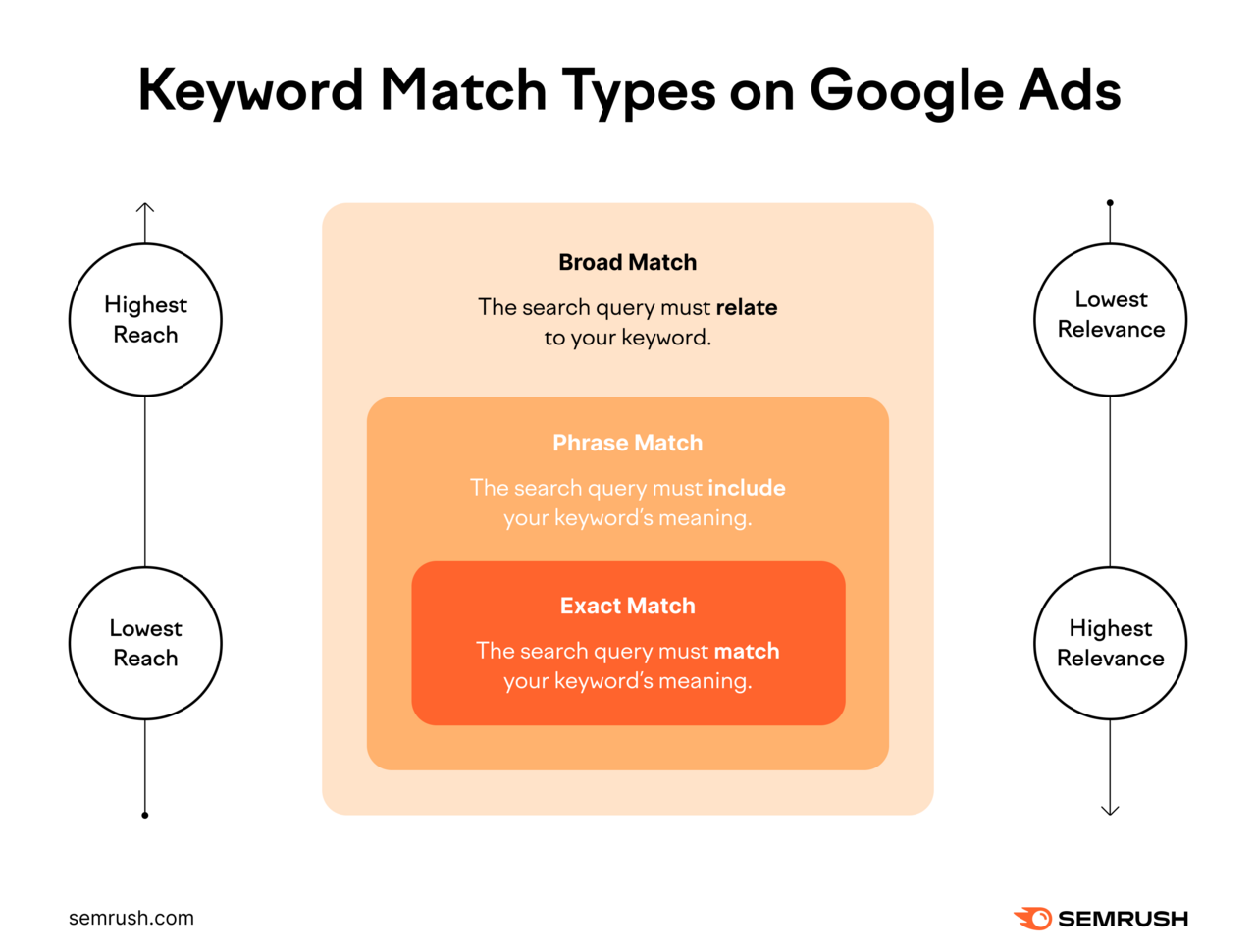
Your job as a performance marketer is to find the optimal point on this spectrum that aligns with your campaign's specific goals, budget, and risk tolerance. Let's break down the strategic implications of each point on this spectrum.
Analyzing the Pros and Cons
To make an informed decision, you need a clear-eyed view of the advantages and disadvantages inherent in each match type. The following reading provides an excellent, detailed breakdown.
Keyword Match Types: Complete Guide to Broad, Phrase & Exact ...
This guide from Young Urban Project offers a very practical analysis of each match type, framed in terms of pros and cons. This structure is ideal for preparing to discuss strategic trade-offs.
In the article, find the section titled "Types of Keyword Match Types in Google Ads (Detailed Breakdown)." Please read the subsections for Broad Match, Phrase Match, and Exact Match. As you read, focus on the "Pros and Cons" for each. Try to rephrase them in your own words. For example: A "pro" of Broad Match is keyword discovery. A "con" is a high risk of wasted budget. A "pro" of Exact Match is maximum relevance. A "con" is potentially missing out on valuable long-tail search variations.
The article you just read makes a critical point: "None of these match types is 'good' or 'bad' on its own. They’re tools." Your ability to choose the right tool for the job is what determines success.
Seeing the Trade-Off in Action
Let's make this trade-off more concrete. In the previous lesson, you saw a Search Terms Report for the keyword pool repair which showed the wildly different queries triggered by each match type. The "Surfside PPC" channel has another excellent example using the keyword farmhouse curtains that clearly demonstrates the drop in relevance as you move from Exact to Broad match.
Keyword Match Types Overview in Google Ads - Everything You Need To Know
This video provides a side-by-side comparison of the actual search terms generated from the same keyword using different match types, making the reach vs. relevance trade-off tangible.
Please watch the segment from this example. Pay close attention to the search terms listed for each match type: Broad Match: Notice how quickly the queries drift into unrelated topics like curtains Canada or general terms like home indoor. This is high reach, low relevance. Phrase Match: The queries here are much more aligned, including terms like country style curtains and modern farmhouse. This is the middle ground. Exact Match: The queries are tightly focused on the core keyword, such as farmhouse style curtains. This is low reach, high relevance.
This example powerfully illustrates the budget risk associated with Broad Match. Every click on an irrelevant search term like curtains Canada is wasted ad spend if you only sell farmhouse-style curtains. This is why disciplined analysis of the Search Terms report is non-negotiable when using broader match types.
From Analysis to Strategy: A Decision Framework
Now that you can analyze the trade-off, how do you apply it strategically? Your choice depends on several factors related to your business and campaign.
The article from Young Urban Project that you read earlier also contains an excellent framework for making this decision. It suggests considering the following:
- Business Type: A local service provider (e.g., a plumber) has a low tolerance for irrelevant clicks and should lean towards Phrase and Exact match. A national e-commerce store can afford to explore with Broad Match to find new product-related searches.
- Budget: A small, limited budget is best protected by the high relevance of Exact and Phrase match. A larger budget allows for the "research and development" spend that comes with Broad Match keyword discovery.
- Competition: In a highly competitive market, you may use tighter match types to focus your budget on only the most qualified, highest-converting clicks.
- Campaign Maturity: New campaigns often start with Phrase and Exact match to establish a baseline of performance with clean data. Once a campaign has a history of conversions and you understand what works, you can layer in Broad Match to expand reach intelligently.
This framework provides a structured way to answer the interview question, "How do you decide which match type to use?" Your answer should demonstrate that you don't have a single default but rather a flexible approach based on the specific context of the campaign.
An Advanced View: Combining Match Types for Control and Scale
To round out your understanding, let's explore a more advanced strategy that many seasoned professionals use. The common advice, sometimes even from Google itself, is to use Broad Match paired with Smart Bidding and let the algorithm do the work. While powerful, this approach relinquishes a significant amount of control.
A more nuanced strategy involves using Exact Match in combination with Broad Match to get the best of both worlds. The following video explains the "why" behind this powerful technique.
Why I Use Both Exact Match + Broad Match (And Ignore Google's 'Expert' Advice)
The presenter from "Grow My Ads" offers a compelling argument for a hybrid strategy, challenging the "Broad Match only" narrative and explaining how to maintain control over your most valuable keywords.
Watch two key segments from this video: First, watch the explanation of semantic vs. syntax targeting from this clip. This gives you a sophisticated way to describe the fundamental difference between Broad and Exact Match. Next, watch the core argument from this segment. The speaker explains why relying only on Broad Match is a risk and how adding an Exact Match keyword for a high-performing search term "forces" Google to prioritize it, giving you back control.
The key insight here is powerful: even if Broad Match could theoretically capture an exact search, you are relying on Google's AI to make that connection in a live auction. By adding a proven, high-converting search term as an Exact Match keyword, you are sending a much stronger signal to Google: "When this specific search happens, I want to be there. Prioritize this." This gives you the precision of Exact Match for your core terms while still leveraging the AI-powered reach of Broad Match for discovery.
Conclusion
In this lesson, you've moved beyond definitions and into strategic analysis. You are now equipped to dissect the critical trade-off between reach and relevance that governs keyword targeting.
Key Takeaways:
- Selecting a keyword match type is a strategic choice that balances the inverse relationship between reach and relevance.
- Broad Match offers maximum reach and keyword discovery but carries a high risk of irrelevant clicks and wasted spend.
- Exact Match provides maximum relevance and control but limits volume and can miss valuable search variations.
- Phrase Match serves as a reliable middle ground, balancing control and reach, making it a safe starting point for many campaigns.
- The best strategy depends on context: your business goals, budget, competitive landscape, and campaign maturity.
- Advanced strategies often combine match types, using Exact Match to secure high-value "money" terms while using Broad Match for scalable discovery.
In our last lesson, we identified a list of keywords for a new Nykaa skincare line. We've now analyzed the tools to control how those keywords are targeted. In our next lesson, we will focus specifically on the most precise tool in our kit. You will learn to justify why Exact Match is the indispensable choice for high-intent, transactional queries, solidifying your ability to build efficient, conversion-focused campaigns from the ground up.