Hello! Following our last session where we mapped out the structure of a Responsive Search Ad, we're now ready to infuse that structure with persuasive and effective content. Knowing the character limits and the asset model is the first step; knowing what to write within those limits is what drives results.
Today, we'll focus on the three pillars of high-converting ad copy. You will learn how to apply best practices for including target keywords for relevance, communicating your Unique Selling Propositions (USPs) for differentiation, and writing clear Calls-to-Action (CTAs) to guide user behavior. Mastering these components is fundamental to turning ad impressions into valuable clicks and, ultimately, conversions.
Pillar 1: Weaving in Keywords for Relevance
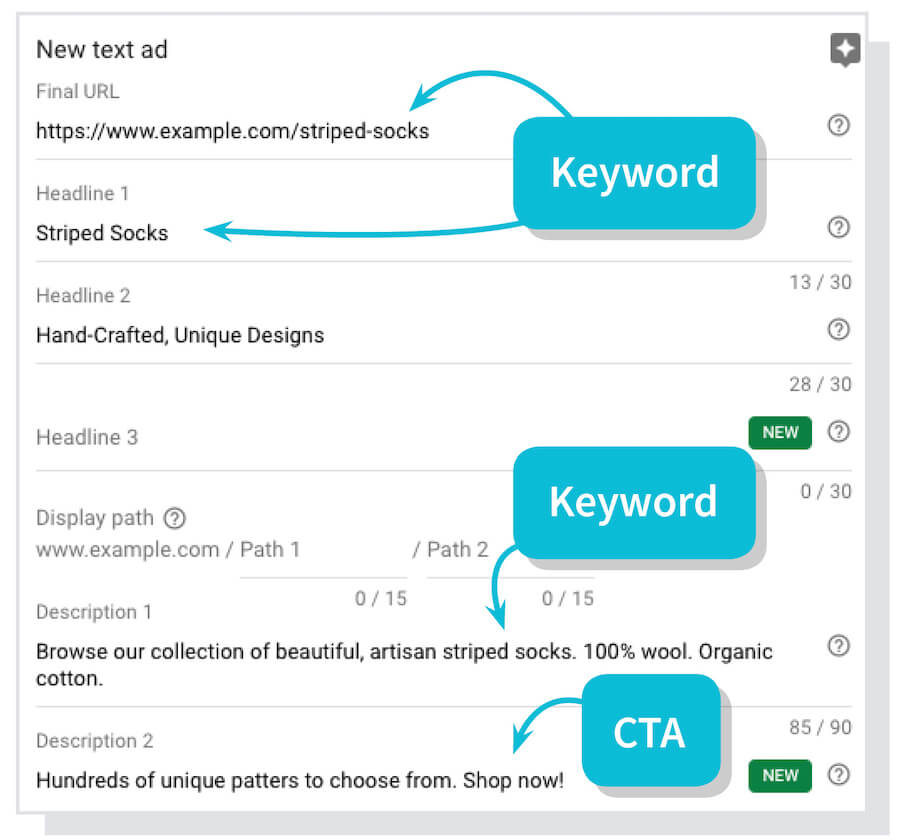
In our last lesson, we established that Headline 1's primary job is to match the user's search intent. The most direct way to achieve this is by including the primary keyword of your ad group directly in your headlines. This practice serves two critical functions:
- User Confirmation: It instantly signals to the searcher that your ad is highly relevant to their query, making them more likely to click.
- Quality Score: It directly improves your Ad Relevance, which is one of the three core components of Quality Score. A higher Quality Score, as we learned in Module 1, can lead to better ad positions and lower costs.
Simply dropping a keyword in a headline is the bare minimum. The art lies in making it compelling.
How to assemble captivating Google Ads copy
This article from Search Engine Land reinforces the importance of using keywords in Headline 1 and provides great tips on how to enhance them.
Please read the section Headline 1: Draw the searcher’s attention. Notice the author's point that "Just including your keyword is boring" and take note of the suggestions for enhancing it with benefits, numbers, or emotional triggers.
The concept of "congruity" between the search term and the ad copy is central here. When a user sees the exact words they just typed appear in an ad, it creates a powerful sense of relevance.
The video below explains this concept of "search and ad copy congruity" and demonstrates how to ensure your main keyword is featured prominently, even using pinning for emphasis.
How To Write Google Ads Copy That CONVERTS!
This video from Ben Heath explains the practical and strategic importance of mirroring the user's search language in your ad copy.
Watch from the beginning until the end of the first point. Pay attention to how he connects ad copy congruity not only to getting the click but also to improving your Quality Score.
This image provides a clear visual of this principle in action. The keyword is the bridge between the user's need and your solution.
Pillar 2: Differentiating with Unique Selling Propositions (USPs)
Once you have the user's attention by matching their keyword, you must immediately answer their next, unspoken question: "Why should I choose you?" This is where your Unique Selling Propositions (USPs) come into play. A USP is what makes your offer distinct from and superior to your competitors'.
Common USPs include:
- Price/Value: "Save 25% Today," "Free Shipping on All Orders"
- Quality/Exclusivity: "Hand-Crafted Designs," "Organic Ingredients"
- Trust/Assurance: "Money-Back Guarantee," "50,000+ 5-Star Reviews"
- Convenience: "Ships in 24 Hours," "24/7 Customer Support"
A crucial skill in copywriting is translating product features into customer benefits. A feature is what something is (e.g., "stain-resistant fabric"). A benefit is what it does for the customer (e.g., "Worry-Free Living"). Your marketing background has surely prepared you for this distinction; in ad copy, it's paramount.
This next segment from the Ben Heath video provides an excellent illustration of this transformation.
How To Write Google Ads Copy That CONVERTS!
This video offers a masterclass in elevating your ad copy by focusing on what truly motivates a customer.
Please watch the following three clips: First, watch the section on emphasizing benefits, not features. The "hassle-free home renovations" example is a perfect demonstration. Next, see how to take this a step further by laddering up benefits to higher-level emotions. This is an advanced technique for crafting truly resonant copy. Finally, watch the segment on the power of including guarantees. A strong guarantee is one of the most effective USPs because it directly reverses the customer's perceived risk.
As you can see, the most powerful ads connect a product's features to a customer's core human desires—for status, health, security, or better relationships.
Pillar 3: Driving Action with a Clear Call-to-Action (CTA)
You've captured their attention with a relevant keyword and persuaded them with a compelling USP. The final step is to tell them exactly what to do next. A Call-to-Action (CTA) is an explicit instruction that guides the user toward your desired conversion.
An ad without a CTA is like a salesperson who gives a great pitch and then walks away without asking for the sale. It leaves the user wondering, "What now?"
How To Write Google Ad Copy That Actually Converts ...
This article from Fermat Commerce provides a great overview of the core principles of high-converting copy, with a specific focus on CTAs.
Read the section on the core principle of a strong CTA. Then, review the section titled "Common Mistakes To Avoid", paying special attention to the mistake of "Neglecting The Call to Action".
Common mistakes with CTAs include:
- Omitting them entirely.
- Being too vague: "Learn More," "Click Here."
- Creating confusion: Including multiple, competing CTAs in one ad.
A strong CTA is:
- Action-oriented: Starts with a verb like Shop, Get, Book, Download, Call.
- Specific and clear: "Get a Free Quote," "Shop the Spring Collection," "Book Your Demo Now."
- Urgent (when appropriate): "Shop Now & Save 25%," "Call for Immediate Service."

Interview Prep: The Troubleshooting Framework
An excellent interview question that tests your practical understanding is: "You've written an ad that follows all the best practices—it has the keyword, a USP, and a CTA—but it's still underperforming with a low Click-Through Rate (CTR). What's your diagnosis?"
A top-tier answer involves moving beyond the checklist and thinking critically about the message in the context of the market. Here's how you could structure your response:
-
Hypothesis 1: The Message Isn't Differentiated. "My first step would be to re-examine the Search Engine Results Page (SERP). Even if my ad is technically well-written, it might be saying the exact same thing as my competitors. If everyone is offering 'Free Shipping,' my ad becomes invisible. I would look for an opportunity to be different. Can I offer a stronger guarantee? A unique product benefit that no one else is mentioning? My goal is to break the pattern, not blend in."
-
Hypothesis 2: The Message Lacks Emotional Punch. "If differentiation isn't the issue, I'd analyze the emotional resonance of the copy. Is it too bland or feature-focused? I would A/B test headlines that use emotional triggers like curiosity, urgency, or even humor. For example, instead of just 'Private Pool Villa,' testing 'Skinny Dip in Your Own Pool' could create intrigue and make the ad memorable."
-
Hypothesis 3: The CTA is Weak or Misaligned. "Finally, I'd review the CTA. Is it compelling enough? Does it match the user's level of commitment? For a high-consideration product, a 'Buy Now' CTA might be too aggressive. A softer CTA like 'Download a Free Guide' or 'Get a Custom Quote' might be more effective at generating a click from a user who is still in the research phase."
The video below offers excellent insights into the power of using emotional triggers and being different from your competitors, which are key to solving this kind of problem.
Google Ads Ad Copy BEST Practices for 2024
This video by Aaron Young dives into the often-missed element of emotion in ad copy and the importance of standing out.
Please watch these three short segments: The explanation of using emotional triggers. The examples of historically best-performing ads that use these triggers effectively. The final tip on researching competitors to find opportunities to be different.
Conclusion
Today we've moved from the blueprint of an ad to the persuasive language that powers it. By mastering the interplay of these three pillars, you can craft ad copy that doesn't just show up, but gets clicked.
Key Takeaways:
- Pillar 1: Keywords: Include target keywords in your headlines to confirm relevance, grab attention, and improve your Quality Score.
- Pillar 2: USPs: Differentiate yourself by translating features into compelling benefits and using risk-reversals like guarantees. Answer the question, "Why choose me?"
- Pillar 3: CTAs: End your ad with a clear, specific, and action-oriented instruction that tells the user exactly what to do next.
- Synthesis: The best ads artfully combine all three pillars to create a cohesive and persuasive message within the tight constraints of the format.
In our next lesson, we will explore ad extensions. These are additional pieces of information—like sitelinks, callouts, and structured snippets—that you can add to your ads to make them larger, more informative, and even more clickable, further enhancing your Ad Rank and performance.