Welcome back! In our last lesson, we focused on the art of persuasion, breaking down the three pillars of effective ad copy: incorporating keywords, highlighting your unique selling propositions (USPs), and driving users with clear calls-to-action (CTAs). You learned what to write. Today, we'll focus on how to deploy that copy in the modern Google Ads ecosystem to maximize its impact.
This lesson is all about Responsive Search Ads (RSAs), the default ad type in Google Search campaigns. We'll explore why Google has moved to this model and how you can leverage it effectively. The goal is for you to learn how to create multiple headline and description variations—or "assets"—to feed Google's machine learning, allowing it to automatically assemble the most relevant and high-performing ad for every single search query.
The Power of Combinations: What are Responsive Search Ads?
At its core, a Responsive Search Ad is a flexible ad format where you are the creative director and Google's machine learning is the editor. Instead of writing one static ad, you provide a pool of ingredients: up to 15 headlines and 4 descriptions. Google's algorithm then tests different combinations of these assets, learning over time which ones perform best for various searches, devices, and user contexts.
To start, let's get the official definition and benefits directly from the source: Google Ads Help.
Read the introduction, which defines the format. Then, review the list of key benefits. Pay close attention to how these benefits all tie back to the idea of providing the system with more options.
This automated process is designed to improve campaign performance by adapting your ad's content to more closely match a user's search query. Think of it as creating a custom-tailored ad for each potential customer, at scale.

Feeding the Machine: Why More Variations are Better
Given your background in computer science, you can think of this process in terms of training a machine learning model. The headlines and descriptions you write are the training data. A limited, repetitive dataset will result in a poorly trained model that makes suboptimal predictions. Conversely, a large, diverse, and high-quality dataset allows the model to learn complex patterns and make much more accurate predictions. In Google Ads, an "accurate prediction" is an ad combination that earns a click and leads to a conversion.
The more distinct and relevant headlines and descriptions you provide, the more combinations Google can test. This increases the chances of finding the perfect message that resonates with a user and drives them to click.
Responsive Search Ads: The Ultimate Guide for Beginners - Semrush
This guide from Semrush provides an excellent overview of the mechanics and best practices for RSAs.
First, read the section explaining the process Google's AI uses to select and score combinations. Then, jump to the first best practice tip, "Provide Multiple Relevant Headlines and Descriptions." This reinforces the core principle of this lesson.
The sheer scale of this optimization is staggering. As you'll see in the next video, with 15 headlines and 4 descriptions, there are thousands of potential ad combinations. It would be impossible for a human to test all of them manually.
The RIGHT Way to Create Responsive Search Ads | Step-by-Step Tutorial
This video from Grow My Ads does a fantastic job of explaining the mathematical reality of RSAs and why it's crucial to understand the volume of data needed for optimization.
Watch the segment from "another thing to think about". The presenter calculates the enormous number of impressions required to test all possible combinations, which is a powerful illustration of why feeding the algorithm diverse assets is so important, especially for accounts with limited traffic.
A Structured Approach to Creativity
So, how do you come up with 15 unique and compelling headlines? The key is not to think of 15 random ideas, but to systematically create variations based on the pillars we discussed in the last lesson. A structured approach ensures you cover all your messaging bases.
Both of the following videos offer excellent, and very similar, frameworks for this process. They recommend categorizing your assets to ensure variety.
Google Ads Responsive Search Ads - Learn how to create the best RSA's with this proven method!
This video from Funnel provides a clear, actionable template for structuring your RSA assets.
Watch the section from "Now let me show you" where the presenter introduces the six categories for headlines: Keyword focus, Features, Benefits, Brand messaging, Social proof/USPs, and CTAs.
The RIGHT Way to Create Responsive Search Ads | Step-by-Step Tutorial
The presenter from Grow My Ads uses a nearly identical framework, which shows this is an industry-standard best practice.
Watch the segment from "here's an ad copy template" where he outlines his five categories: Message to intent (keywords), Features/benefits, Price/promotions/guarantees, Social proof, and Calls to action.
Let's synthesize these frameworks into a practical plan. When building your next RSA, aim to write 2-3 assets for each of these categories:
- Keyword Focus: Headlines that directly include the keywords from your ad group. (e.g., "Pet-Friendly Sectionals," "Sofas for Homes with Pets").
- Features: Specific attributes of your product. (e.g., "Stain-Resistant Fabric," "Hardwood Frame Construction").
- Benefits: The value the customer gets from the features. (e.g., "Easy to Clean & Maintain," "Worry-Free Movie Nights").
- Social Proof & USPs: What makes you trustworthy and unique? (e.g., "Loved by 80,000+ Families," "10-Year Warranty Included," "Free Shipping & Returns").
- Calls-to-Action: Clear, action-oriented instructions. (e.g., "Shop The Collection Now," "Build Your Custom Sectional," "Get a Free Quote").
By filling out these categories, you will easily generate a diverse set of 10-15 headlines and 3-4 descriptions that give Google's AI everything it needs to find winning combinations.
Taking Back Control: Strategic Pinning
While it's generally best to give the machine learning algorithm as much freedom as possible, there are times when you need to maintain some control. For example, you might have a brand name that must appear in every ad, or a legal disclaimer that has to be in a specific place. This is where "pinning" comes in.
Pinning allows you to lock a headline or description to a specific position. For example, you can "pin" your brand name to Headline Position 1.
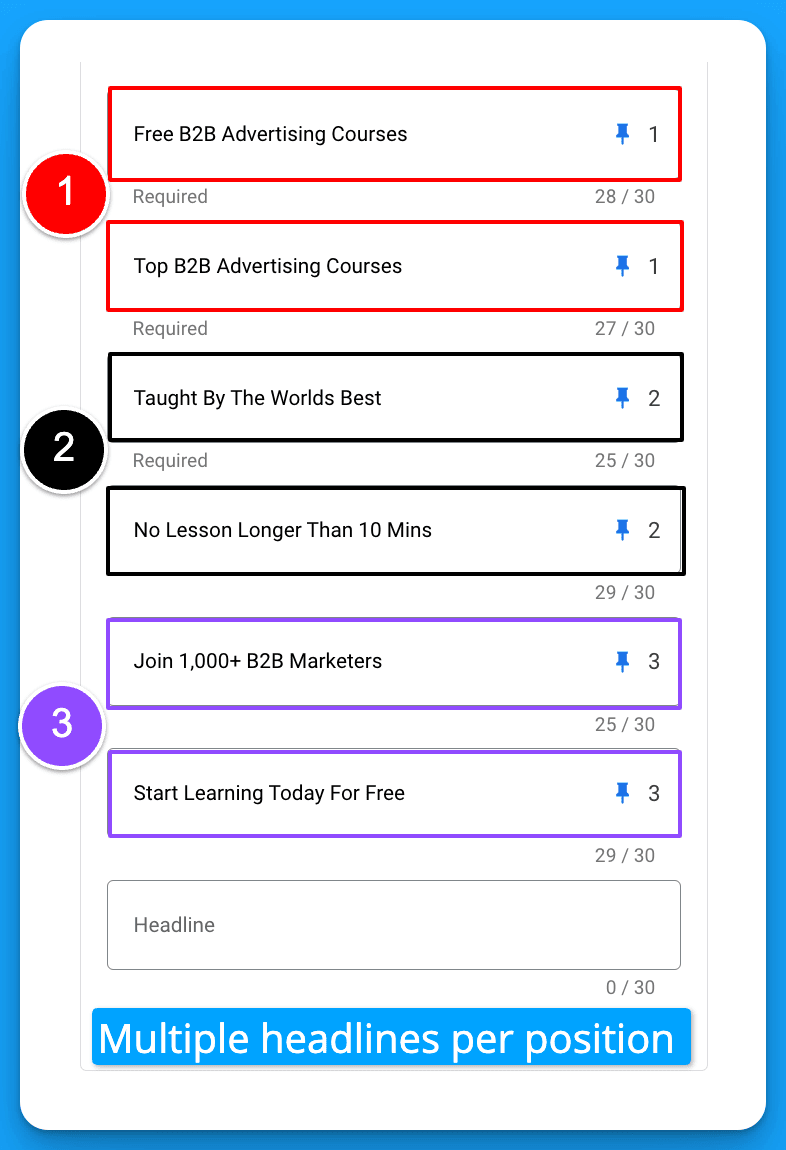
However, use this feature with caution.
Let's return to the Google Ads Help documentation to understand the implications of pinning.
Read the entire section on pinning. Crucially, note Google's advice that "pinning isn't recommended for most advertisers" because it reduces the number of combinations and can negatively affect performance. Also, pay attention to the tip about pinning multiple assets to the same position to give the system some flexibility within your constraints.
Pinning just one asset to each of the three headline positions effectively turns your Responsive Search Ad back into a static Expanded Text Ad, defeating the purpose of the format. A smarter way to use pinning is to provide a few options for a pinned position. For instance, you could pin three different keyword-focused headlines to Position 1. This ensures your ad always starts with a highly relevant message, but still gives the algorithm a choice of which one to use.
Conclusion
Today you've learned the "why" and "how" behind creating assets for Responsive Search Ads. It’s a shift from crafting a single perfect ad to building a versatile toolkit of messages that Google's AI can use to construct the perfect ad for any situation.
Key Takeaways:
- RSAs are the standard: They work by testing combinations of up to 15 headlines and 4 descriptions.
- Feed the machine: Providing a large and diverse set of assets is crucial for enabling Google's machine learning to find high-performing ad combinations.
- Structure your creativity: Use a category-based framework (Keywords, Benefits, Features, USPs, CTAs) to systematically generate a wide range of compelling headlines and descriptions.
- Pin with purpose: Use the pinning feature sparingly to control essential messages, but avoid over-constraining the algorithm. A good compromise is to pin multiple assets to a single position.
In our next lesson, we will continue building on this ad structure by exploring ad extensions. You'll learn how these additional pieces of information, such as sitelinks, callouts, and structured snippets, can make your ads bigger, more informative, and more effective at attracting clicks, further improving your Ad Rank.