In our last lesson, we introduced Ad Rank as the core metric that determines your ad's position in the Google Ads auction. We established that while your bid is important, your Quality Score is the powerful equalizer that can help you win higher positions at lower costs. You now understand that a high Quality Score is a signal to Google that you are providing a relevant and valuable experience to users.
This lesson takes the next crucial step by deconstructing that 1-10 score. We will break down Quality Score into its three fundamental components: Expected Click-Through Rate (eCTR), Ad Relevance, and Landing Page Experience. For your interview preparation, mastering these components is non-negotiable. They form the basis of nearly every campaign diagnosis and optimization strategy, and understanding them allows you to answer the critical "why" questions behind campaign performance.
The Three Pillars of Quality Score
Think of your overall Quality Score as a final grade. This grade is derived from the performance of three key sub-components. Inside your Google Ads account, you won't just see a single "7/10" score; you can also see how Google rates each of the three pillars that contribute to it.
The three core factors are:
- Expected Click-Through Rate (eCTR): Google's prediction of how likely your ad is to be clicked when shown.
- Ad Relevance: A measure of how closely your ad's message matches the user's search query.
- Landing Page Experience: An assessment of how relevant, useful, and user-friendly your landing page is to the person who clicks your ad.
Each of these is given a rating of "Below Average," "Average," or "Above Average." These ratings are your diagnostic tools, telling you exactly where your weaknesses lie.

To begin, let's get a formal definition of these three factors.
Google Ads Quality Score: The Ultimate Guide
This guide from Adalysis provides concise, clear definitions for each of the three components of Quality Score.
Read the section What makes up your quality score number?. Focus on the definitions of Expected CTR, Ad Relevance, and Landing Page Experience. This will give you the foundational vocabulary we'll build on.
Now that you have the official definitions, let's deconstruct each of these "levers" to understand the strategy behind improving them.
Lever 1: Expected Click-Through Rate (eCTR)
Expected CTR answers the question: "Will they click?" It's Google's prediction of whether a user will find your ad compelling enough to click on it when it's shown for a particular keyword.
It's crucial to understand that eCTR is not your raw click-through rate. It is a predictive metric that is heavily influenced by your historical CTR, but it's also normalized for factors you don't control, like ad position. Google doesn't expect an ad at the bottom of the page to get the same CTR as the ad in the top spot. A high eCTR is a powerful signal to Google that your ad is a good answer to the user's query.
For an in-depth look at the strategies for improving eCTR, the following resource provides an excellent framework.
The Real Way to Improve Google Ads Quality Score — North Country Consulting
This article from North Country Consulting provides a brilliant breakdown of each Quality Score component as a "lever" you can pull.
Please read the section titled Lever 1: Expected CTR. Pay close attention to the four strategies outlined: tight keyword theming, mirrored language, concrete offers, and systematic testing. The point about eCTR being measured against ad position is a sophisticated insight that's valuable for interviews.
To summarize the key methods for improving eCTR:
- Create Tightly Themed Ad Groups: Ensure the keywords within an ad group share a single, specific user intent. The search "emergency plumber" has a different urgency and need than "cost to install new faucet," and they should not be in the same ad group.
- Mirror the User's Language: Your ad headlines and descriptions should reflect the language of the keyword. If a user searches for "B2B SEO agency," your ad should explicitly say "B2B SEO Agency," not just "Digital Marketing Services."
- Write Compelling Ad Copy: Use clear, specific offers ("Get a Free 30-Minute Audit"), numbers, and a strong call-to-action (CTA). Create a sense of urgency or highlight a unique selling proposition (USP).
Lever 2: Ad Relevance
Ad Relevance answers the question: "Is this the right ad for this search?" This component measures the semantic link between your keyword and your ad copy.
Google wants to see that your ad is a direct, logical response to the search. A low Ad Relevance score is often a symptom of ad groups that are too broad. If you have one ad serving dozens of loosely related keywords, it's impossible for that ad to be highly relevant to all of them.
The Real Way to Improve Google Ads Quality Score — North Country Consulting
Continuing with the same article from North Country Consulting, we'll now focus on the second lever.
Read the section Lever 2: Ad Relevance. Focus on how campaign structure (separating brand, non-brand, etc.) and message hierarchies are fundamental tools for ensuring relevance. Also, note the strategic use of negative keywords.
As the article highlights, improving Ad Relevance comes down to structure and precision:
- Structure Campaigns by Intent: Separate campaigns for brand searches (e.g., "Nykaa"), competitor searches, and generic searches ("buy vitamin c serum"). Each has a different user mindset and requires a different ad message.
- Build Granular Ad Groups: As discussed for eCTR, tight ad groups are the foundation. Each ad group should focus on a small cluster of highly similar keywords, allowing you to write a perfectly tailored ad.
- Use Negative Keywords: Proactively block your ads from showing on irrelevant searches. If you sell premium running shoes, you might add "free," "jobs," and "reviews" as negative keywords to filter out searchers with the wrong intent.
Lever 3: Landing Page Experience
Landing Page Experience answers the question: "Did the user land in the right place?" This component evaluates the quality of the user's experience after they click your ad.
Google doesn't want to be a gateway to slow, confusing, or irrelevant web pages. A poor post-click experience reflects badly on Google and leads to a dissatisfied user. Therefore, Google's algorithm assesses your landing page for relevance, transparency, and ease of use.
How To Improve Google Ads Quality Score for Cheaper Clicks
This video from Ben Heath provides a clear explanation of how Google evaluates user experience on the landing page and why it's a critical part of Quality Score.
Watch the segment from user experience to cost per click. The speaker explains how Google infers user experience by looking at signals like how long a user stays on the site versus quickly bouncing back to the search results. This directly connects the quality of your website to your ad costs.
To improve your Landing Page Experience, focus on reducing friction and delivering on the promise of your ad.
The Real Way to Improve Google Ads Quality Score — North Country Consulting
Finally, let's examine the third lever using the North Country Consulting article.
Read the section Lever 3: Landing Page Experience. The concepts of "Message Match" and "Single Dominant Action" are particularly important for creating high-converting and high-quality landing pages.
The key takeaways for improving Landing Page Experience are:
- Message Match: The landing page headline and content must directly correspond to the ad copy and keyword. If your ad promises "24/7 Emergency AC Repair," the landing page shouldn't be your generic HVAC homepage.
- Mobile-First Design: The page must be fast, easy to navigate, and fully functional on a smartphone.
- Fast Load Times: Page speed is a critical factor. Use Google's PageSpeed Insights tool to diagnose and fix issues.
- Trust and Transparency: Include clear contact information, a privacy policy, and social proof like testimonials or client logos to build user confidence.
A Framework for Improvement
When you see a low Quality Score, you now know how to diagnose the problem by looking at its three components. This simple flowchart provides a great starting point for troubleshooting.
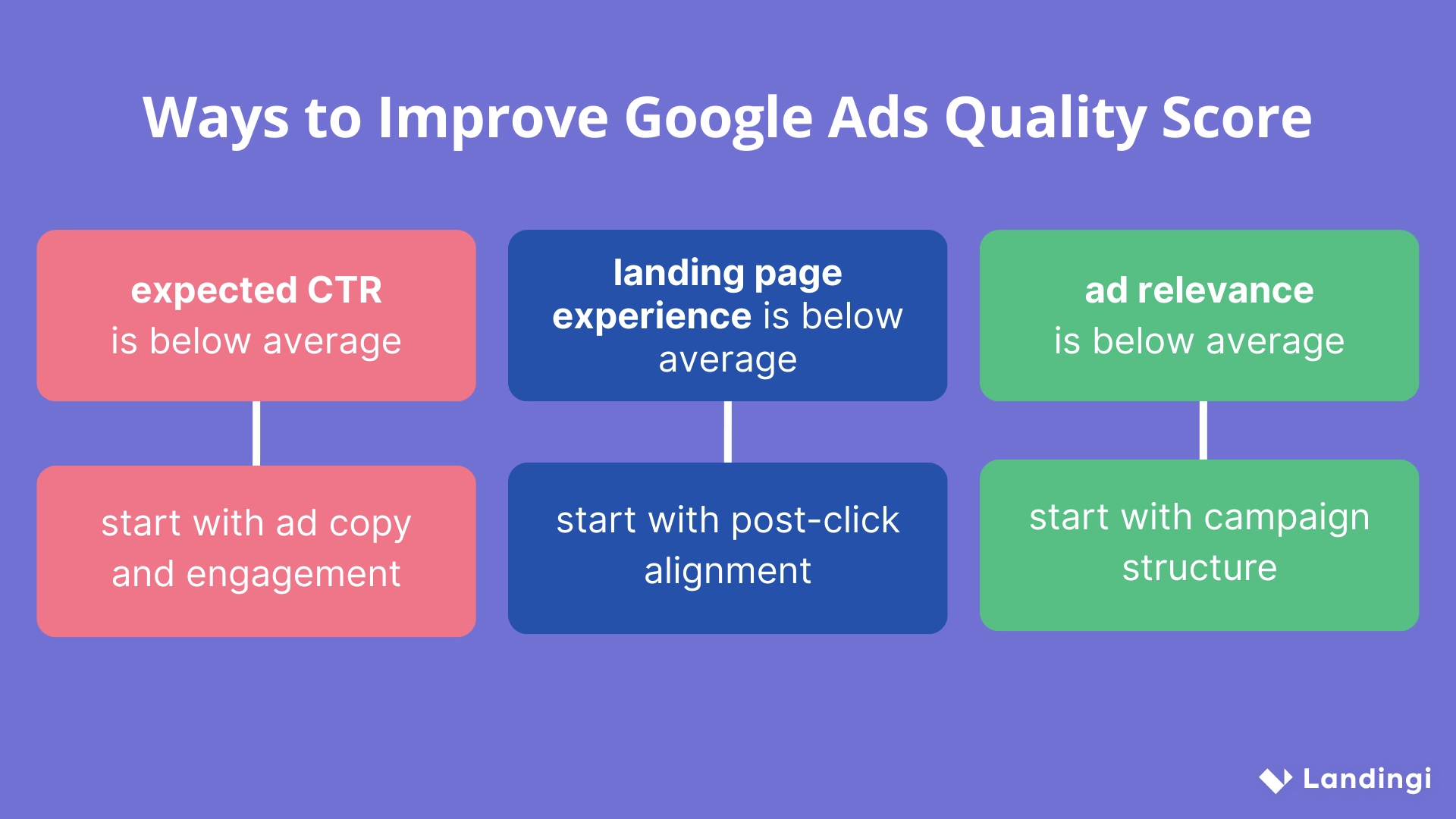
Conclusion
In this lesson, we've dissected the Quality Score into its three constituent parts. This granular understanding moves you from simply knowing that Quality Score is important to knowing exactly which levers to pull to improve it. This is the kind of practical, diagnostic knowledge that is highly valued in job interviews and in day-to-day campaign management.
Key Takeaways:
- Quality Score is composed of three core factors: Expected CTR, Ad Relevance, and Landing Page Experience.
- Each factor is rated as Below Average, Average, or Above Average, providing a clear diagnostic tool.
- Expected CTR is about predicting clicks and is improved by tight ad groups and compelling, relevant ad copy.
- Ad Relevance is about the connection between the keyword and the ad, improved by granular campaign structure and specific messaging.
- Landing Page Experience is about the post-click journey, improved by message match, speed, mobile usability, and trustworthiness.
Now that you understand the components of Quality Score, we are ready to see how it works in a live auction scenario. In our next lesson, we will use this knowledge to calculate Ad Rank for competing advertisers, determine the winner, and see how a better Quality Score directly translates into paying less for a click.