Welcome back! In our previous lesson, we broke down Quality Score into its three critical components: Expected CTR, Ad Relevance, and Landing Page Experience. You now have the diagnostic tools to understand why Google rates your ads the way it does.
Today, we'll put that knowledge into action. We will take the Quality Score, combine it with your bid, and use them to answer the most fundamental question in the Google Ads auction: "Who wins?" This lesson focuses on calculating Ad Rank to determine ad positions. Mastering this simple calculation is not just academic; it's a core concept that allows you to explain campaign dynamics in job interviews and make smarter strategic decisions.
The Ad Rank Formula: Determining Your Position
Every time a search triggers an ad auction, Google calculates a value called Ad Rank for every eligible advertiser. The advertiser with the highest Ad Rank gets the top ad position, the one with the second-highest gets the second position, and so on.
The simplified formula at the heart of the auction is straightforward:
Where:
- Your Max Bid is the highest amount you're willing to pay for a single click.
- Your Quality Score is the 1-10 rating of your keyword's quality, which we explored in the last lesson.
While this core formula is what you'll use for most practical scenarios, it's worth noting for a complete understanding that the full Ad Rank calculation also includes the expected impact of ad extensions and other ad formats. Think of well-chosen extensions as a booster that can slightly increase your final Ad Rank score. However, for determining the winner of an auction, the Bid × QS calculation is the engine driving the process.
To see this formula defined and presented in a different context, the following reading is helpful.
Google Ad Rank: How to Secure Top Ad Positions - Factors.ai
This article from Factors.ai provides a concise and clear definition of the Ad Rank formula.
In the article, find the section titled "FAQs on Google Ad Rank". Read the answer to the question What is the formula for Google Ad Rank?. This reinforces the core calculation we'll be using.
An Auction in Action
Now, let's simulate an auction. Imagine four advertisers—Sam, Mary, Jane, and Pat—are all bidding on the same keyword. They each have a different maximum bid and a different Quality Score.
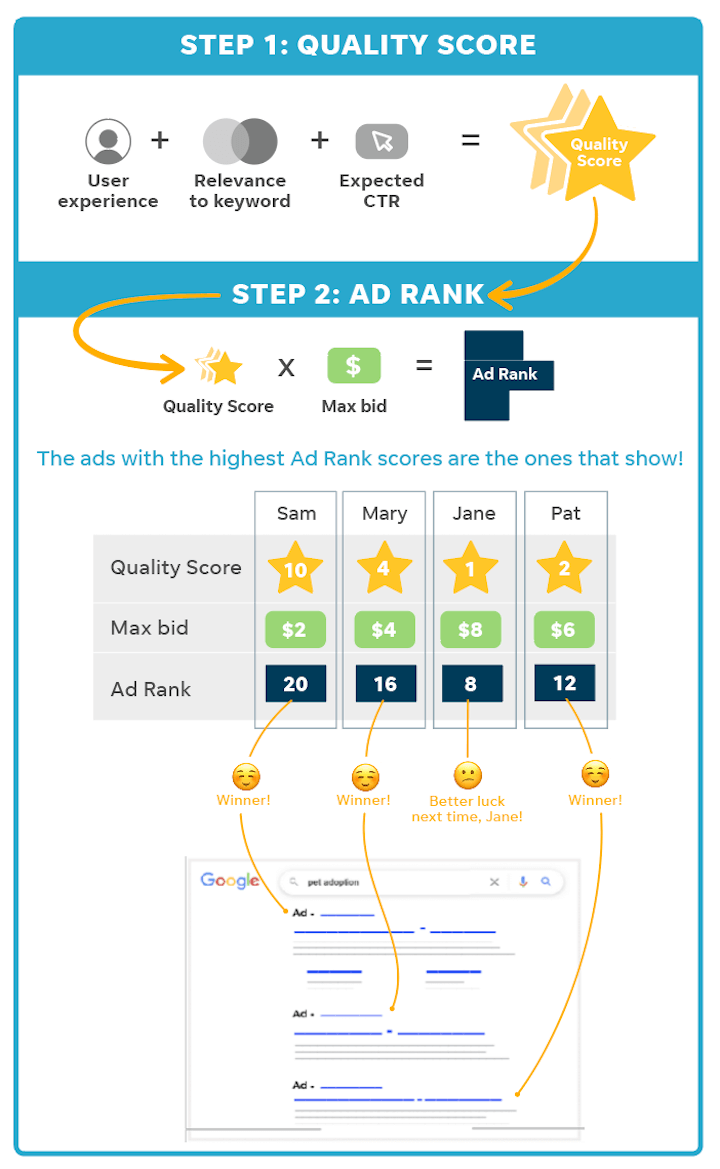
Let's walk through the calculations for each advertiser based on the data in the "STEP 2: AD RANK" section of the infographic:
-
Sam:
- Max Bid: $2
- Quality Score: 10/10
- Ad Rank = $2 × 10 = 20
-
Mary:
- Max Bid: $4
- Quality Score: 4/10
- Ad Rank = $4 × 4 = 16
-
Pat:
- Max Bid: $6
- Quality Score: 2/10
- Ad Rank = $6 × 2 = 12
-
Jane:
- Max Bid: $8
- Quality Score: 1/10
- Ad Rank = $8 × 1 = 8
Now, we rank them by their Ad Rank score to determine their position on the search results page:
- Position 1: Sam (Ad Rank: 20)
- Position 2: Mary (Ad Rank: 16)
- Position 3: Pat (Ad Rank: 12)
- Position 4: Jane (Ad Rank: 8)
This example powerfully illustrates the single most important strategic takeaway of the Google Ads auction: the highest bidder does not always win. Sam wins the top position despite bidding only $2, a quarter of Jane's $8 bid. His perfect Quality Score of 10 more than compensated for his lower bid. Conversely, Jane's high bid was nullified by a dismal Quality Score, landing her in last place.
This is a critical insight for your interviews. When asked how to improve ad position, your first answer shouldn't be "increase the bid." It should be "diagnose and improve the components of Quality Score."
To see another worked example, take a look at the following resource.
Google Ad Rank: How to Secure Top Ad Positions - Factors.ai
This section of the Factors.ai article provides another clear, step-by-step calculation to solidify your understanding.
Please read the section Google Ad Rank Formula With Example. Pay close attention to the table and the "Inference" that follows, as it reinforces the point that Quality Score can overcome a lower bid.
The Ad Rank Threshold: The Price of Entry
There's one more crucial concept: the Ad Rank Threshold. To be shown at all, an ad must meet a minimum Ad Rank score. This threshold is dynamic, changing based on the user's search context, but it acts as a quality gatekeeper.
If the minimum Ad Rank to show on the page was, for example, 10, then Jane (with an Ad Rank of 8) wouldn't appear in the results at all, even if there were open ad slots. Google would rather show organic results than a low-quality, irrelevant ad.
This video from Surfside PPC provides a great explanation of this concept.
Google Ads Ad Rank Explained - Ad Rank Formula, Thresholds, & How to Improve
This video clearly explains the concept of the Ad Rank threshold and how it functions as a gatekeeper in the auction.
Watch the segment from how ad rank works. Focus on how the speaker describes an advertiser failing to reach the threshold and thus not having their ad shown at all.
This system ensures that simply being the only bidder, or bidding very high with a poor quality ad, isn't enough to guarantee visibility. You must provide a baseline level of quality to even participate.
Conclusion
In this lesson, you've learned how to calculate the metric that sits at the very center of the Google Ads auction. By combining an advertiser's bid with their Quality Score, you can now predict the outcome of a competitive auction and understand the mechanics behind ad positioning.
Key Takeaways:
- Ad Rank is the score that determines an ad's position on the search results page.
- The core formula is Ad Rank = Max Bid × Quality Score.
- A high Quality Score can allow you to win a higher ad position even with a lower bid, debunking the myth that the highest bidder always wins.
- Advertisers must also meet a minimum Ad Rank Threshold to be eligible to appear in the auction at all, ensuring a baseline level of quality.
We've now determined the position of each ad. The next logical question is, "What price does the winner actually pay?" As we've seen, Sam's max bid was $2, but he likely won't pay that full amount. Our next lesson will introduce the formula for Actual CPC (Cost Per Click), showing you how to calculate the final price an advertiser pays based on the Ad Rank of their competitor below them.