Welcome back. In our last lesson, we established the foundational trigger of the Google Ads process: a user's search query initiates a real-time auction among all eligible advertisers. This laid the groundwork for understanding when and why an auction happens.
Now, we move to the next logical question, which sits at the very heart of Google Ads strategy: Once your ad is eligible for the auction, how does Google decide if you win, where your ad appears, and if it appears at all? In this lesson, we will dissect the single most important metric that answers this question: Ad Rank. You will learn what Ad Rank is and how it is calculated from its primary components—your bid, your Quality Score, and the impact of your ad extensions. Mastering this concept is non-negotiable for success in Google Ads and for acing technical interview questions.
Defining Ad Rank: The Score that Determines Placement
Imagine the Google Ads auction as a competition where every eligible ad is given a score. The ad with the highest score gets the top position, the second-highest gets the next, and so on. That score is Ad Rank. It is the value Google calculates for every ad in an auction to determine its position on the search results page.
A crucial point to understand is that Ad Rank is not a fixed number stored in your account. It's calculated fresh for every single auction. This is why your ad position can change even for the same keyword, as the competitors and context shift from one search to the next.
How Does Ad Rank Affect Your Google Ads Campaigns?
This article from blobr.io provides an excellent conceptual overview of Ad Rank. It clarifies that Ad Rank is a dynamic, auction-time calculation.
Please read the first main section, What Ad Rank really is. Focus on understanding that Ad Rank is calculated in real-time and that it is shaped by several predictable inputs, which we will now break down.
The Three Levers of Ad Rank
While Google's full Ad Rank algorithm incorporates many signals, there are three primary components that you, as the advertiser, directly control. Think of these as the main levers you can pull to influence your score in the auction:
- Your Bid Amount (Max. CPC Bid)
- Your Quality Score
- The Expected Impact of Ad Extensions and Other Ad Formats
Let's examine each of these components individually.
1. Your Bid Amount
The bid is the most straightforward component. It’s the maximum amount of money you are willing to pay for a single click on your ad (your maximum cost-per-click, or Max. CPC). While it's a critical factor, it's important to remember that Google Ads is not a simple "highest bidder wins" auction. It's just one piece of the puzzle. Your bid sets a ceiling on what you might pay, but it doesn't guarantee a top position if your quality is poor.
2. Quality Score: The Great Equalizer
Quality Score is Google's rating of the overall quality and relevance of your ads, keywords, and landing pages. It’s reported on a scale of 1 to 10, where 10 is the best. This metric is the single most powerful way to compete in the Google Ads auction, especially against competitors with larger budgets.
A high Quality Score signals to Google that your ad is a great match for the user's search query, leading to a better user experience. Google rewards this with a higher Ad Rank and often, a lower cost-per-click. This means an advertiser with a fantastic Quality Score can actually pay less for a higher position than a competitor with a low Quality Score who is bidding more.
Let's look at a classic illustration of this principle.
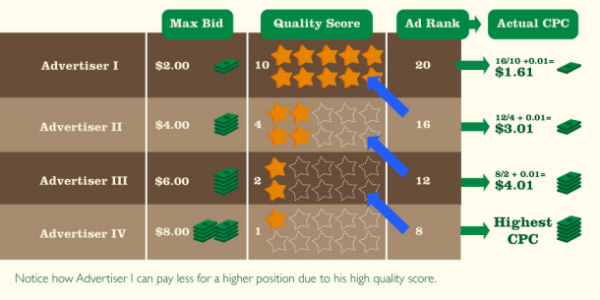
In the example above:
- Advertiser IV bids the most ($8.00) but has a terrible Quality Score (1/10). Their Ad Rank (8) is too low to win a top spot.
- Advertiser II bids $4.00 with a Quality Score of 4, resulting in an Ad Rank of 16.
- Advertiser I bids only $2.00 but has a perfect Quality Score of 10. Their Ad Rank is 20 (2 x 10), allowing them to outrank everyone else while being positioned to pay the lowest price.
This dynamic is fundamental to your success. Focusing on improving your Quality Score is the most sustainable path to cost-effective results.
3. The Expected Impact of Ad Extensions
Ad extensions are additional pieces of information that can be shown with your ad, such as phone numbers (call extensions), additional links to your site (sitelinks), or special offers (promotion extensions).
When calculating Ad Rank, Google considers the "expected impact" of these extensions. It predicts how much they will improve your ad's visibility and click-through rate. Ads with relevant extensions take up more space on the results page, are more eye-catching, and provide more value to the user. Because of this, using extensions properly can give your Ad Rank a significant boost.
Inside the Google Ads Auction: How Bidding & Quality Score Decide ...
This article from Redcrown Technologies gives concise definitions for the components of Ad Rank.
First, review the bulleted list under the section heading "2. The Formula Behind Ad Rank." This list clearly defines each of the factors. Then, skip down to read section 5. How Ad Extensions Influence Ad Rank to solidify your understanding of their role.
The Full Picture: A Visual Summary
We've covered the three main inputs you control. However, Google's auction is more nuanced and also considers other real-time factors like the user's location, device, and the time of day. The following flowchart provides a comprehensive map of all the factors that contribute to Ad Rank.

As you can see, your bid and quality-related factors are combined with contextual signals (Box 5) and auction-time dynamics (Boxes 3 & 4) to produce the final Ad Rank that determines your ad's fate in that specific auction.
Conclusion
In this lesson, you've moved from knowing that an auction happens to understanding how Google determines the winner. This knowledge is crucial for developing a sound strategy that balances bidding with a relentless focus on quality.
Key Takeaways:
- Ad Rank is a score calculated in every auction that determines your ad's position. It is not a fixed value.
- A higher Ad Rank leads to a better ad position and a higher likelihood of your ad being shown.
- Ad Rank is primarily determined by three components you control: your Bid Amount, your Quality Score, and the Expected Impact of Ad Extensions.
- Quality Score is the great equalizer. A high score can allow you to achieve a better ad position for a lower cost, even against higher-bidding competitors.
We've established that Quality Score is arguably the most important long-term lever for success. But what exactly goes into that 1-10 score? In our next lesson, we will break down Quality Score into its three core components: Expected Click-Through Rate, Ad Relevance, and Landing Page Experience.