Recommended resources
The freely available resources this lesson will direct you to.
- Human in the Loop in LangGraph.jswww.youtube.com
- Building a self-corrective coding assistant from scratchwww.youtube.com
- Self-Correcting AI Agents: Reflection, Retry, and Validation Loop Patterns | CallSphere Blogcallsphere.tech
- Human-in-the-loop patterns · Cloudflare Agents docsdevelopers.cloudflare.com
In our last lesson, we gave our agents a memory, allowing them to maintain state and recall past interactions using StateGraph and persistent checkpoints. We designed a production-grade memory architecture, which is crucial for building sophisticated, long-running agents. However, building reliable systems isn't just about what agents remember; it's also about how they behave when things inevitably go wrong.
This lesson addresses that challenge head-on. You will learn to design a general agent error policy, a critical component for any production AI system. We'll explore a layered approach to resilience, starting with simple automated retries, moving to intelligent self-correction, and culminating in the ultimate safety net: human-in-the-loop (HITL) fallbacks. Mastering these patterns is essential for building robust agents and a key differentiator in AI engineering system design interviews.
The Spectrum of Agent Failure
In traditional software, you might handle a null pointer or a failed network request. In agentic systems, the failure modes are more varied and nuanced. We can group them into three broad categories:
- Transient Failures: These are temporary, non-deterministic issues like a brief network outage, an API provider's rate limit, or a model returning a one-off garbled response.
- Deterministic Failures: These are consistent errors where the agent repeatedly makes the same mistake, such as generating invalid JSON, using a tool with the wrong arguments, or getting stuck in a logical loop.
- High-Stakes Actions: These aren't failures in the traditional sense, but situations where the cost of an error is unacceptably high. Examples include authorizing a payment, deleting user data, or publishing content publicly. The action itself might be correct, but it requires explicit confirmation.
A robust error policy uses different strategies for each category.
Level 1: Automated Retries for Transient Failures
For transient failures, the simplest and often most effective strategy is to just try again. As a software engineer, you're likely familiar with implementing retry logic, often with exponential backoff to avoid overwhelming a struggling service.
In AI systems, we can enhance this by providing incrementally more detailed feedback with each attempt. This helps guide the LLM away from a flaky response without immediately escalating to a more complex correction mechanism.
Self-Correcting AI Agents: Reflection, Retry, and Validation Loop Patterns | CallSphere Blog
This article from the CallSphere Blog provides excellent, practical patterns for agent self-correction. We'll use it throughout this lesson.
Start by reading the section on retry mechanisms. The Python code in the RetryWithFeedback class demonstrates a classic pattern. Notice the feedback_escalation list, which provides increasingly specific hints on each failed attempt. This is a simple but powerful way to improve success rates for recoverable errors.
This pattern is your first line of defense, efficiently handling temporary hiccups.
Level 2: Self-Correction through Reflection
What happens when the agent keeps making the same mistake? A simple retry won't fix a fundamental misunderstanding or a logical error. Here, we need the agent to perform a kind of "meta-cognition"—to stop, analyze its own error, and formulate a new plan. This is known as the Reflection Pattern.
The core loop is:
- Generate: The agent attempts the task.
- Validate: The output is checked against a set of predefined rules (e.g., Is it valid JSON? Does the code compile? Are the required fields present?).
- Reflect & Retry: If validation fails, the agent is prompted with the original task, its failed output, and the specific validation errors. It's asked to identify the root cause and generate a corrected output.
Self-Correcting AI Agents: Reflection, Retry, and Validation Loop Patterns | CallSphere Blog
Let's return to the same article to explore the reflection pattern.
Read the section on Reflection Prompting. Pay close attention to the REFLECTION_PROMPT. This is a powerful example of prompt engineering used to guide the model's reasoning about its own failures. The ReflectionAgent class shows how to integrate this into a retry loop.
This self-correction technique can dramatically improve the reliability of agents on complex tasks. The next video shows this in action for a code generation task, a scenario where this pattern is particularly effective.
Building a self-corrective coding assistant from scratch
This video from LangChain demonstrates building a self-correcting coding assistant using LangGraph, inspired by the AlphaCodium paper. It's a perfect real-world example of the reflection pattern.
First, watch the introduction from the beginning to understand the concept of "flow engineering." Next, jump to the core logic showing how errors are fed back into the prompt for a retry at this segment. Then, see a live example of the agent failing and then self-correcting from this part. Finally, observe the powerful results at the evaluation section, where this technique boosted code execution success from ~55% to 80%.
As the video shows, self-correction isn't just theoretical; it delivers a measurable improvement in task completion rates.
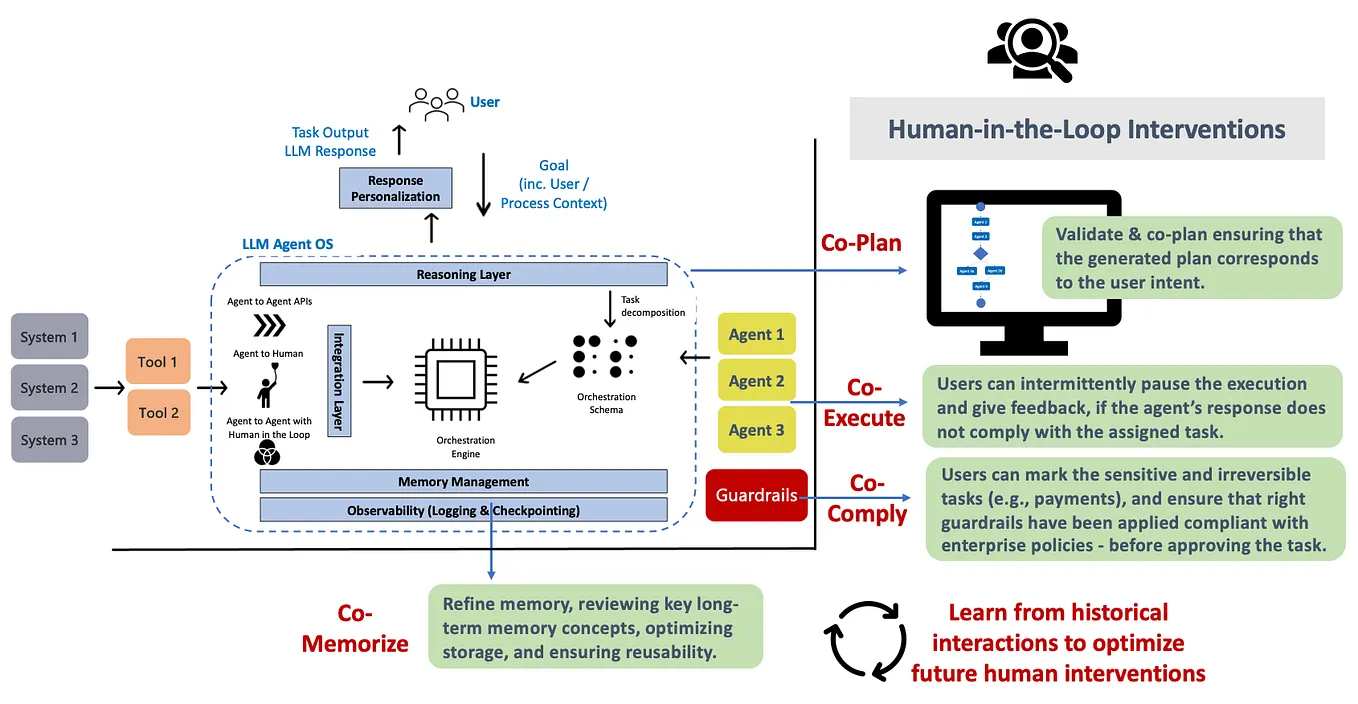
Level 3: Human-in-the-Loop (HITL) Fallbacks
Some actions are too critical to be left to full automation, and sometimes, even a self-correcting agent gets stuck. In these cases, the safest and most robust solution is to pause the workflow and request human intervention.

This pattern is a cornerstone of building safe and compliant AI systems. Fortunately, frameworks like LangGraph provide built-in mechanisms to support it, connecting directly to the checkpointing concepts from our previous lesson.
Human in the Loop in LangGraph.js
The official LangChain channel has a great tutorial on implementing HITL directly in LangGraph.js. This will show you the practical "how-to" that builds on our last session.
Watch the entire video. It's short and packed with relevant information. Pay special attention to: The concept of static interrupts to pause the graph before a specific node (like a tool call). How to programmatically update the state of the paused graph to grant authorization. The more flexible approach of using dynamic interrupts, where the graph pauses itself based on runtime logic.
While LangGraph provides the mechanics, production systems require more durable and feature-rich HITL workflows. This includes features like timeouts, escalations, and audit trails.
Human-in-the-loop patterns · Cloudflare Agents docs
This documentation for Cloudflare Agents shows a production-grade implementation of HITL. The syntax is TypeScript-based and should be very readable for you.
Read through the following sections to see how to build a robust approval workflow: Start with the "Workflow-based approval" pattern. Notice the use of waitForApproval() to pause the workflow. Review the <tf start="Timeout handling" end="Error("Approval timeout");">"Timeout handling" section. This is crucial to prevent workflows from getting stuck indefinitely. See how to build a proactive system in the <tf start="Escalation with scheduling" end="console.log("Escalating to manager");">"Escalation with scheduling" section, which uses a scheduler to send reminders or escalate to a manager. Finally, look at the "Audit trail with SQL" section. This is a vital component for compliance and accountability.
Designing a Comprehensive Error Policy
We've now seen three layers of defense: retries, reflection, and HITL. The final step is to combine them into a coherent policy that decides which strategy to use and when. This is where the EscalationManager comes in.
An EscalationManager is a piece of logic (it could be a simple function or a dedicated class) that acts as a central dispatcher for failures. When an agent's self-correction loop fails after a set number of attempts, the EscalationManager takes over.
Self-Correcting AI Agents: Reflection, Retry, and Validation Loop Patterns | CallSphere Blog
Let's look at the final piece of the puzzle from the CallSphere article.
Read the section on Graceful Escalation. The EscalationManager class provides a clear example of a policy-based approach. It considers several factors to make a decision: Number of attempts: Has it already tried to self-correct? Task criticality: Is this a high-stakes operation? User presence: Is the agent interacting directly with a user who can provide clarification? Based on these inputs, it decides whether to retry, simplify the task, ask the user (a form of HITL), fail safely, or queue the task for offline human review.
This strategic approach to escalation is what separates a brittle, prototype agent from a resilient, production-ready one.
Conclusion
In this lesson, you have learned to design a multi-layered error policy that makes AI agents significantly more reliable and safe.
Key Takeaways:
- Error Handling is a Spectrum: Agent failures range from transient glitches to high-stakes decisions, each requiring a different strategy.
- Retry and Reflect: For automated recovery, start with simple retries with exponential backoff and escalating feedback. For more stubborn errors, use the Reflection Pattern where the agent analyzes and corrects its own mistakes.
- Human-in-the-Loop is the Ultimate Safety Net: For critical actions or unrecoverable errors, pause the agent's execution and request human approval or input. Frameworks like LangGraph provide
interruptsto facilitate this. - Design an Escalation Policy: The core of your error handling strategy is an
EscalationManagerthat decides which recovery mechanism to use based on the context of the failure (e.g., attempt count, task criticality, user presence).
You now have the tools to build agents that can not only remember their state but also gracefully handle the complexities and uncertainties of the real world. In our next lesson, we will zoom in on a particularly common and tricky source of errors: tool calls. You'll learn to implement robust input validation and error handling specifically for when agents interact with external tools.