Recommended resources
The freely available resources this lesson will direct you to.
Welcome back. In our previous lesson, you learned to orchestrate teams of specialized agents using AgentGraph and Supervisor patterns. We defined the "control plane"—the logic that dictates who does what and in what order. However, for agents to collaborate effectively on anything more than a trivial task, they need a shared understanding of the problem's state and a memory of past interactions.
This lesson focuses on that "data plane." We will explore how to implement state and memory management for long-running agent interactions. You'll learn how frameworks like LangGraph manage state within a single workflow and persist it across conversations. More importantly, we'll dissect the architecture of a production-grade memory system—a topic that is fundamental to building scalable AI applications and a frequent subject in AI Engineer system design interviews.
The Problem of Amnesia: From Stateless to Stateful Agents
By default, an LLM call is stateless. It has no memory of previous requests beyond what's explicitly provided in the current context window. For an agent to perform a multi-step task like researching and writing a report, or to hold a coherent conversation with a user over time, this amnesia is a critical limitation.
We solve this by building a state management layer. Let's start with how this is achieved within a single, complex workflow.
LangGraph Explained for Beginners
This video from KodeKloud provides an excellent visual demonstration of why state is crucial and how LangGraph solves this problem.
First, watch the segment comparing a traditional stateless chain to a stateful graph from this section. Pay attention to how the stateless chain "forgets" the user's name, while the stateful graph remembers it, enabling a more coherent interaction. Next, watch the shopping cart example from this part of the video. This clearly illustrates the concept of state accumulation, where each node in the graph adds to or modifies a shared state object rather than replacing it.
The core component that enables this is the StateGraph. As you saw, a StateGraph allows all nodes (the functions your agents execute) to read from and write to a shared, persistent state object for the duration of the workflow.
Controlling State Updates with Reducers
So, how does the state object get updated? By default, when a node returns a value for a field in the state, it simply overwrites the old value. But often, we need more sophisticated logic, like appending to a list (as in the shopping cart example) or aggregating values.
In LangGraph.js, this is controlled by reducers. If you have experience with state management libraries like Redux in JavaScript, this concept will feel very familiar. A reducer is a function you define that specifies how an update should be applied to the existing state.
LangGraph.js Concept Guide - DEV Community
This section of the LangGraph.js guide explains the concept of state interfaces and reducers with clear code examples.
Please read the section titled "State Management". Contrast the default "override" behavior in StateA with the custom add reducer in StateB. This demonstrates how you gain fine-grained control over the state flow. The code uses TypeScript, which should be comfortable for you given your JavaScript background.
By defining reducers, you can implement logic like:
- Appending new messages to a chat history list.
- Incrementing a counter for API calls.
- Merging results from multiple parallel tool calls into a single list.
This gives you precise control over the agent's "working memory" during a single, complex task. But what happens when the task ends and the user comes back the next day?
Persistence: Memory Across Conversations
The state we've discussed so far is typically held in memory and lost when the process ends. To create truly long-running interactions, we need to persist this state. LangGraph achieves this through checkpoints.
A checkpoint is a snapshot of the graph's state at a specific point in time. By saving these checkpoints to a persistent store (like a database), you can pause and resume an agent's execution, even across different sessions.
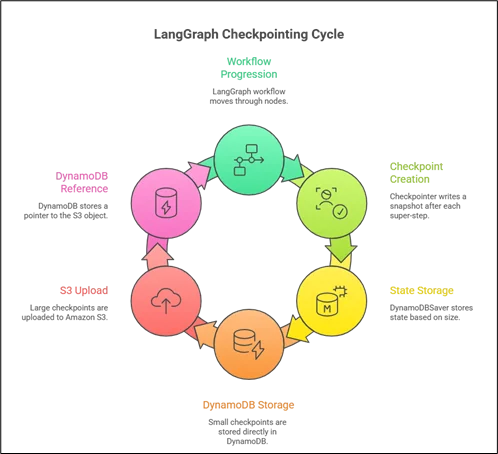
The key to linking these checkpoints into a continuous conversation is a thread_id. Each conversation gets a unique ID, and all its state snapshots are saved under that ID.
LangGraph.js Concept Guide - DEV Community
Let's return to the LangGraph.js guide to see how checkpoints enable multi-turn memory.
First, read the sections "Persistence" and "Checkpoints" to understand the concept and its benefits, like fault tolerance and human-in-the-loop workflows. Then, carefully study the final example. Walk through the four invocations of the graph. Notice how using the same thread_id ("some-thread") allows the total to accumulate across the first three calls, even when the input for a turn doesn't specify total. When a new-thread-id is introduced, the memory starts fresh. This is the practical mechanism for implementing conversational memory.
Checkpoints provide the foundation for short-term memory (remembering the current conversation). But for an agent to be truly intelligent and personalized, it needs a more sophisticated, long-term memory system.
System Design: A Production-Grade Memory Architecture
Managing memory is far more complex than just saving and loading a chat history. A production AI system needs to intelligently distill, store, retrieve, and maintain information about a user's preferences, constraints, and history over the long term.
This is a classic system design problem. The following framework provides a robust, layered approach to thinking about and implementing agent memory.

Agent Memory Systems: A Complete Engineering Guide - Medium
This guide presents a framework-agnostic, 5-layer architecture for designing memory in any AI agent. This is an invaluable resource for preparing for system design interviews.
Please read through the first four layers of the architecture described in the article: Layer 1: State Definition. Focus on the separation of global_memory (long-term) and session_memory (short-term), and the structure of a MemoryNote with fields like importance. Layer 2: Live Distillation. Understand the "Distillation Tool Pattern," where the agent actively decides what is worth remembering. The prompt engineering of the tool's docstring is critical here. Layer 3: Injection. This is key. It's not enough to have memory; you must inject it effectively. Pay close attention to the concepts of relevance filtering and the Memory Injection Policy with its precedence rules (e.g., session memory overrides global memory). Layer 4: Consolidation. Learn how session notes are merged into long-term memory. The Writer-Critic Pattern is a powerful technique for preventing memory corruption, and importance-based aging is essential for keeping the memory store clean.
This layered model moves you from a simple chat log to a sophisticated cognitive architecture. In an interview, being able to discuss the trade-offs and mechanics of distillation, injection policies, and consolidation will demonstrate a deep understanding of building robust AI systems.
For your reference, the article concludes with a section that is perfect for interview prep.
Agent Memory Systems: A Complete Engineering Guide - Medium
This section frames common memory challenges as interview-style questions.
Review the Q&A section "Key Questions to Pressure-Test Your Design". Think about how you would articulate these answers, drawing on the concepts from the 5-layer architecture.
Conclusion
In this lesson, you've bridged the gap between stateless LLM calls and stateful, intelligent agents. You now have both the practical tools and the architectural patterns to manage memory across different time horizons.
Key Takeaways:
- Stateful Workflows:
StateGraphin LangGraph provides a shared state object, or "working memory," for agents collaborating on a single task.Reducersgive you fine-grained control over how this state is updated. - Conversational Persistence:
Checkpoints, identified by athread_id, allow you to save and load a graph's state, enabling multi-turn conversations that persist across sessions. - Production Memory Architecture: A robust memory system is a multi-layered construct. It involves:
- Distillation: Actively capturing important information.
- Injection: Intelligently filtering and inserting relevant memories into the prompt with clear precedence rules.
- Consolidation: Periodically merging temporary memories into a clean, de-duplicated long-term store, often using a safe "Writer-Critic" pattern.
So far, we've designed our agent workflows and given them a memory. But in the real world, things go wrong. Tools fail, LLMs hallucinate, and users provide unexpected input. In our next lesson, we will address this reality by designing a general agent error policy, including retries, and human-in-the-loop fallbacks.