Recommended resources
The freely available resources this lesson will direct you to.
Introduction
In our previous lesson, we examined the concept of rights, defining them as entitlements that impose duties on others. We also drew the crucial distinction between natural rights, which are seen as inherent and universal, and legal rights, which are created and enforced by a governing authority. This sets the stage perfectly for our topic today, as we now turn our focus to defining that very authority: the state.
To rigorously analyze any political ideology, especially one like libertarianism that is fundamentally concerned with the limits of power, we must first have a clear and precise understanding of what the state is. This lesson will define the state by identifying its core components and its most essential characteristic. We will also outline its primary functions, such as creating laws, enforcing them, and providing defense. Understanding what the state is and what it does is a prerequisite for asking the critical libertarian question: what, if anything, should it do?
Defining the State: The Basic Components
In everyday conversation, we might use "state," "country," and "government" interchangeably. In political philosophy, however, these terms have more precise meanings. The state is best understood as the political and legal entity that exercises authority over a specific population in a given territory.
Political scientists generally agree that for an entity to be considered a state, it must possess four essential elements: a population, a defined territory, a government, and sovereignty. A helpful video from Allensens provides a great overview of these core characteristics, along with a couple of others that are important in the modern world.
This video, titled "The State," provides a clear and systematic introduction to the state's key features.
Please watch the main segment from the definition of the state. As you watch, focus on how the presenter explains each of the following components: Defined Territory (Border): A geographical area with clear boundaries. Permanent Population: The people living within that territory. Central Government: The administrative machinery of the state. Sovereignty: The ultimate authority within its borders, free from outside interference. Mutual Recognition: The acknowledgement by other states that it has a right to exist.
As the video explains, these elements work together. You cannot have a state without people, a place for them to live, a system to organize them, and the final authority to make decisions.
State vs. Government
One of the most important distinctions to grasp early on is the difference between the state and the government. This is a common point of confusion. The state is the abstract, permanent entity. The government is the specific group of people and institutions that run the state at any given time. Think of it this way: the United States is a state, and it has existed since 1776. The Biden administration is the current government. Governments come and go, but the state persists.
Let's read a brief text that clarifies this relationship.
Understanding State and Government in Political Science
This article from Manupatra Academy makes the distinction between state and government very clear.
Please read the two sections starting from the first paragraph and then the list under the heading "Some of the main differences". This will solidify your understanding of the government as an agency of the state.
To summarize, the government is the tangible, operational part of the state. It formulates and enforces the will of the state, but it is not the state itself.
The Defining Characteristic: Monopoly on Legitimate Force
While the four elements above describe the components of a state, the celebrated German sociologist Max Weber offered a definition that cuts to the heart of what makes the state unique. He argued that the state cannot be defined by its goals (its ends), because states have pursued countless different goals throughout history. Instead, it must be defined by the specific means that it alone possesses.
According to Weber, a state is a human community that successfully claims the monopoly of the legitimate use of physical force within a given territory.
This is perhaps the most influential definition of the state in modern social science. Let's break down its key parts with the help of a video dedicated to explaining Weber's idea.
Understanding Max Weber's Definition of the State
The video "Understanding Max Weber's Definition of the State" unpacks this crucial concept.
Please watch from the introduction. Pay close attention to the distinction between the state's means (force) and its ends, and the explanation of what makes violence "legitimate."
Let's review the two most important concepts from this definition:
-
Monopoly: This means the state is the only entity that is recognized as having the right to use violence. Other individuals or groups (like a parent punishing a child, a security guard detaining a shoplifter, or a person acting in self-defense) are only allowed to use force to the extent that the state permits it. If a criminal gang uses force, it is seen as illegitimate. If the police use force, it is, in principle, seen as legitimate.
-
Legitimate: This word is doing a lot of work. "Legitimacy" means that the use of force is seen as justified, proper, and lawful by the population over which it is exercised. This legitimacy is what separates the state's police force from a private gang of thugs, even if they both use violence. The police action is backed by law and (ideally) public acceptance.

This definition is absolutely central to understanding libertarianism. Libertarians are deeply concerned with this monopoly on force. They ask: Is this monopoly ever justified? If so, under what extremely limited conditions? And what safeguards are needed to prevent it from being abused?
The Functions of the State
Now that we have a solid definition of what the state is, we can ask what it does. The learning outcome for this lesson specifically mentions legislation, enforcement, and defense. These are indeed the most fundamental functions.
- Legislation: The state creates laws and rules that govern the conduct of the people within its territory. This is typically done by a legislature (like a parliament or congress).
- Enforcement & Justice: The state enforces its laws. This involves a police force to investigate crimes and apprehend suspects, and a judicial system (courts) to adjudicate disputes and determine guilt or innocence.
- Protection (Defense): The state protects its territory and population from external threats, which is the role of the military. It also provides internal protection from crime, which is a role of the police.
These three functions are often considered the "core" or "minimal" functions of a state. However, modern states perform a much wider range of tasks.
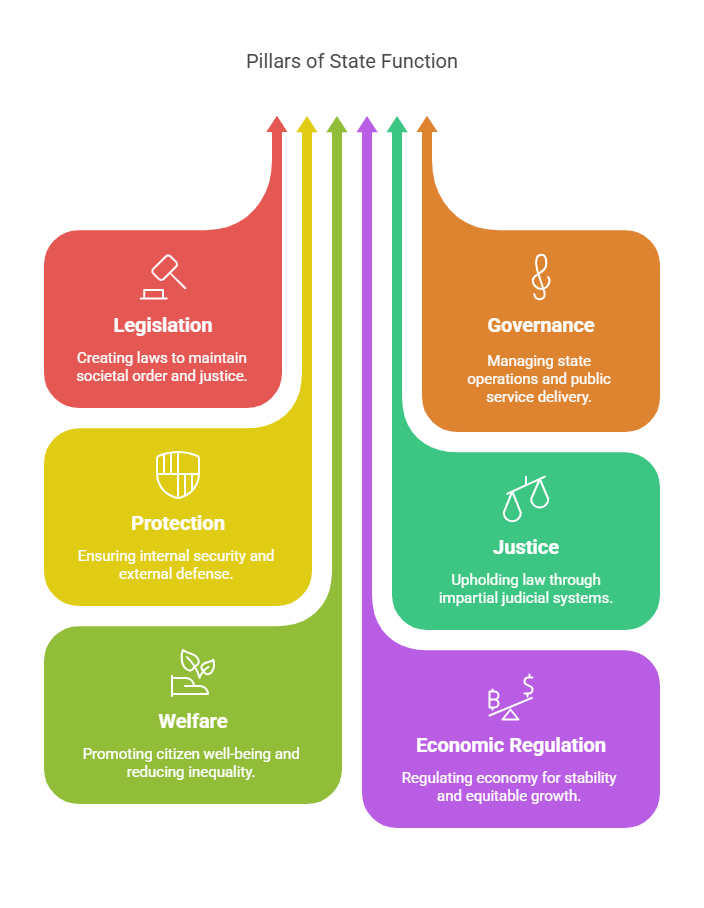
As the chart shows, in addition to legislation, protection, and justice, modern states are also deeply involved in:
- Governance: The general administration of public services and state operations.
- Welfare: Promoting the well-being of citizens through social programs like public education, healthcare, and social security.
- Economic Regulation: Managing the economy to promote stability and growth, for example by regulating banks, setting a minimum wage, or controlling pollution.
This expansion from the core functions to the broader welfare and regulatory functions is a major point of contention in political philosophy. While most ideologies agree that the state must perform its core functions, they disagree vehemently about whether it should engage in the others. Libertarianism, as we will see, argues for a state that is strictly limited to the absolute minimum—or, for some, no state at all.
Conclusion
In this lesson, we have constructed a clear and layered definition of the state. We began by identifying its four essential components and then sharpened our focus with Max Weber's classic definition, which is crucial for understanding debates about political power.
Here are the key takeaways:
- The state is a political and legal entity with four key elements: a population, a defined territory, a government, and sovereignty.
- The government is the temporary administrative body that acts on behalf of the permanent, abstract state.
- The defining characteristic of the state, according to Max Weber, is its successful claim to a monopoly on the legitimate use of physical force within its territory.
- The basic functions of the state are legislation (making laws), enforcement/justice (upholding laws), and defense (protecting from threats). Modern states have expanded to include welfare and economic regulation.
We now know what the state is. The next logical question is: why should it exist? What gives this entity, with its monopoly on violence, the right to rule over individuals? The most famous answer to this question in Western political thought is the social contract theory. In our next lesson, we will explore this theory and how it attempts to justify the existence and authority of the state.