Recommended resources
The freely available resources this lesson will direct you to.
Introduction
In our last lesson, we established a clear definition of the state, concluding with Max Weber's powerful idea that the state is the entity that successfully claims a monopoly on the legitimate use of physical force. This naturally leads to a profound question: What gives any group of people this right to rule over others? Why should we, as individuals, obey the state's laws and submit to its authority? This is the fundamental question of political legitimacy.
Today, we will explore the most influential answer to this question in the history of Western political thought: the social contract theory. We will investigate its core logic, compare the foundational versions developed by Thomas Hobbes and John Locke, and explain why this theory is so crucial for justifying the existence of the state. Understanding this mainstream justification is essential, as it provides the backdrop against which libertarianism will later pose its radical challenge.
The Basic Idea: Escaping the State of Nature
To understand social contract theory, we begin with a thought experiment. Imagine a world with no government, no laws, no police, and no courts. Philosophers call this hypothetical scenario the "state of nature." What would life be like?
While the idea of total freedom might sound appealing at first, most social contract theorists argue it would be a disaster. The 17th-century English philosopher Thomas Hobbes famously painted a grim picture, describing life in the state of nature as “solitary, poor, nasty, brutish, and short.” Without any rules or authority to enforce them, people would live in constant fear. The strong could dominate the weak, and even the strong would be insecure, as a group of weaker individuals could band together to overpower them.
Faced with this chaotic and dangerous existence, social contract theorists argue that rational, self-interested people would come to a logical conclusion: they would be better off cooperating. They would agree to give up some of their absolute, natural freedom in exchange for peace, order, and the security of living in a civilized society. This foundational agreement is the social contract.
Let's watch a short video that introduces this core concept.
Contractarianism: Crash Course Philosophy #37
This video from Crash Course Philosophy, titled "Contractarianism," does an excellent job of setting the stage for why a social contract would be desirable.
Please watch from the beginning to the introduction of contracts. As you watch, focus on: Thomas Hobbes's description of the "state of nature" and why it's a "terrible way to live." The fundamental trade-off: why rational people would agree to give up some of their freedom. The basic definition of contractarianism: moral and political rules are based on the free, rational agreements we make to improve our lives.
As the video explains, the social contract is the idea that morality and political authority are not handed down from a divine source or discovered in nature, but are instead constructed by people. They are the result of an agreement made for mutual benefit.
Two Competing Visions: Hobbes and Locke
While the basic idea of a contract seems straightforward, philosophers have disagreed sharply on its specific terms. The two most influential thinkers in this debate are Thomas Hobbes and John Locke. Their different views on human nature and the purpose of the contract led to radically different conclusions about the proper role and power of government.
Thomas Hobbes: The Absolute Sovereign
Writing during the chaos of the English Civil War, Hobbes had a deeply pessimistic view of human nature. He believed the state of nature was a war of "all against all," and that the primary goal of the social contract was to escape this horror at any cost.
For Hobbes, the contract involved citizens giving up nearly all of their rights and freedoms to an all-powerful sovereign, which he called the Leviathan. This sovereign—a monarch or ruling assembly—would have absolute and unlimited authority to make and enforce laws. The sovereign's power must be absolute, Hobbes argued, because any limit on its power would risk creating disagreement and division, potentially causing society to slide back into the chaos of the state of nature. For Hobbes, even a tyrannical government is better than no government at all.
John Locke: The Limited Government
John Locke, writing a few decades later after England's "Glorious Revolution," had a more optimistic view. He did not see the state of nature as a horrific war. Instead, he believed it was a state of perfect freedom governed by a "law of nature." Using their reason, individuals could understand that they had natural rights—most importantly, the rights to life, liberty, and property.
The problem, for Locke, wasn't that the state of nature was a constant war, but that it was inconvenient. Without a neutral judge, people would have to enforce their own rights. When disputes arose, everyone would be a judge in their own case, leading to bias, escalating conflicts, and an unstable environment.
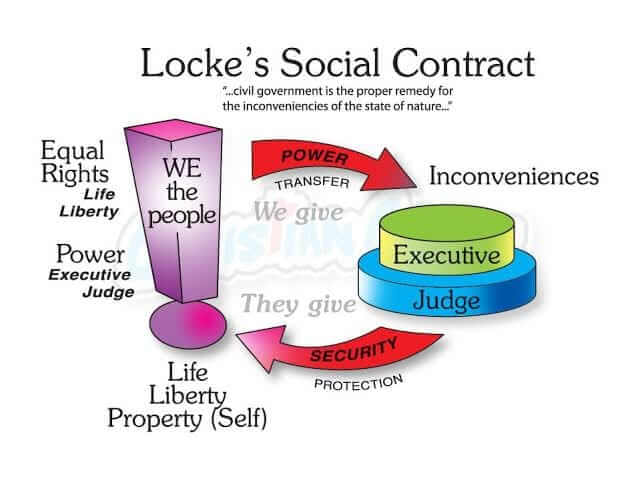
Therefore, Locke's social contract is more specific and limited. Individuals do not surrender all their rights. They only give up one: the right to personally enforce the law of nature (to be their own judge, jury, and executioner). They transfer this right to a government, whose sole purpose is to act as a neutral arbiter and protect the pre-existing natural rights of its citizens.
Key to Locke's theory is the idea of limited government and the consent of the governed. The government's authority is legitimate only so long as it protects the rights of the people and rules with their consent. If the government violates the contract—by infringing on the natural rights it was created to protect—the people have the right to withdraw their consent and overthrow it.
The following video provides an excellent summary and comparison of these two foundational theories.
The Social Contract - Thomas Hobbes & John Locke
The video "The Social Contract - Thomas Hobbes & John Locke" by the channel Philosophy Vibe offers a clear and direct comparison of these two monumental thinkers.
Please watch the following segments: First, watch the section on Hobbes from his theory. Note his justification for an all-powerful sovereign. Next, watch the section on Locke from his ideas. Pay close attention to how his view of natural rights leads to a very different kind of government. Finally, watch the summary of the differences from the main difference. This will crystallize the contrast between their two approaches.
To visualize Locke's model, which has been far more influential in the development of Western democracies (and libertarianism), consider this diagram:
Why the Social Contract Matters: Consent and Legitimacy
So, how does this theory justify the state? The key concept is consent. Social contract theory grounds the state's authority in the idea that we have, in some sense, agreed to be ruled. The government isn't legitimate because of divine right or because it is the strongest (might makes right); it is legitimate because it is founded on a rational agreement among the people it governs. This principle—that government derives its just powers from the "consent of the governed"—is the philosophical bedrock of modern democracy.
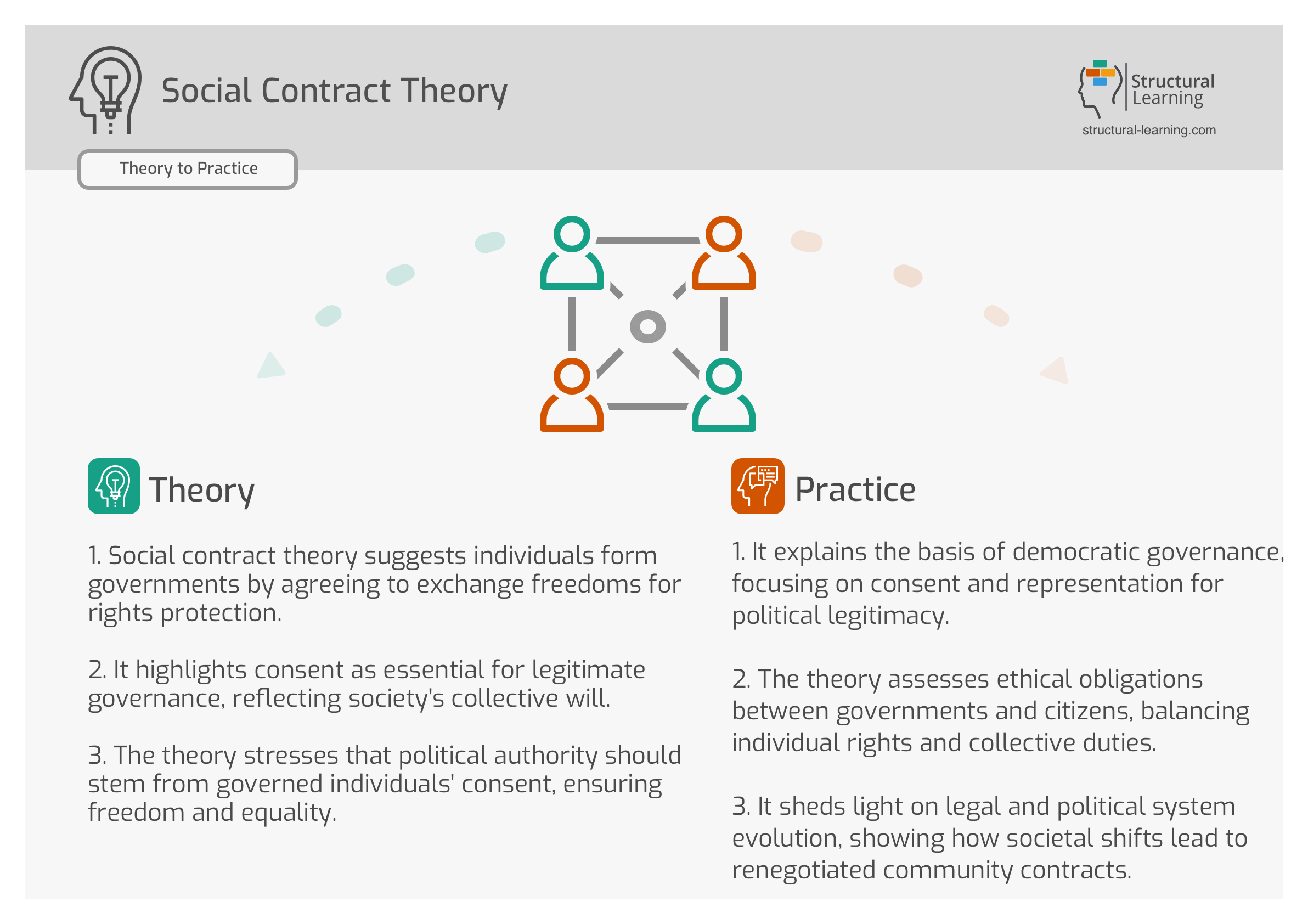
However, this raises an obvious and difficult question. You and I never signed a literal contract. So how can we be said to have consented? Philosophers address this with the idea of tacit consent. The argument is that by choosing to live within a state's borders, enjoying the benefits it provides (like safe roads, police protection, and national defense), and participating in its society, we implicitly or tacitly agree to abide by its laws and accept its authority.
This idea of tacit consent is one of the most debated aspects of the theory and a major point of attack for critics, as we'll see later in the course.
Social Contract Theory: Hobbes, Locke, and the State of Nature
The problem of consent is a major hurdle for social contract theory. This short reading from 1000-Word Philosophy explores the challenge of "tacit consent."
Please read the "Conclusion" section, beginning from the start of section 3. Focus on Locke's own acknowledged difficulty with defining tacit consent and the subsequent critique of whether simply receiving benefits truly counts as voluntary agreement.
Conclusion
In this lesson, we have explored the social contract, the most prominent theory for justifying the state's authority. We have seen how it frames the state as a solution to the problems of a hypothetical "state of nature."
Here are the key takeaways:
- Social contract theory argues that the state's authority is justified because rational individuals would voluntarily agree to form a government to escape the chaos or inconvenience of the state of nature.
- This agreement, or contract, gives the state its legitimacy because its power is based on the consent of the governed.
- Thomas Hobbes argued for an absolute sovereign to maintain order at all costs, believing we give up most of our rights for security.
- John Locke argued for a limited government whose only purpose is to protect our pre-existing natural rights to life, liberty, and property. This government can be justifiably overthrown if it violates the contract.
- The theory relies on the concept of tacit consent to explain how people who never signed a contract can be bound by it, a point of significant controversy.
We've now established the mainstream justification for the state: it exists by our consent to protect us and our rights. But the terms of this protection often revolve around the concept of "freedom." What exactly does it mean to be free? In our next lesson, we will dissect this crucial idea by distinguishing between two types of liberty: negative liberty and positive liberty. This distinction is vital for understanding the specific kind of freedom that libertarians believe the state should, at most, be concerned with protecting.