Recommended resources
The freely available resources this lesson will direct you to.
Introduction
In our first lesson, we established that political philosophy is the rigorous, questioning discipline that asks how we ought to live together. We saw that it grapples with fundamental questions about power, justice, and the purpose of government. This provides the intellectual framework for evaluating any political ideology.
Today, we will delve into one of the most powerful and essential concepts in all of political thought: rights. The idea of rights is a cornerstone for answering the questions we raised last time. It provides a way to define the relationship between individuals and the state, drawing lines that power should not cross. For our study of libertarianism, a solid grasp of this concept is non-negotiable, as the entire ideology is built upon a particular theory of rights.
By the end of this lesson, you will be able to explain what a right is in the philosophical sense and, most importantly, distinguish between the two major categories: natural rights and legal rights. This distinction is a fundamental fault line in political thought and will be critical for everything that follows.
What Is a Right?
Before we can compare different types of rights, we must first have a clear definition of what a right is. In everyday language, we use the term in many ways, but in political philosophy, it has a more precise meaning.
At its core, a right is an entitlement. It is a claim that an individual can justifiably make. This entitlement can be to perform an action, to be free from certain actions, or to be in a particular state.
A crucial aspect of this concept is that for every right, there is a corresponding duty. If you have a right to something, then others have a duty to respect that right. This relationship between rights and duties creates a structure of obligations within a society.
To explore this definition more deeply, let's watch a short video that clarifies the concept of a right and introduces the right/duty connection.
The video "Understanding Law and Rights" from the Allversity channel provides a concise explanation of what a right is and its connection to duty.
Please watch the section from this timestamp. Pay close attention to the definition of a right as an entitlement and the example used to illustrate the corresponding duty.
As the video explains, your right to speak your mind implies a duty on others not to forcibly stop you. At the same time, your right does not impose a duty on others to listen to you or agree with you. Understanding this reciprocal relationship is key. A right isn't just a personal claim; it's a claim that imposes a specific kind of obligation on others.
Natural Rights vs. Legal Rights
Now we arrive at the central distinction of our lesson. While all rights are entitlements, their source and nature can be understood in two fundamentally different ways. This leads to the two main categories: natural rights and legal rights.
The same video we just watched provides an excellent introduction to this division, framing it within the broader concepts of natural law and positive (man-made) law.
This segment of the video lays out the foundational difference between ideas of law and rights that are derived from nature or reason, and those that are created by human societies.
Watch the portion of the video from the beginning. The first part discusses natural law vs. positive law, and the second part applies that same structure directly to natural rights vs. legal rights.
Let's break down what you just watched and add some detail.
Natural Rights
Natural rights are considered to be universal and inherent. They are not granted by any government, law, or social custom. Instead, they are thought to belong to human beings simply by virtue of their nature—because they are human. Proponents of natural rights believe these rights are discoverable through reason and exist independently of whether they are recognized or written down.
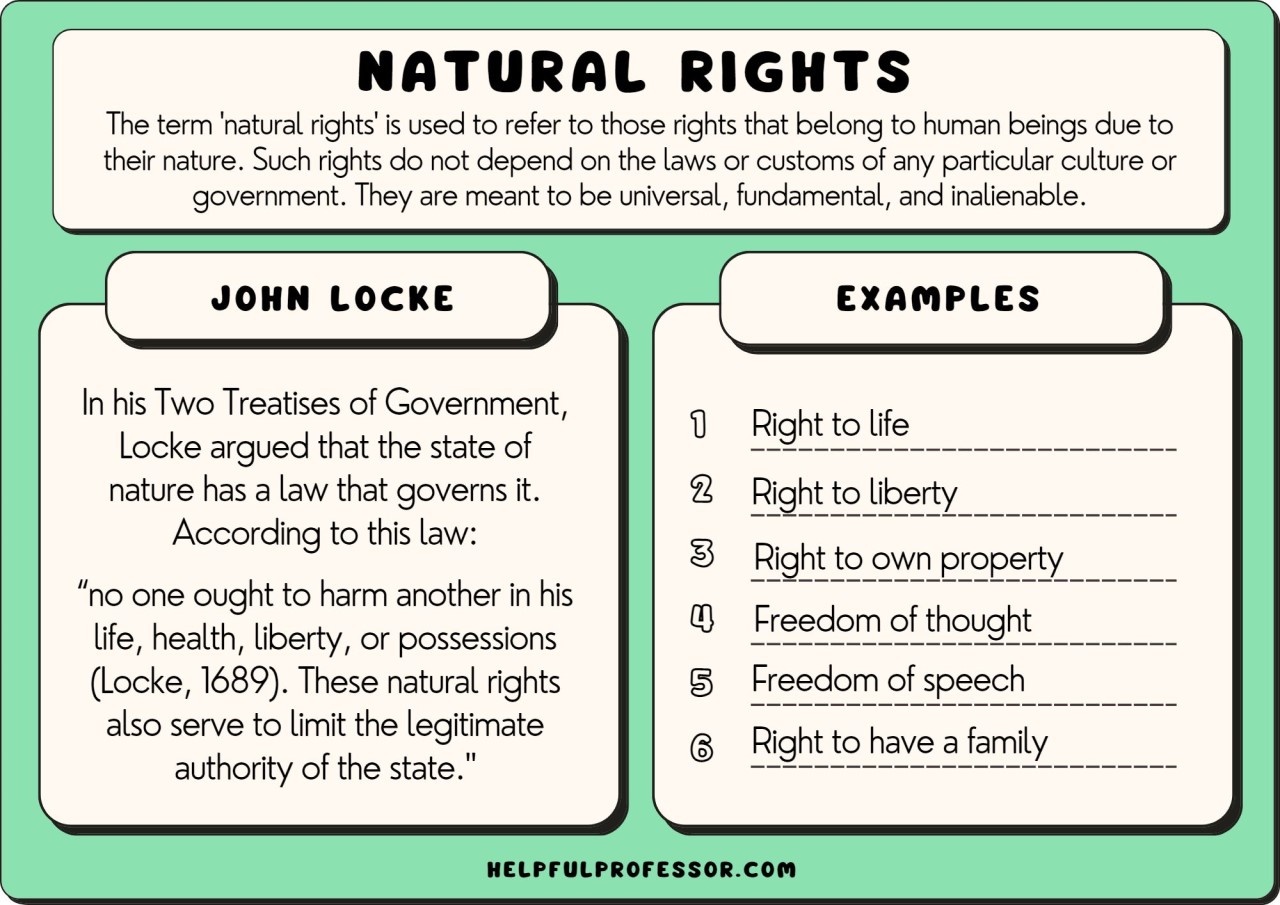
The core characteristics of natural rights are:
- Inherent: You are born with them.
- Universal: They apply to all people, everywhere, at all times.
- Inalienable: They cannot be taken away or given away.
Classic examples, as noted in the infographic, include the rights to life, liberty, and property.
Exploring the Different Types of Rights: Natural, Moral, Legal, and ...
This article from the Political Science Institute offers clear definitions and examples of natural rights.
Please read the first three sections, from "The inherent entitlements" through "Examples of natural rights". This will reinforce the definition and connect it to its philosophical origins.
Legal Rights
In contrast, legal rights (also sometimes called "positive rights" in this context) are entitlements that are granted by a specific legal system. They are man-made, codified in laws, constitutions, or statutes, and enforced by the state.
Unlike natural rights, legal rights are not universal. They are specific to a particular society at a particular time. They can be created, modified, or abolished through the political and legal process.
Exploring the Different Types of Rights: Natural, Moral, Legal, and ...
Let's continue with the same article to get a clear picture of legal rights and their different categories.
Now, please read the section titled "Legal rights: Enforceable by law", including the subsections on civil, political, and economic rights.
As the article details, examples of legal rights include:
- The right to vote in an election.
- The right to a fair trial.
- The right to a minimum wage or social security (in countries that have such laws).
Three Key Differences Systematized
We now have working definitions for both types of rights. To solidify your understanding, it is helpful to organize their differences into a clear structure. An excellent article from the law firm Cobb Defense lays out three fundamental points of contrast.
How Natural Rights Differ From Legal Rights: 3 Key Points
This article provides a systematic comparison of natural and legal rights, focusing on their origins, enforcement, and permanence.
Please read the article from the beginning, focusing on the three main sections: Origin and Nature, Enforcement and Protection, and Permanence vs. Changeability.
Let's summarize the three key distinctions you just read about:
- Origin: Natural rights originate from human nature or reason and are considered pre-political. Legal rights originate from a government or legal code.
- Enforcement: Legal rights are enforced by formal institutions like courts and police, with clear penalties for violations. Natural rights, when not codified into law, rely on moral consensus, social pressure, and activism for their defense.
- Permanence: Natural rights are held to be constant and inalienable. Legal rights are changeable and can be granted or revoked by the same legal processes that created them.
The Tension Between Natural and Legal Rights
This distinction is not merely an academic exercise. The relationship between natural and legal rights is a central source of tension in political philosophy and real-world politics.
Many political movements, such as the American Revolution or the Civil Rights Movement, were fueled by the argument that the laws of the land (legal rights and prohibitions) were in conflict with the fundamental natural rights of the people. In these cases, natural rights were used as a moral standard to judge and challenge the legitimacy of existing laws.
However, the two are not always in conflict. Many legal rights are attempts to codify and protect natural rights. For example, the First Amendment to the U.S. Constitution, which grants the legal right to freedom of speech, can be seen as the legal system's attempt to protect what many believe is a pre-existing natural right to express oneself.
This brings up a debate between two major schools of thought.
- Natural Law Theory: Argues that for a law to be valid, it must be just and align with natural rights. An unjust law, in this view, is not a true law at all.
- Legal Positivism: Argues that a law is valid simply if it has been enacted through the proper legal procedures, regardless of its moral content.
The following video succinctly explains the pros and cons of relying on each type of framework.
Legal positivism versus natural law
The video "Legal positivism versus natural law" by Dr. Wernaart clearly outlines the two opposing viewpoints and their practical implications.
Please watch from the beginning of the video. This will clarify the core conflict and highlight the trade-offs between legal certainty (positivism) and inherent justice (natural law).
As you can see, there is a trade-off. A system based purely on written, legal rights provides certainty and predictability. We can simply read the law to know our rights. However, it risks creating a system where profoundly unjust laws are considered legitimate. Conversely, a system based on unwritten, natural rights provides a powerful moral compass but can be vague and lead to disagreements about what those rights are and what they require.
Conclusion
In this lesson, we have unpacked the crucial concept of rights. We began by defining a right as an entitlement that creates a corresponding duty on others. From there, we explored the fundamental distinction between natural and legal rights.
Here are the key takeaways:
- Natural rights are thought to be universal, inherent, and inalienable, deriving from human nature itself. Key examples include life, liberty, and property.
- Legal rights are created and granted by a specific legal system. They are enforceable by the state but can be changed or revoked. Examples include the right to vote and the right to a fair trial.
- The two types differ fundamentally in their origin, enforcement, and permanence.
- The relationship between them is often one of tension, with natural rights serving as a moral standard by which to judge man-made laws. This tension is a driving force in political history and debate.
This distinction is the bedrock for much of what we will discuss. Libertarianism, in its most common form, is a political philosophy founded squarely on a theory of natural rights.
In our next lesson, we will turn our attention to the other side of the political coin. Having just discussed rights, which limit power, we will now define the state—the primary institution that wields power in modern society. Understanding what the state is and what it does is the next essential step toward analyzing the libertarian argument for strictly limiting its reach.