Recommended resources
The freely available resources this lesson will direct you to.
Introduction
In our last lesson, we built the essential skill of identifying the subtle yet damaging microaggressions that can occur in a tech workplace. You learned to recognize the link between unconscious bias and these behaviors, and you now have a clear framework for categorizing them. This awareness is the foundation, but it's only the first step.
This lesson moves us from recognition to response. The goal is to apply a framework for responding to microaggressions in real-time. Knowing what to do when you are interrupted, patronized, or have your expertise questioned is a powerful tool for self-advocacy and for shaping a more respectful environment. We will explore structured, memorable frameworks that you can adapt to your own style, giving you the confidence to address these situations constructively and professionally.
1. The Strategic Pause: To Respond or Not to Respond?
The first, and perhaps most critical, part of any response is deciding if and how you want to engage. Reacting to every microaggression can be emotionally and mentally exhausting. The goal is not to police every conversation but to strategically protect your space and well-being. The choice to respond is yours alone, and it should feel empowering, not obligatory.
The Harvard Business Review article "When and How to Respond to Microaggressions" provides an excellent lens for this decision-making process.
When and How to Respond to Microaggressions
This article from HBR outlines the pros and cons of different response timings and introduces a model for deciding whether to engage. It frames the decision as a strategic choice.
First, read the section that outlines the three main ways to react, from the three main ways, to understand the trade-offs of each approach (letting it go, responding immediately, or responding later). Then, focus on the section titled "Discern," beginning with the sentence "Determine how much of an investment". This section encourages you to consider your energy levels, the context, and your desired outcome before acting.
As the article suggests, before you say or do anything, take a mental moment to "discern." Ask yourself:
- Is this worth my energy right now? You are not obligated to educate others at the expense of your own peace or productivity.
- What is the potential outcome? Is the person likely to be receptive? Is this a pattern that needs addressing, or a one-off comment you can let slide?
- Is this the right time and place? Sometimes, a public, immediate response is effective. Other times, a private conversation later is more constructive.
Choosing not to respond is a valid and sometimes powerful choice. It can be an act of self-preservation. If you do choose to respond, having a plan is essential.
2. A Memorable Blueprint: The ACTION Framework
When you're caught off guard by a comment, it's hard to formulate a thoughtful response on the spot. This is where a simple, memorable framework becomes invaluable. One of the most effective is the ACTION framework, which breaks down the response into six manageable steps.

Let's explore each part of this framework in more detail.
[PDF] A Framework for Responding to Disruptions and Microaggressions
This guide from Penn State's Schreyer Institute for Teaching Excellence provides a detailed breakdown of the ACTION framework, complete with practical, adaptable phrases for each step.
Please read the entire section from the beginning down to the "Additional Phrases" part. As you read, focus on the sample sentences provided for each step of the ACTION acronym: ACTION steps and examples.
As you've just read, the framework guides you through a structured conversation:
- A - Ask clarifying questions: This is a non-confrontational opening. It gives the other person a chance to reflect and possibly self-correct. "I want to make sure I understand, were you saying that...?"
- C - come from Curiosity, not judgment: Using a curious tone can lower defensiveness. "I'm curious why you asked that question." or "Can you help me understand what you meant by that?"
- T - Tell the facts: State what you observed in a neutral, factual way. "I noticed that you interrupted me while I was explaining the bug."
- I - explain the Impact: This is the most crucial step. It shifts the focus from their intent (which may have been harmless) to the impact of their words or actions. "When you ask where I'm 'really' from, it makes me feel like you don't see me as a true member of the team."
- O - Own your thoughts and feelings: Use "I" statements to express your reaction. This is your subjective experience and is difficult to argue with. "When I hear that comment, I feel uncomfortable."
- N - discuss Next steps: This moves the conversation toward a productive resolution. "I'd appreciate it if we could ensure everyone gets to finish their updates without interruption."
The power of ACTION is that it's not an aggressive script. It's a method for opening a dialogue, explaining the impact of a behavior, and establishing a boundary.
3. Expanding Your Toolkit: Alternative Strategies
The ACTION framework is a great all-purpose tool, but it's not the only one. Different situations and personal styles may call for different approaches. It's useful to have a "menu" of options.
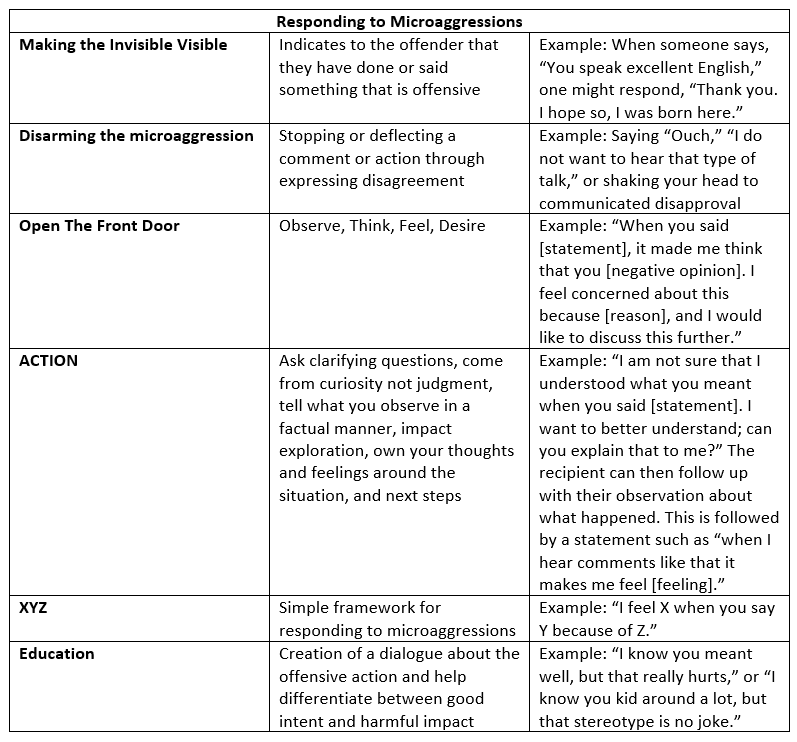
Notice the variety here. Some other concise and effective models include:
- Disarming: A simple "Ouch" or shaking your head can communicate disapproval non-verbally and immediately, stopping a comment in its tracks without a full conversation.
- The XYZ Formula: This is a compact way to express the core of the ACTION framework: "I feel X when you do Y because of Z."
- Example: "I feel frustrated (X) when I'm interrupted in meetings (Y) because it prevents me from sharing critical information with the team (Z)."
The HBR article you reviewed earlier also contains two excellent tactical concepts that can be used alone or with the ACTION framework.
When and How to Respond to Microaggressions
This article also provides tactical advice for managing the conversation itself, focusing on lowering defensiveness and using questions to prompt reflection.
Please read the two sections titled "Disarm" and "Defy." Disarm focuses on acknowledging the potential awkwardness to invite a more open dialogue. Defy explains how to use probing questions to shift the focus from intent to impact.
The "Disarm" and "Defy" tactics are powerful.
- Disarming ("I know this might be awkward to discuss, but...") signals that you're aiming for a constructive conversation, not a fight.
- Defying with a question ("What did you mean by that?") puts the onus on the other person to examine their own words, which is often more effective than a direct accusation.
4. Application in Practice: Tech Workplace Scenarios
Let's translate this theory into real-world situations you might face as a software developer.
Scenario 1: The "Helpful" Re-explanation
You've just explained a complex part of the Spring Boot application in a team meeting. A male colleague immediately re-explains your point, using slightly different words, to the rest of the team ("So, to put it another way..."). This is a common microaggression that devalues your technical competence.
- Your Goal: Re-establish your authority without creating major conflict.
- Possible Response (mixing ACTION and Defy):
- Wait for him to finish.
- Use a calm, questioning tone: "Thanks for the summary. I'm curious, was there a part of my explanation that was unclear?" (This Asks a question and comes from Curiosity, while also Defying his implicit suggestion that your explanation was insufficient).
- Or, more directly: "Yes, that's another way of phrasing what I just outlined." (This is simple, factual, and subtly reclaims ownership).
Scenario 2: The "Surprising" Compliment
You submit a pull request for a challenging feature. The senior developer reviewing it comments, "Wow, this is surprisingly well-structured code." The word "surprisingly" is a microinsult, implying they had low expectations of your work.
- Your Goal: Address the implicit bias while acknowledging the positive feedback on your work.
- Possible Response (using ACTION's A & C):
- "Thanks for the feedback on the structure. Can you help me understand what was surprising about it?" (This Asks for clarification and uses a Curious tone). This invites them to reflect on their word choice and the assumptions behind it.
Scenario 3: The Interruption
You are in the middle of your daily stand-up update, explaining a blocker you've encountered with a database query, when a colleague cuts you off to suggest a solution.
- Your Goal: Immediately reclaim the floor and finish your thought.
- Possible Response (using a Disarming/Direct approach):
- Hold up a hand slightly. "Hold on, I'd like to finish my update first, then I'd love to hear ideas." (This is a firm but polite Next Step).
- Or, using Tell from ACTION: "I wasn't finished yet." Then, simply continue your sentence. The directness here is often all that's needed.
The key is to practice these phrases so they feel natural to you. You can even write down a few go-to sentences that align with your personality and keep them handy.
Conclusion
In this lesson, you have moved from a passive observer to an active participant in shaping your professional environment. You are now equipped with concrete, actionable strategies for responding to microaggressions in real-time.
Here are the key takeaways:
- Responding is a strategic choice. You have the power to "discern" if and when to engage based on your energy and desired outcome.
- The ACTION framework provides a reliable script: Ask, come from Curiosity, Tell the facts, explain the Impact, Own your reaction, and discuss Next steps.
- You have a toolkit of options. Beyond ACTION, simple disarming statements, the XYZ formula, and probing questions are also effective.
- Practice builds confidence. Rehearsing your response to common scenarios makes it easier to act effectively in the moment.
Mastering this skill is not about being confrontational; it's about clear, professional self-advocacy. This ability to set boundaries and communicate impact is a hallmark of a senior professional.
In our next lesson, we will leverage this theme of self-advocacy and apply it on a larger scale. We will focus on how to negotiate for promotions, raises, or project assignments using evidence-based arguments from your brag document, translating your daily contributions into tangible career growth.