Recommended resources
The freely available resources this lesson will direct you to.
Introduction
Welcome to the first lesson in our module on Career Strategy and Professional Branding. In the previous module, we focused on building your internal "operating system"—perfecting your productivity, knowledge management, and self-review protocols. Now, with that solid foundation in place, we shift our focus outward to strategically shape how you are perceived in the professional world.
This lesson tackles the foundational step of this process: defining a professional developer niche and crafting a personal brand statement that highlights your unique value. Just as a company needs a clear mission and value proposition, a developer aspiring to senior and leadership roles needs to move beyond being a "generalist coder" to being recognized for specific expertise. This brand statement will become the cornerstone of your career narrative, guiding how you update your LinkedIn profile, what you write about, and how you introduce yourself.
1. What is Personal Branding for a Developer?
First, let's dispel a common misconception. Personal branding for an engineer isn't about becoming a social media influencer. It's about consciously shaping your professional reputation so that the right opportunities—whether for a senior role, a promotion, or a leadership position—come to you. It’s the answer to the question, "Why should we hire or promote you over other candidates with similar technical skills?"
The following video from the freeCodeCamp Talks channel provides an excellent introduction to what a personal brand is for a software engineer and why it's a critical asset for career growth.
Personal Branding For Software Engineers
This video, "Personal Branding For Software Engineers," introduces the core concepts and benefits of building a professional brand.
Please watch from the beginning to the section on benefits. Pay close attention to the three key advantages the speaker discusses: Career advancement Building a reputation and trust Increasing your visibility for opportunities
As the video explains, your brand is what people say about you when you're not in the room. By being intentional, you can ensure that conversation is about the value and expertise you want to be known for.
2. Finding Your Niche: The Power of Specialization
The most effective personal brands are built on a foundation of specialized expertise, or a "niche." In a market where many developers have solid skills in popular technologies like Java, Spring Boot, and React, specialization is what makes you stand out. A generalist competes with everyone; a specialist is sought after for their specific knowledge.
This next video is a concise, powerful argument for why every software engineer needs a niche to move their resume to the top of the stack.
Stop applying for "software engineering job" without a niche.
This video, "Stop applying for 'software engineering job' without a niche," explains the strategic advantage of specialization and breaks down the different types of niches you can pursue.
Watch these two key segments: From the beginning, watch the introduction to understand why coding skills plus niche expertise is the formula for standing out. Next, watch the segment that breaks down the four categories of niches: industry, technical, constraint-based, and environment.
As the video outlines, you can create a powerful niche by combining these categories. Let's consider your background:
- Technical Skills: Java, Spring Boot, React, SQL
- Interests: Management, public speaking, teaching, art
Here are a few examples of potential niches you could build by combining these elements:
- Technical Niche: A full-stack developer specializing in modernizing legacy Java monoliths with scalable Spring Boot microservices and fresh React front-ends. This is a high-demand, high-value skill.
- Industry + Technical Niche: A software developer focused on the EdTech (Education Technology) industry. This would leverage your interest in teaching while applying your core Java/React skills.
- Constraint-Based + Technical Niche: An engineer who excels at building highly performant and observable APIs in the FinTech space, where latency and reliability are critical.
- "Meta" Niche: A developer who specializes in mentoring and upskilling backend engineers on topics like clean architecture and test-driven development in Java/Spring Boot. This directly leverages your interests in teaching and public speaking.
Choosing a niche is a strategic decision. It should be an area that is in demand, aligns with your skills, and, crucially, holds your interest for the long term.
3. Crafting Your Personal Brand Statement
Once you've identified a potential niche, the next step is to distill it into a clear, concise personal brand statement. This is your professional "elevator pitch." It communicates who you help, what result you deliver, and how you do it uniquely.
A great visual model for this is the Personal Brand Statement Pyramid.

To turn this model into a practical formula, we can use the positioning statement framework suggested in an article from Educative.io, which you will find very useful.
How to build a personal brand as a software engineer - Educative.io
This article provides a superb, actionable framework for defining the foundation of your brand.
In the article, find the section "1. Build your foundation." Focus on the subsection Positioning that sticks. The key takeaway is this one-line formula: I help [who] achieve [outcome] using [skill/topic] with [proof/point of view].
Let's break this down using one of the niche examples from before:
- Who: "engineering teams at mid-sized SaaS companies"
- Outcome: "reduce technical debt and ship features faster"
- Skill/Topic: "modernizing their legacy Java applications"
- Proof/Point of View: "with pragmatic microservice refactoring and a focus on developer enablement."
Putting it all together: "I help engineering teams at mid-sized SaaS companies reduce technical debt and ship features faster by modernizing their legacy Java applications with pragmatic microservice refactoring and a focus on developer enablement."
This statement is specific, confident, and clearly articulates your value beyond just "writing code." It positions you as a problem-solver with a strategic perspective.
Finally, remember that your statement can be styled in different ways to reflect your personality and the specific role you're targeting.
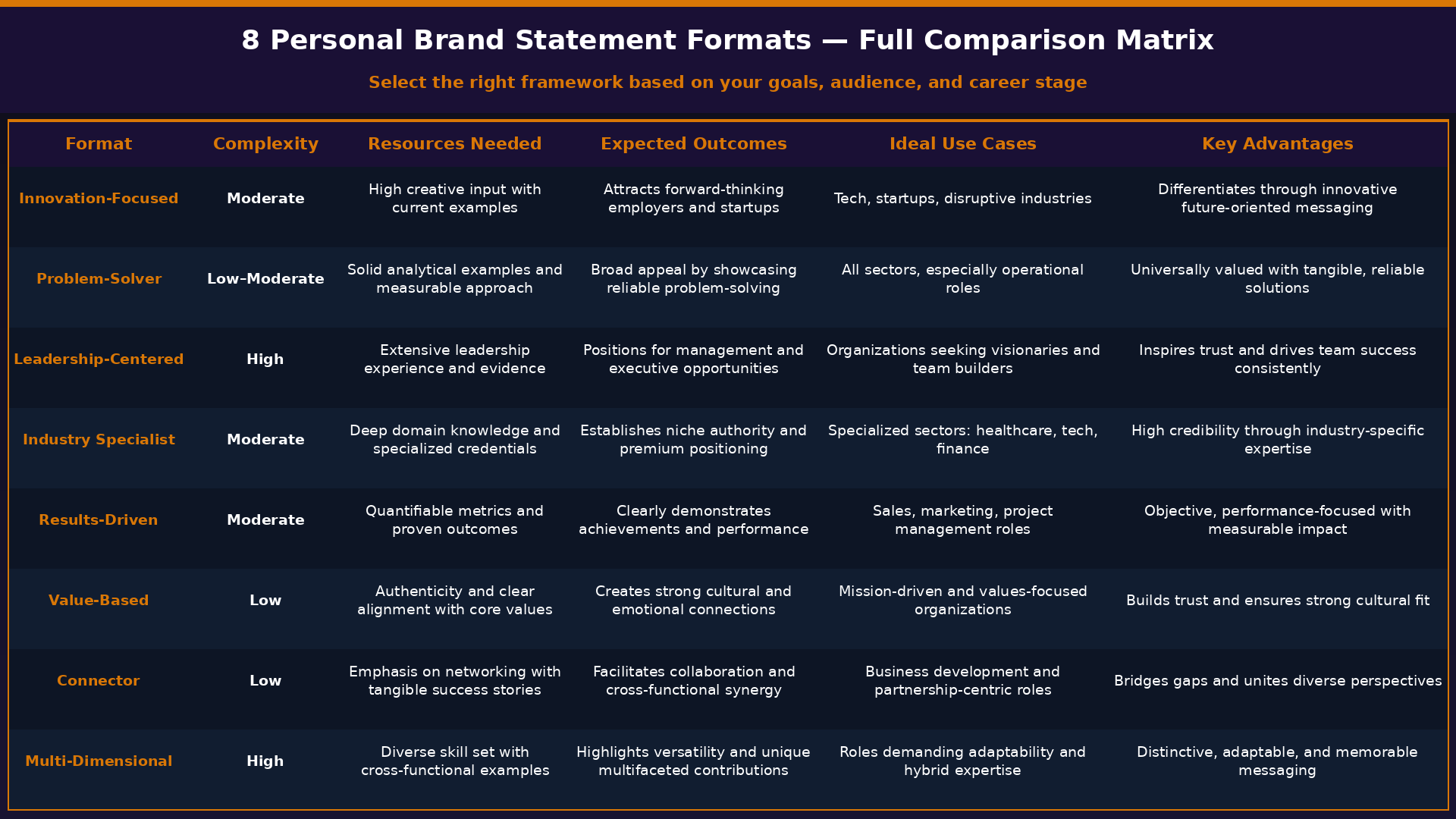
For example, the statement above is a strong Problem-Solver format. If you were leaning into your teaching interest, you might frame it in a more Value-Based way, emphasizing mentorship and team growth.
Practical Application: Define Your Niche and Draft Your Statement
Now it's your turn to apply these concepts. This exercise will guide you through creating the first version of your personal brand statement. Open a note in your Obsidian vault to document your work.
1. Niche Brainstorm (10 mins)
- Based on the four categories (Industry, Technical, Constraint, Environment), list 3-5 potential niches that genuinely interest you. Combine your technical skills (Java, React) with your passions (teaching, management, art). Don't filter yourself—just write them down.
2. Niche Evaluation (10 mins)
- Pick your top 2-3 niches from the brainstorm. For each one, evaluate it using the "Niche Scorecard" criteria mentioned in the "Stop applying..." video (LINK):
- Demand: Are companies hiring for this? (A quick LinkedIn Jobs search will tell you).
- Rarity: How many other people have this specific combination of skills?
- Moat: How difficult is it to acquire this expertise?
- Profitability/Proof: Can you demonstrate this skill with a project or past experience?
- Enjoyment: Are you genuinely interested enough to become an expert in this?
- Based on this analysis, select one niche to focus on for now.
3. Component Breakdown (10 mins)
- Using your chosen niche, fill in the blanks for the "Personal Brand Statement Pyramid":
- Target Audience (Who do I help?): ___________________
- Desired Result (What outcome do I create?): ___________________
- Unique Method (How do I do it?): ___________________
4. Draft Your Statement (10 mins)
- Use the formula
I help [who] achieve [outcome] using [skill/topic] with [proof/point of view].to write a complete, one-sentence brand statement. - Write at least two different versions. Play with the wording until it feels both powerful and authentic.
5. Refine and Style (5 mins)
- Review your draft statement. Look at the 8 Personal Brand Statement Formats image. Which format does your statement most closely resemble? Could you rephrase it slightly to better align with a format like "Industry Specialist" or "Results-Driven" to make it even stronger?
Conclusion
In this lesson, you have taken the critical first step in building a powerful career strategy. You've moved beyond the mindset of a generalist developer and started thinking like a specialist who offers unique, targeted value.
Here are the key takeaways:
- Personal branding is strategic reputation management, not just self-promotion. It's about ensuring your expertise is visible to the right people.
- A niche is your competitive advantage. Specialization moves you from being a commodity to being a sought-after expert.
- A personal brand statement is your value proposition in a single sentence. It clearly communicates who you serve, the results you deliver, and what makes you unique.
The statement you drafted today is a living document; it will evolve as you gain more experience. However, it now provides the essential message for all your professional communication.
In our next lesson, we will put this statement into action. We will focus on how to optimize your LinkedIn profile with a keyword-rich headline, about section, and experience to maximize recruiter visibility. Your newly crafted brand statement will be the engine that powers your entire profile.