Recommended resources
The freely available resources this lesson will direct you to.
Hello! In our previous lessons, we've focused on using two pointers to define a "sliding window"—a contiguous subarray whose properties we analyze. You've become adept at expanding and contracting this window to solve problems like finding the minimum substring that meets certain criteria.
Today, we're going to pivot to a different, equally powerful application of the two-pointer pattern: partitioning. Instead of just observing a subarray, we'll use pointers to actively rearrange an array's elements in-place. The goal is to group elements into distinct regions based on a chosen condition. This is a fundamental technique you'll encounter frequently, both as a standalone problem and as a building block for more complex algorithms like Quicksort.
By the end of this lesson, you will be able to partition an array into distinct regions using several different pointer strategies, and you'll understand which strategy to apply based on the problem's constraints.
Two-Way Partitioning: Inward-Moving Pointers
Let's start with the most straightforward type of partitioning. Imagine you're given an array of numbers and asked to move all the even numbers to the left side and all the odd numbers to the right side. The relative order of the even numbers among themselves doesn't matter, and the same goes for the odd numbers.
This is a classic partitioning problem. The core idea is to establish two "regions" in the array: an "even" region on the left and an "odd" region on the right. We can do this efficiently with two pointers starting at opposite ends of the array.
- A
leftpointer starts at the beginning. Its job is to find the first odd number, which is "misplaced" in the even region. - A
rightpointer starts at the end. Its job is to find the first even number, which is "misplaced" in the odd region.
Once both pointers have found a misplaced element, we simply swap them. This places both numbers in their correct respective regions. We then continue moving the pointers inward until they meet or cross, at which point the array is fully partitioned.
The following resource from Algo.monster provides an excellent explanation of this logic for the "Sort Array By Parity" problem.
905. Sort Array By Parity - In-Depth Explanation
This guide will walk you through the intuition, algorithm, and a concrete example of partitioning an array using inward-moving pointers. It provides the kind of clear, step-by-step breakdown that helps build confidence and avoid common errors.
Please read the following parts: Start with the Intuition section to understand the core concept. Next, study the Solution Approach, which formalizes the pointer movement and swapping logic into a clear algorithm. Finally, trace the algorithm's execution with the Example Walkthrough. This will solidify your understanding of how the pointers and array state evolve.
The partitioning logic you've just reviewed is a cornerstone of many algorithms. For example, the famous Quicksort algorithm uses this exact mechanism to partition an array around a "pivot" value.
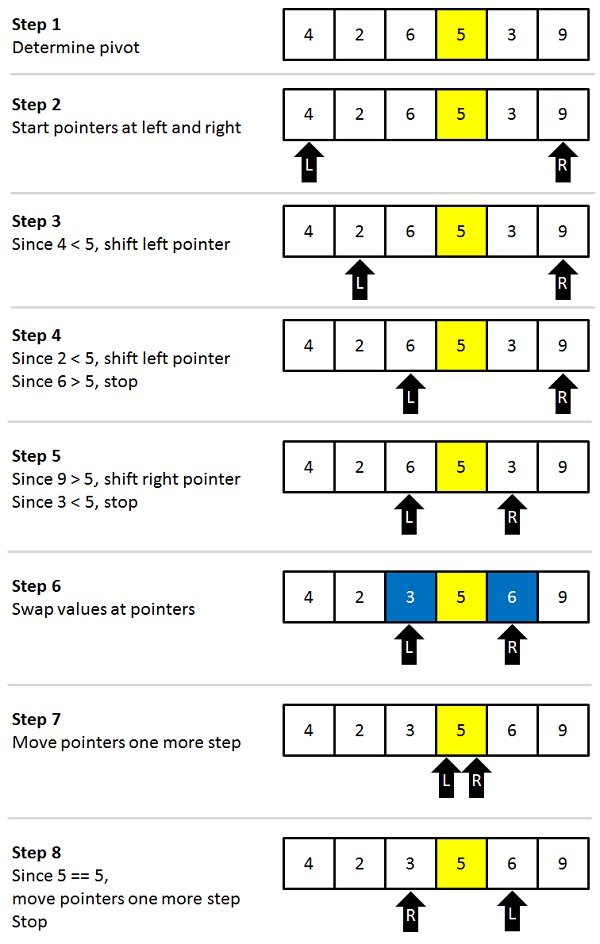
Here is the TypeScript implementation from the resource you read. It cleanly translates the logic of advancing pointers for "correctly placed" elements and swapping "misplaced" ones.
function sortArrayByParity(nums: number[]): number[] {
    let leftIndex: number = 0;
    let rightIndex: number = nums.length - 1;

    while (leftIndex < rightIndex) {
        // If left element is even, it's in the right place. Move on.
        if (nums[leftIndex] % 2 === 0) {
            leftIndex++;
        }
        // If right element is odd, it's in the right place. Move on.
        else if (nums[rightIndex] % 2 === 1) {
            rightIndex--;
        }
        // Otherwise, left is odd and right is even. They are misplaced. Swap them.
        else {
            [nums[leftIndex], nums[rightIndex]] = [nums[rightIndex], nums[leftIndex]];
            leftIndex++;
            rightIndex--;
        }
    }
    return nums;
}
This pattern is highly efficient, running in time with space, as it only requires a single pass and modifies the array in-place.
Partitioning While Maintaining Relative Order
Now, let's add a constraint. What if you need to partition an array, but the relative order of the elements within one of the partitions must be preserved?
Consider the "Move Zeroes" problem: given an array, move all 0s to the end while maintaining the relative order of the non-zero elements.
For [0, 1, 0, 3, 12], the result must be [1, 3, 12, 0, 0]. Note that 1, 3, and 12 appear in the same order as they did in the original array. The inward-moving pointer approach from before won't work here, because swapping an element from the end (like 12) with a zero at the beginning would break the relative order.
We need a different pointer strategy. A common solution uses two pointers that move in the same direction:
- A write pointer (let's call it
k) marks the end of the "processed non-zero" region. It indicates the next position where a non-zero element should be placed. - A read pointer (let's call it
i) iterates through the entire array from left to right.
As the read pointer i scans the array, if it encounters a non-zero element, it swaps that element with the one at the write pointer's position k, and then k is incremented. This effectively collects all non-zero elements at the beginning of the array, in the order they were found.
This article from Algo.monster provides a fantastic analogy and a clear walkthrough.
283. Move Zeroes - In-Depth Explanation
This resource explains the same-direction pointer strategy, which is crucial for partitioning problems where relative order matters.
Please read the following sections: The Intuition section introduces a great "bookshelf" analogy to make the logic clear. The Solution Approach and Algorithm Steps formalize this into a single-pass algorithm. Finally, the Example Walkthrough visualizes how the pointers work together to solve the problem.
As you saw, the key is to focus on placing the "desired" elements (the non-zeros) correctly. The "undesired" elements (the zeros) naturally end up in the remaining space. This single-pass swap-based approach is both elegant and efficient.
Three-Way Partitioning: The Dutch National Flag Problem
We've partitioned an array into two regions. Can we do it for three?
Absolutely. This is the basis of the famous Dutch National Flag problem, first proposed by Edsger Dijkstra. Given an array containing only the numbers 0, 1, and 2, sort it in-place. The final array should have all the 0s first, then all the 1s, and finally all the 2s.
This requires partitioning the array into three distinct regions:[region of 0s | region of 1s | region of unknowns | region of 2s]
To manage these regions, we use three pointers:
low: Marks the boundary after the0s region.mid: The current element under consideration. It scans through the "unknown" region.high: Marks the boundary before the2s region.
The algorithm iterates as long as mid <= high:
- If
nums[mid]is a0: It belongs in thelowregion. We swapnums[mid]withnums[low]and increment bothlowandmid. - If
nums[mid]is a1: It's in the correct middle region (for now). We don't need to move it, so we just incrementmidto examine the next element. - If
nums[mid]is a2: It belongs in thehighregion. We swapnums[mid]withnums[high]and decrementhigh. Crucially, we do not incrementmidbecause the new element atnums[mid]came from thehighboundary and we haven't processed it yet.
This video provides an excellent animated explanation of this algorithm.
Sort Colors (LeetCode 75) | Dutch National Flag Problem | Full Solution with Visuals and Animations
This video visually breaks down the three-pointer logic for the Dutch National Flag problem. The animation makes the movement of pointers and regions very easy to follow.
Please watch these two segments: First, understand the problem setup from the problem explanation. Then, watch the core algorithm animation from the three-pointer solution. Focus on how the start (low), middle, and end (high) pointers interact based on the value of the middle element.
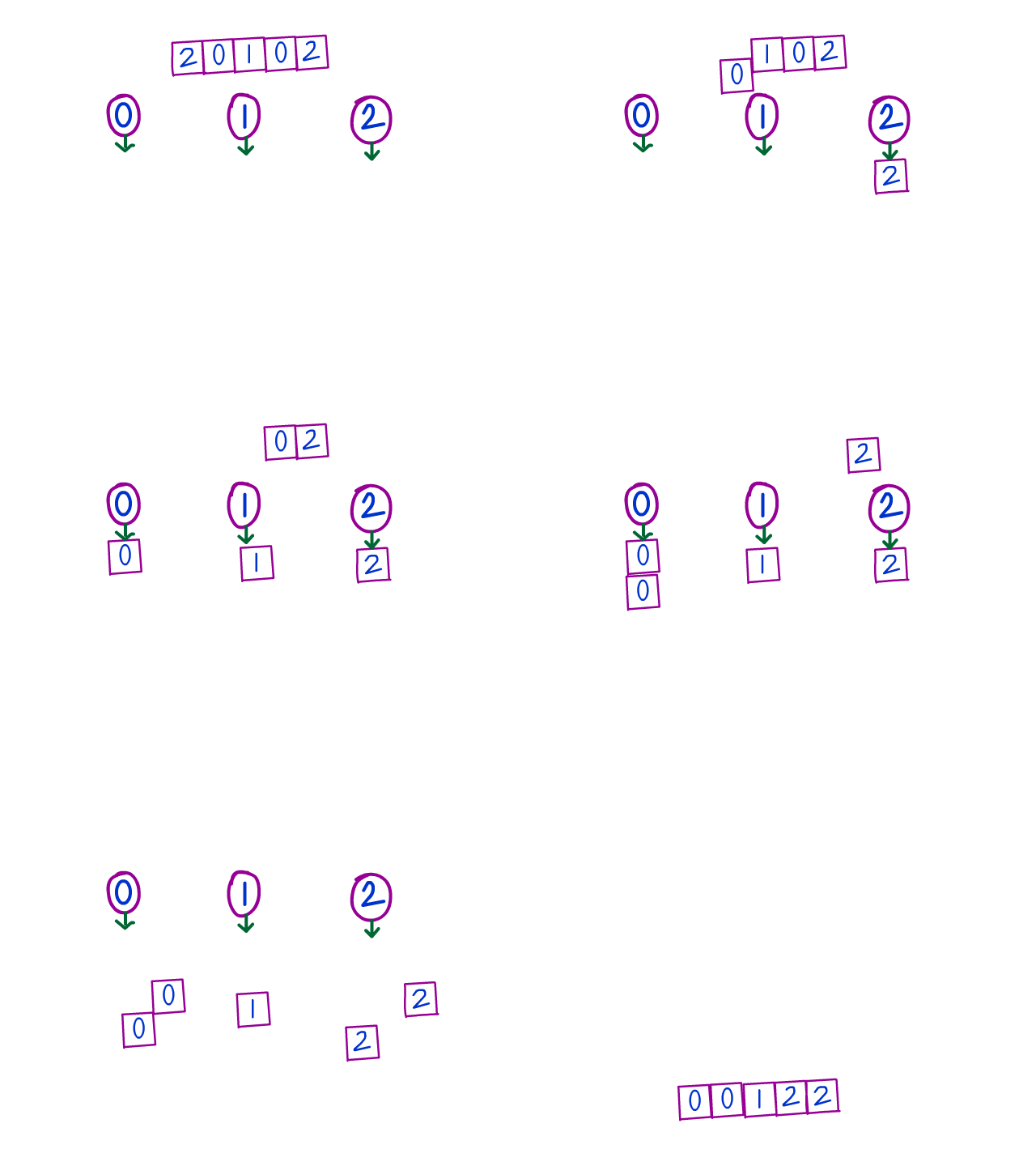
The animated GIF below provides a quick summary of the process you just watched. The three pointers methodically shrink the "unknown" region from both sides until the array is fully sorted.
Conclusion
In this lesson, you've added several powerful partitioning strategies to your algorithmic toolkit. You've moved beyond using pointers to simply define a window and are now using them to efficiently reorganize arrays in-place.
Key Takeaways:
- Partitioning is the process of rearranging an array into distinct regions based on a condition.
- For two-way partitioning where relative order is unimportant (e.g., evens/odds), use inward-moving pointers from opposite ends of the array.
- When relative order must be preserved, use same-direction pointers (a "read" pointer and a "write" pointer) to collect elements into their new positions.
- For three-way partitioning (e.g., sorting
0s,1s, and2s), the Dutch National Flag algorithm withlow,mid, andhighpointers is the standard, efficient approach.
The crucial skill is to identify the problem's constraints—how many partitions are needed, and does relative order matter?—to select the correct pointer strategy.
In our next and final lesson of this module, we will synthesize what you've learned. You'll practice how to choose between hashing, two pointers, and a sliding window when presented with a problem, solidifying your pattern-recognition abilities.