Recommended resources
The freely available resources this lesson will direct you to.
Welcome back! In our last lesson, we introduced the powerful technique of tracking character frequencies and a "satisfaction count" within a sliding window. You saw how this allows us to efficiently check if a window meets complex criteria, like being a permutation of another string.
Today, we will formalize and master a crucial pattern built on that foundation: finding the minimum valid substring window. While you've already had a glimpse of the "Minimum Window Substring" problem, this lesson will focus specifically on the elegant expand-and-contract logic that allows us to find the shortest possible substring that satisfies a set of requirements. This is a common and important interview pattern, and understanding its mechanics is key to solving a wide range of problems.
The Minimum Window Substring Problem
Let's begin by clearly defining the problem we'll be working with.
Given two strings,
sandt, find the minimum contiguous substring ofswhich contains all the characters oft. The frequency of characters in the substring must be greater than or equal to their frequency int.
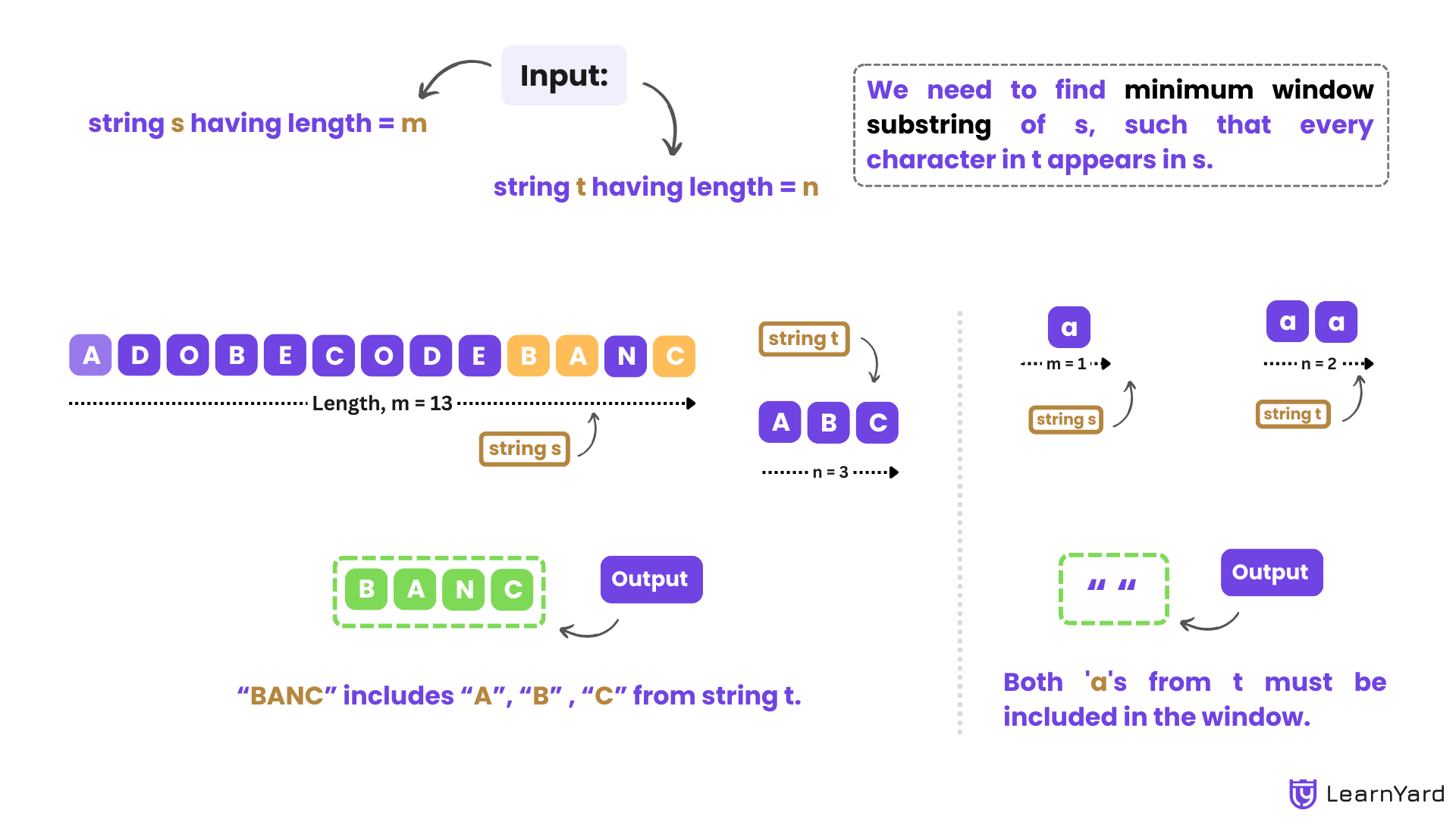
The image below illustrates this. We have a long string s and a shorter string t. The goal is to find the smallest possible "window" in s that contains all the characters from t. Notice that t can have duplicate characters, and the window must contain at least that many duplicates.
The brute-force approach—checking every single substring in s—would be far too slow, likely or worse, where is the length of s and is the length of `t). A sliding window offers a much more efficient path.
The Expand and Contract Rhythm
The core idea of the algorithm is a dynamic two-phase process:
- Expand: We grow the window by moving its right pointer. We keep expanding until the window contains all the required characters from
t. We'll call such a window "valid." - Contract: Once we have a valid window, we've found a potential answer. But is it the minimum? To find out, we shrink the window from the left, moving the left pointer inward. We keep shrinking as long as the window remains valid. Each time we shrink, we have a new, smaller, valid window, which might be our new best answer.
We stop shrinking the moment the window becomes invalid (i.e., it no longer contains all the required characters). At this point, the cycle repeats: we go back to expanding the right side to find the next valid window.
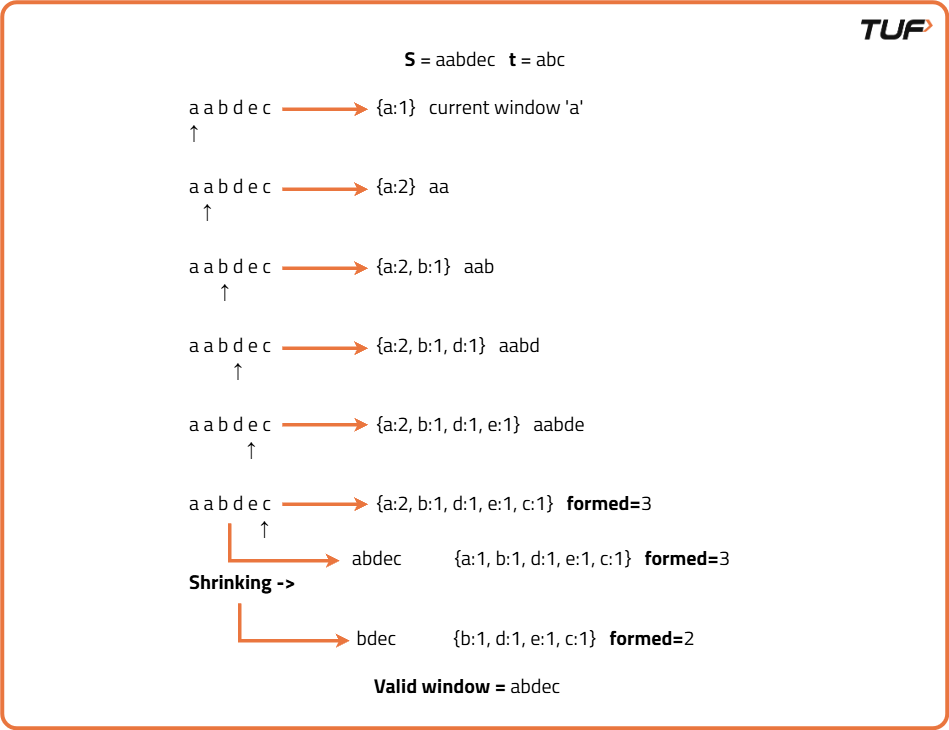
This image shows the process on a different example. The window first expands until it becomes valid ("abdec" contains a, b, and c). Then, it starts shrinking from the left.
The 'Have' vs. 'Need' Mental Model
In the last lesson, we introduced the concept of a satisfaction count. A very intuitive way to manage this for the minimum window problem is to track what you have versus what you need.
need: The number of unique characters intwhose frequency requirements we must satisfy.have: The number of unique characters in our current window that have met or exceeded their required frequency fromt.
The window is valid when have === need. This simple check is the trigger to switch from expanding to contracting.
The following video from NeetCode provides an excellent walkthrough of this logic. It starts by showing why a naive check is inefficient and then builds up the have/need optimization.
Minimum Window Substring - Airbnb Interview Question - Leetcode 76
Watch the following two segments. The first explains the core optimization of using have and need counters to track window validity in O(1) time. The second shows how to apply this logic to shrink the window once it becomes valid, which is the key to finding the minimum.
First, watch the explanation of the optimized approach, where the have and need variables are introduced to efficiently check if the window is valid. Then, watch how this logic is used to shrink the window from the left while recording the minimum length found so far.
The process described in the video can be summarized with the following logic structure:
This diagram shows the cycle: expand until valid (C), then enter the inner loop of updating the result (D) and contracting (E) until the window is no longer valid (F), at which point you go back to expanding.
A Detailed Walkthrough and Implementation
Now that you have the intuition, let's look at a detailed breakdown and a TypeScript implementation. The resource from Algo.monster provides a clear, step-by-step guide that formalizes the approach.
76. Minimum Window Substring - In-Depth Explanation
This guide will walk you through the algorithm's structure, trace it on our main example, and provide a clean TypeScript implementation.
First, read the Solution Approach section. Focus on the four main steps: Initialize, Expand, Contract, and Return. Pay close attention to the logic for updating the satisfaction count (cnt). You can find this under the heading "Solution Approach" or by looking for the phrase Key Algorithm Details. Next, follow the Example Walkthrough. This traces the pointers and variables for s = "ADOBECODEBANC" and t = "ABC". Seeing the window and cnt variables change step-by-step will solidify your understanding of the expand/contract cycle. This starts right after the Solution Approach section, with the text Let's walk through the algorithm. Finally, review the TypeScript implementation. You can find it under the "Solution Implementation" section. Connect the code back to the concepts: The outer for loop is the right pointer expanding. The inner while (matchedChars === targetLength) loop is the left pointer contracting. Note how minWindowLength and minWindowStart are used to track the best result seen so far.
The TypeScript implementation in that resource uses matchedChars and targetLength (total characters) instead of have and need (unique characters), but the underlying principle is the same. Both are valid ways to implement the satisfaction count. The have/need approach is often slightly simpler when dealing with duplicates, as you only increment have once per character type.
Common Pitfalls
When implementing this pattern, several subtle bugs can arise. Being aware of them is crucial, especially in an interview setting.
76. Minimum Window Substring - Solution & Explanation
NeetCode.io provides a concise list of common mistakes made when solving this problem. Please read this section carefully.
In the "Common Pitfalls" section, pay special attention to the points about Incorrect Validity Check Logic and Off-by-One Errors. These are exactly the kinds of details that distinguish a correct solution from a nearly-correct one.
Conclusion
You have now dissected one of the most versatile sliding window patterns. The ability to find a minimum window that satisfies complex criteria is a significant step up from basic fixed-size or simple variable-size windows.
Key Takeaways:
- Expand-Contract Cycle: The algorithm for minimum-length window problems follows a rhythm: expand the window with the right pointer until it's valid, then contract it from the left until it's invalid, updating your best result along the way.
- Nested Loop Structure: This logic is typically implemented with a
forloop for the right pointer and a nestedwhileloop for the left pointer. Thewhileloop only executes when the window is valid. - Efficient Validity Check: Using frequency maps and a satisfaction counter (like
have/needormatchedChars) allows the validity of the window to be checked in time at each step. - Linear Time Complexity: Because each character in the input string
sis visited at most twice (once by the right pointer and once by the left), the overall time complexity is , where and are the lengths of the stringssandt.
In our next lesson, we'll explore a different application of the two-pointers technique: partitioning an array. Instead of finding a contiguous subarray, we'll use pointers to rearrange elements within an array based on a specific condition. This will further broaden your toolkit for array manipulation problems.