Recommended resources
The freely available resources this lesson will direct you to.
- Data Structure and Algorithm Patterns for LeetCode Interviews – Tutorialwww.youtube.com
- Coding Interview Patterns - Sliding Window | 10 different problems in a single videowww.youtube.com
- Sliding Window & Two Pointers: Templates and Decision Framework | Expora Blogtryexpora.com
- Solving the LeetCode Two Sum Problem with JavaScript | John Kavanaghjohnkavanagh.co.uk
Welcome to the final lesson of our module on Two Pointers and Sliding Windows. In our previous sessions, we've explored the mechanics of hashing, two-pointer techniques, and sliding windows as individual tools. You've learned to count frequencies with hash maps, partition arrays with pointers, and find optimal contiguous subarrays with sliding windows.
Today, we'll take a step back and focus on a crucial meta-skill: pattern recognition. When you're faced with a new array or string problem in an interview, how do you decide which of these powerful techniques is the right one to apply? This lesson is all about building a mental framework to make that choice confidently and quickly. We will synthesize everything you've learned in the last two modules to help you move from knowing how each pattern works to knowing when to use it.
By the end of this lesson, you will be able to analyze a problem's constraints and keywords to strategically choose between hashing, two pointers, and a sliding window.
The Foundational Choice: Lookup vs. Traversal
At the highest level, the choice between these patterns often boils down to a single question: Are you tracking relationships between elements regardless of their position, or are you processing a sequence of adjacent elements?
-
Hashing (Maps and Sets) excels at the first task. Its strength lies in providing average time complexity for lookups, insertions, and deletions. This makes it ideal for problems where you need to remember what you've seen before, count occurrences, or find a "complement" to a value you're currently examining. The elements can be anywhere in the array; their adjacency is irrelevant.
-
Two Pointers and Sliding Windows excel at the second task. They are traversal patterns, designed to process a linear data structure (like an array or string) in a single pass, , avoiding the complexity of nested loops. Their power comes from intelligently moving indices based on specific conditions related to the sequence.
Distinguishing Pointers and Windows
Within the realm of traversal patterns, the distinction between Two Pointers and Sliding Window is critical. While a sliding window is technically a form of two pointers, their applications and pointer movements are distinct.

The most reliable way to distinguish them is to ask: Does the problem require analyzing a contiguous block of elements?
-
Sliding Window: If the answer is yes, you are almost certainly in sliding window territory. Problems that use keywords like "subarray," "substring," or ask for the "longest," "shortest," or "maximum sum" of a contiguous range are strong indicators for a sliding window. The two pointers (left and right) define the boundaries of this window, which moves as a single unit.
-
Two Pointers: If the elements being compared do not have to be adjacent, it's more likely a two-pointer problem. Classic applications involve a sorted array where pointers move from opposite ends to find a pair, or in-place partitioning where pointers manage different regions of the array.
The following blog post provides an excellent breakdown of these distinctions, complete with a comparison table and a list of keyword "signals" for each pattern. This is a crucial resource for building the pattern-recognition reflex.
Sliding Window & Two Pointers: Templates and Decision Framework | Expora Blog
This article clearly articulates the differences between the Two Pointers and Sliding Window patterns, which are often confused. It focuses on the key question that helps differentiate them and provides lists of common problem "signals" or keywords.
Please read the article from the beginning down to the end of the "Sliding Window signals" list. Pay close attention to the comparison table and the central question it poses: "Does the problem ask about a contiguous range of elements?". Also, study the lists of keyword signals for each pattern.
A Decision-Making Heuristic
Based on the reading and our prior knowledge, we can construct a simple decision tree to guide our choice when tackling a new problem.
This heuristic isn't absolute, but it's a powerful starting point. It forces you to ask the right questions about the problem's structure before diving into code.
Case Study: The "Two Sum" Problem
Let's apply this thinking to a classic interview problem: Given an array of integers nums and an integer target, return indices of the two numbers such that they add up to target.
How would we approach this using our framework?
- Contiguous? No. The two numbers can be anywhere. So, it's probably not a Sliding Window.
- Sorted? The problem doesn't say the array is sorted. We could sort it, which would point towards a Two Pointer solution.
- Value-based lookup? Yes. For each number
x, we are looking for its complement,target - x. This is a strong signal for Hashing.
This leaves us with two viable candidates: a Two Pointer approach (after sorting) and a Hashing approach. Which one is better? The following article analyzes both solutions for this exact problem.
Solving the LeetCode Two Sum Problem with JavaScript | John Kavanagh
This article provides clear, commented TypeScript code for solving the "Two Sum" problem using both a hash map and the two-pointer technique. It's a perfect case study for comparing the trade-offs between these two patterns.
First, read the section "Solution Using a Hash Map" to understand the most efficient approach for an unsorted array. Then, read about the alternative in the two-pointer section. Finally, the "Wrapping Up" section directly compares the two, discussing their time/space complexity and when to choose one over the other.
As you saw, for the standard "Two Sum" problem on an unsorted array, the Hashing solution is superior. It achieves time and space complexity in a single pass. The Two Pointers approach requires sorting, leading to time complexity, and it also complicates returning the original indices. However, if the input array were already sorted (as in the "Two Sum II" variant), the Two Pointers method would be an excellent choice, achieving time and space.
This case study demonstrates that the "best" pattern depends critically on the problem's constraints.
Review and Reinforcement
To solidify your understanding, it can be helpful to quickly review the core ideas of each pattern. This comprehensive video covers many fundamental patterns. The timestamps below will take you directly to the relevant sections on Hashing, Two Pointers, and Sliding Windows.
Data Structure and Algorithm Patterns for LeetCode Interviews – Tutorial
This video from freeCodeCamp.org provides a great overview of several key algorithmic patterns. Watching these segments will help reinforce the core logic of each pattern we've discussed today.
For a refresher on Hashing, watch the segment on Hash Maps from the introduction to the end of the first code example. For Two Pointers, watch from the introduction of the pattern up to the first problem walkthrough. For Sliding Window, watch the explanation from the beginning up to the start of the first code walkthrough. Focus on how it's described as an extension of two pointers for contiguous ranges.
As a final piece of reference, this cheatsheet provides a condensed summary of patterns for array and string problems, including several we've covered.
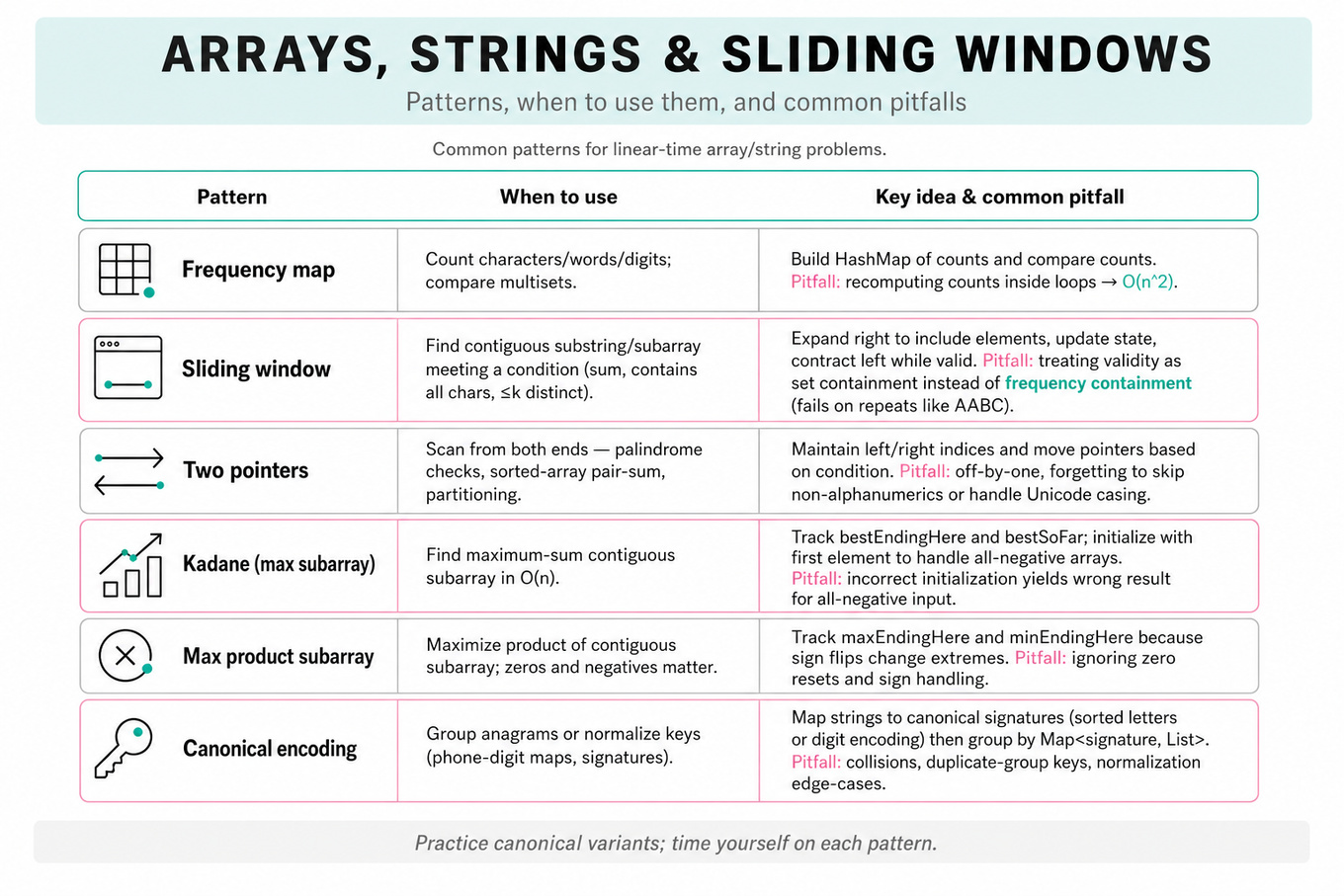
Conclusion
You've now reached the end of our module on pointer-based techniques, and you've equipped yourself with a powerful new skill: algorithmic pattern recognition. The ability to quickly and accurately categorize a problem is often more valuable than knowing the implementation details by rote.
Key Takeaways:
- Decision Framework: Your first questions when seeing an array/string problem should be about its core structure:
- Is it about a contiguous subarray/substring? Think Sliding Window.
- Is the input sorted, or would sorting help? Think Two Pointers.
- Is it about finding complements, counting frequencies, or tracking existence regardless of position? Think Hashing.
- Trade-offs Matter: As the "Two Sum" problem shows, there can be multiple valid approaches. The optimal choice depends on the problem's specific constraints, such as whether the input is sorted and the required time/space complexity.
- Keywords are Signals: Pay attention to the vocabulary used in problem statements. Words like "contiguous," "subarray," "sorted," "pair," and "in-place" are strong hints that point you toward a specific pattern.
In our next module, we will dive deep into "Sorting and Binary Search Patterns." You've already seen how a sorted array enables the powerful two-pointer technique. In the upcoming lessons, we'll explore sorting itself more formally and discover how the property of "sortedness" unlocks one of the most efficient search algorithms: binary search.