Recommended resources
The freely available resources this lesson will direct you to.
Hello! Last lesson showed how a B2B software brand can become memorable and trusted, and why that may support preference and pricing power without replacing product value. This lesson asks a more specific question: trusted by whom, and against which risks?
We’ll return to the fictional invoice-exception software company. Its prospective customers currently handle unusual invoices through shared inboxes and spreadsheets. A product that promises clearer ownership and approval history might appeal to them, but adopting it would affect several people—and choosing it could feel riskier than keeping the familiar workflow. We’ll examine how those concerns should shape the brand’s promises, evidence, and communication.
A purchase can be risky even when the product looks useful
Suppose a finance leader sees a convincing demo. They may still wonder what happens if employees do not adopt the software, approval records are incomplete, sensitive information is mishandled, or the provider cannot support the rollout. A disappointing purchase would cost the organization time and money. It could also reflect on the person who recommended it.
The alternative is not risk-free. Shared inboxes may leave exceptions unowned or make approvals hard to reconstruct. Yet the risk of changing a known process is often more vivid than the risk of continuing it. A brand that describes only the upside of its product may miss the central obstacle to buying.
Forrester’s Are B2B Buyers Cowards?, by Ian Bruce and Zachary Stone, provides a useful account of this tension. The title is provocative; the substance treats caution as an understandable response to responsibility.
Are B2B Buyers Cowards? The Importance Of Trust
Read this Forrester article to distinguish a buyer’s organizational responsibility from their personal exposure, then identify the qualities that make a provider feel safer to choose.
Start with the opening paragraphs immediately below “Are B2B Buyers Cowards?” Read the risk context. In “Most Buyers Are Defensive Decision-Makers,” continue through the discussion of choosing the safest option, beginning “One consequence is that buyers at B2B companies frequently make” and ending at this description. Then read the trust discussion in “Risk Aversion Drives The Trust Premium.” Finish in “B2B Buyer Trust = Competence, Consistency, And Dependability”: read the explanation through the end of that paragraph. Focus on competence, consistency, and dependability rather than memorizing all seven trust dimensions.
These three qualities suggest more precise branding decisions than “look established.” Competence means showing that the provider understands the problem and can address it. Consistency means that the website, demo, sales answers, and product describe substantially the same capability. Dependability means giving buyers reason to expect the provider to deliver and support what it promises.
For the invoice-software company, a polished claim such as “eliminate approval risk” would be difficult to justify. A demonstration of how an exception receives an owner and how its approval history can be viewed is narrower—but easier to assess. An implementation outline and candid answers about limitations may strengthen that impression. If the software does not actually retain the records a buyer needs, however, better branding cannot remove the underlying risk.
It helps to separate reducing actual risk from reducing uncertainty about risk. Product safeguards, reliable operation, and support can reduce actual risk. A clear demo or accurate security information helps a buyer judge what risk remains. Good brand communication does not pretend those are the same achievement.
“The buyer” is several people with different concerns
The finance leader in our example may initiate the search, but someone who handles invoices daily will judge whether the workflow is usable. An IT or security colleague may evaluate data handling and integration. Someone responsible for budget may ask whether the change is worth its total cost. Approval may also depend on a person who has not attended a single demo.
Forrester calls the internal participants the buying group and places them within a wider buying network. The network includes sources the provider does not control, such as customer communities, partners, and independent commentators. The diagram makes that distinction visible.
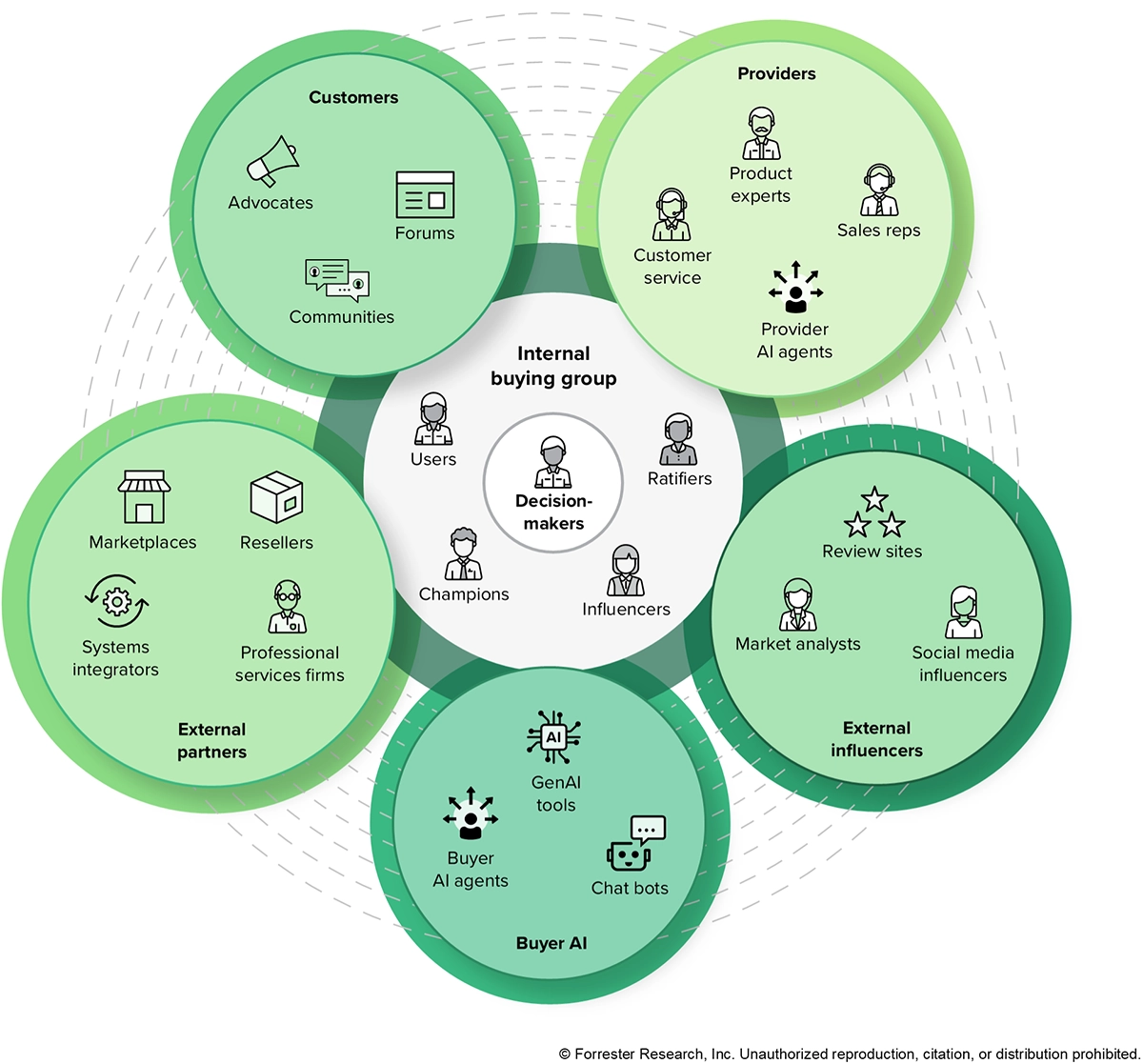
The diagram is a map of possible participants, not a claim that every purchase involves every circle. A small software purchase may involve only a few people; a consequential one may draw in many more. Forrester’s Who’s In Your Buying Group? explains the internal roles in more detail.
Get To Know Your B2B Buying Group
Read Forrester’s guide to understand what the five buying-group roles contribute to a decision, rather than treating each role as a fixed job title.
Under “Who’s In Your Buying Group?” and “Get To Know The Players And Their Roles,” read the opening distinction. Then read the profiles under “Champion,” “Decision-Maker,” “Influencer,” “User,” and “Ratifier,” beginning with the champion and stopping at the end of the ratifier’s “What They Look For” paragraph, just before “Six Steps To Buying Group Success.” For each role, note what that person needs to decide and what information would help them.
The roles are useful because they reveal different questions about the same proposed change:
| Role | Possible question about the invoice software | Useful evidence |
|---|---|---|
| Champion | “Can I make a sound case for changing our workflow?” | A concise account of the problem, expected outcome, and rollout |
| Decision-maker | “Does this support an important business goal?” | A credible value case and a realistic account of cost |
| Influencer | “Will this satisfy a requirement I am responsible for?” | Relevant implementation, integration, or security details |
| User | “Will this make my daily work easier?” | A realistic workflow demonstration or trial |
| Ratifier | “Are the terms and total commitment acceptable?” | Clear pricing, conditions, and purchasing information |
These are roles, not five mandatory individuals. One person may be both a champion and a user; a decision-maker may scrutinize the costs usually associated with a ratifier. Nor does each person need an entirely different brand. If one presentation calls the product a simple way to assign exceptions, while another implies it is a complete finance-control platform, the group may struggle to determine what it actually does.
The better distinction is between a shared promise and role-relevant evidence. Everyone should encounter a consistent account of the product’s purpose. Each person should also be able to find the detail needed to judge their part of the decision.
Help the group reach confidence, not just individual interest
Imagine that the invoice-software champion is impressed by a personalized presentation about saving their own time. They still need to explain the proposal to colleagues concerned about adoption, records, cost, and security. A message can be highly appealing to one individual yet give them little help building agreement.
The Gartner chart below offers a caution about that gap. In the study shown, higher agreement that content was relevant only at the individual level was associated with lower buying-group consensus; higher agreement about buying-group and organizational relevance was associated with greater consensus.
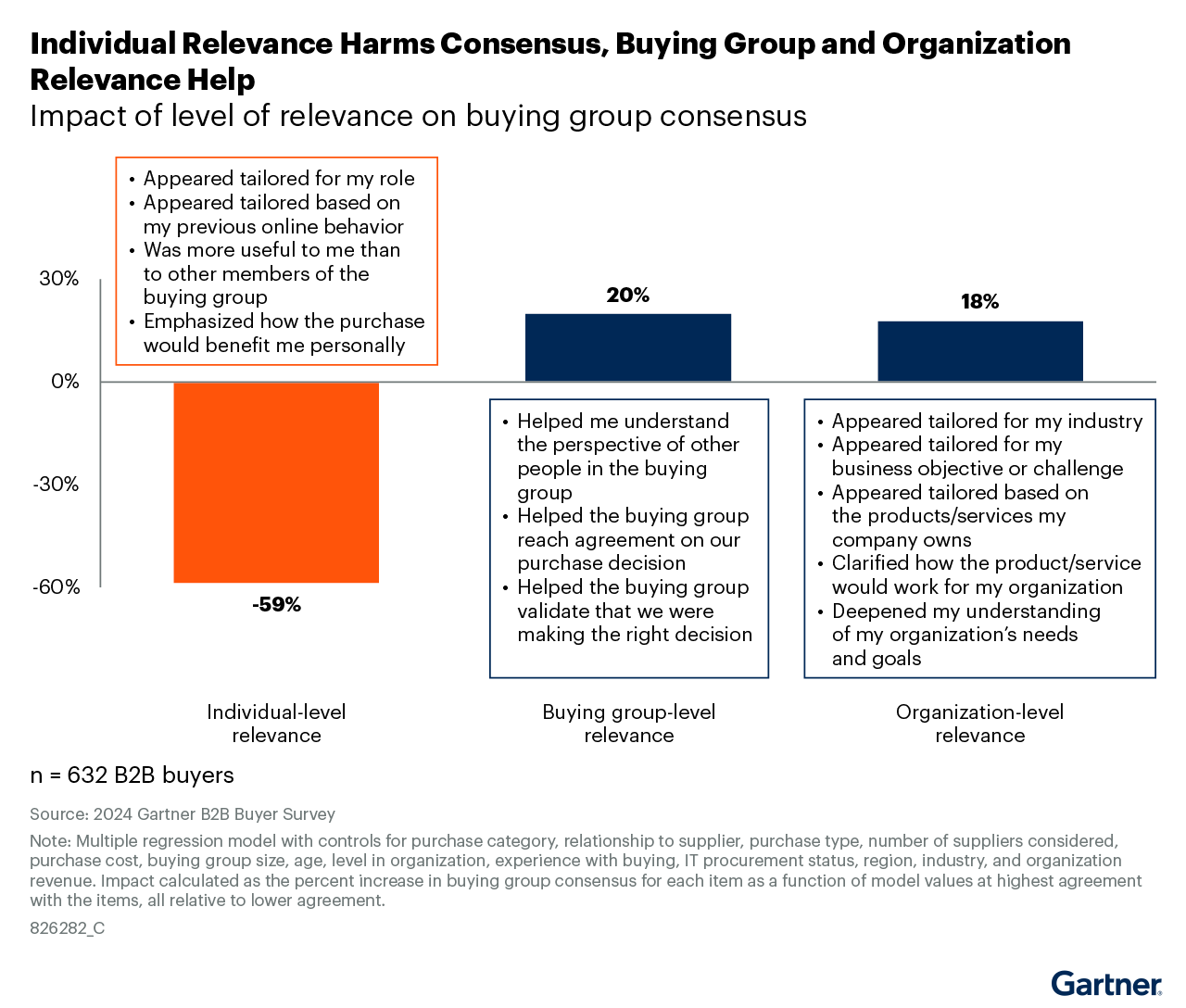
This does not mean that information tailored to a user or finance leader is always harmful. The chart’s “individual-level relevance” includes content focused on a person’s role, previous online behavior, or personal benefit. Its contrast is a reminder to connect that detail to what the group and organization need to resolve. A user-focused demo, for example, is more useful to the wider decision when it also clarifies training effort and how the new workflow would operate.
Gartner’s video How to Progress Customers Through the B2B Sales Funnel makes a related point: buying is work for the customer, and buyers may revisit questions rather than moving neatly through a seller’s planned sequence.
How to Progress Customers Through the B2B Sales Funnel
Watch Gartner’s “How to Progress Customers Through the B2B Sales Funnel” for a buyer-centered way to think about purchasing friction. The selected passages explain why useful information matters alongside a persuasive pitch.
Watch buying friction for the discussion of customers’ purchasing tasks, their return to earlier questions, and their use of both digital and in-person sources. Skip ahead to buyer information for the idea of providing the material customers need to make progress confidently. As you watch, consider why a question raised after a demo might call for clearer evidence rather than another sales claim.
A non-linear decision has a practical implication for brand design. The champion should be able to share a clear explanation with someone who was not present. A security question should have an accurate answer when it arises, even if the sales conversation has already moved on to pricing. If several people encounter the provider through different channels, contradictions become more costly: they make the group’s task of judging the purchase harder.
Turn risk and stakeholder insight into brand choices
For the fictional company, an effective brand decision begins with a bounded proposition: help finance teams assign invoice exceptions and see their approval history in one place—assuming the product genuinely does those things. That sentence gives the group a common subject to evaluate. It does not promise that every exception will be resolved or that an audit will succeed.
The company can then ask what would make that proposition believable to the people involved:
- A champion needs an explanation they can repeat accurately, including why the current inbox-and-spreadsheet process is worth changing.
- Users need to see what happens to a real exception from assignment through approval, including where the workflow still requires human judgment.
- Technical evaluators need factual answers about data handling and integration—not a general statement that the platform is “secure.”
- Budget holders need to understand expected value, implementation effort, price, and the costs of both changing and staying put.
These are not four competing identities. They are four views of one purchase. The brand’s voice can remain clear and measured throughout; the level of detail changes with the question. Likewise, credibility may come from a working demo, a carefully scoped pilot, or precise documentation before it comes from an extensive customer track record. An early-stage company should state what its evidence does—and does not—establish.
Finally, remember the wider buying network. A prospect may check what customers say, ask a peer, consult a partner, or use an AI tool to summarize available information. The company cannot dictate those accounts. It can make its own descriptions accurate, consistent, and easy to verify, then earn stronger external signals through delivery. An impressive visual identity helps people recognize the provider; it cannot reconcile conflicting claims on its behalf.
Conclusion
Perceived purchase risk includes the consequences of both changing a workflow and keeping it. A trustworthy B2B software brand helps buyers judge those consequences through a credible promise, consistent explanations, and evidence suited to the questions they face. Because several people may influence the purchase, brand communication must support group confidence, not merely one person’s enthusiasm.
Next, you’ll audit the signals a software brand currently sends across its customer touchpoints. The risk and buying-group lens from this lesson will help you decide which inconsistencies or credibility gaps matter most.