Recommended resources
The freely available resources this lesson will direct you to.
Hello! Last lesson separated the brand buyers hold in mind from the positioning, messages, design, product, and track record that help shape it. Now we can ask what those impressions are worth. For a B2B software company, a strong brand can help buyers remember the company, feel more confident evaluating it, prefer it over a plausible alternative, and sometimes accept a higher price. None of those effects is automatic, and none makes the business impossible to compete with.
We’ll follow the fictional invoice-exception software company from the previous lesson. Its prospective customers currently coordinate unusual invoices through shared inboxes and spreadsheets. Keeping that alternative in view will help us distinguish a genuine brand advantage from a claim that merely sounds persuasive.
Memorability begins with being remembered at the right moment
Imagine a finance leader who has heard of the company but cannot recall what it does. When an audit exposes missing approval histories, that recognition may be of little use. Contrast that with a leader who remembers the company specifically when an invoice exception lacks an owner. The second association is more likely to put the product on a shortlist.
This is mental availability: how readily a brand comes to mind in a relevant buying situation. It is more specific than general name recognition. The trigger might be a failed audit, a growing backlog, or a new finance leader reviewing an improvised workflow. Clear, repeated links between the company and such situations make later recall more likely. Consistent visual and verbal cues help a buyer recognize that separate encounters—a useful article, a colleague’s mention, a sales conversation—concern the same provider.
The companion idea is physical availability: once someone thinks of the provider, can they find and buy a suitable offering without unnecessary friction? In software, this can mean a findable website, an understandable product scope, an accessible demo, and a purchasing route the customer can use. The image captures the distinction.
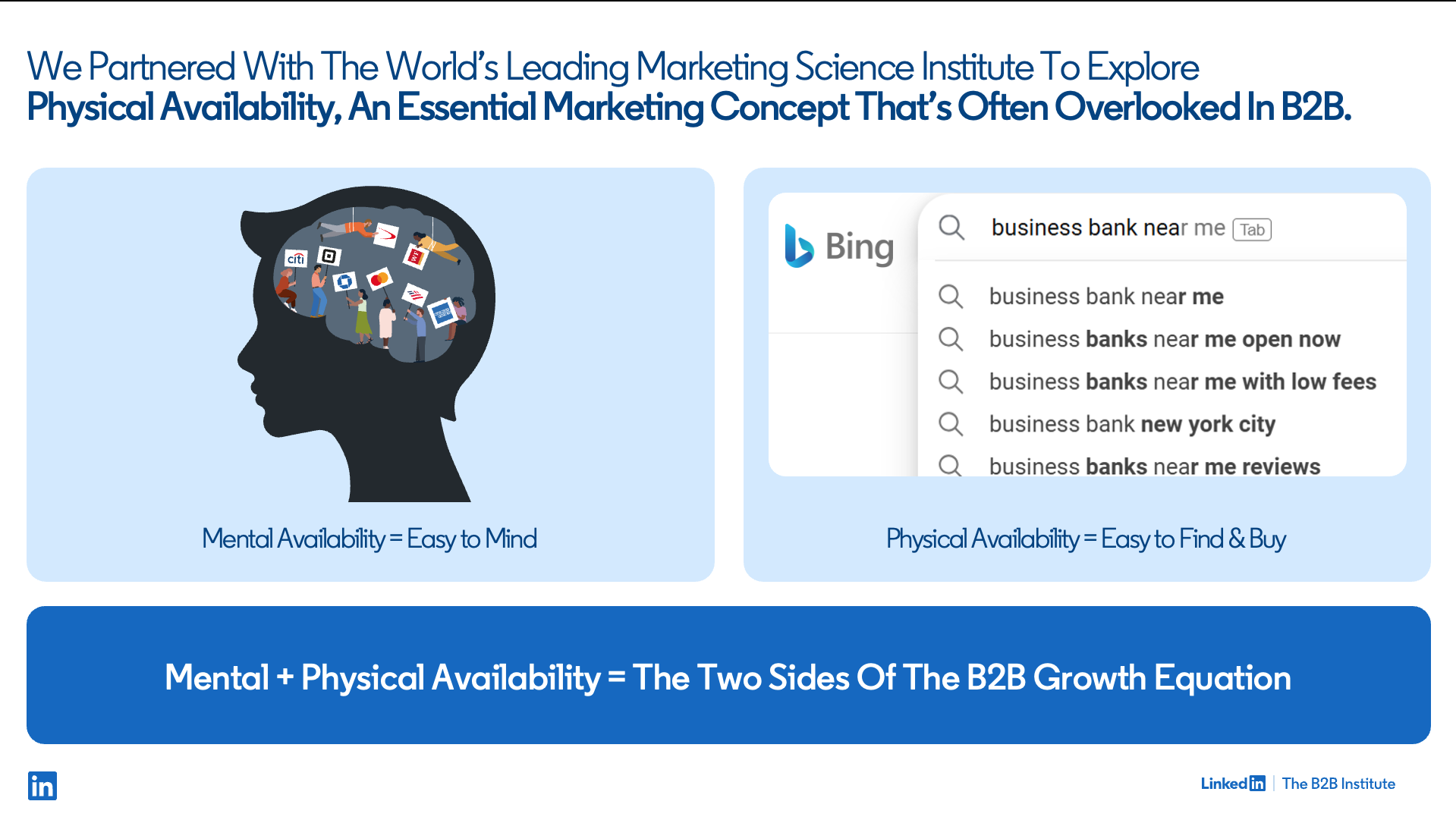
The B2B Institute’s How B2B Brands Grow develops the more demanding question behind memorability: not simply “Have buyers heard of us?” but “When would buyers think of us?”
Read the case-study discussion from the B2B Institute to see why broad awareness and situational recall are different.
In the case study “How Salesforce’s Trailblazer Campaign Builds Mental Availability,” go to the discussion around pp. 10–12, including the subsection “How Building Mental Availability Grows Brands” on p. 11. Begin just after the quoted account of an awareness problem, at “Despite its fame,” and read the explanation through the paragraph beginning “Do this.” Focus on the definition of mental availability and on buying triggers, called category entry points. Treat the case as an illustration of the principle, not as a campaign template for a small software company.
For an early-stage provider, the practical implication is not “advertise to everyone.” It is to become recognizable to a relevant group of buyers for a small number of situations the product can address. Being easy to mind gets a company considered; it does not prove it is the right choice.
Trust and preference require more than familiarity
Trust is confidence that a provider will do what the buyer needs it to do. Familiarity can help: an unfamiliar vendor may feel harder to assess than one a buyer has encountered repeatedly. But familiarity is only a starting signal. For invoice-exception software, a buyer might look for a working demonstration of approval history, a realistic account of implementation, responsive answers about limitations, and customer evidence where it exists. These give the buyer grounds to revise an initial impression into a more informed expectation.
Preference is the tendency to choose one acceptable option over another. It can arise because a buyer associates the brand with a particularly relevant problem, understands its advantage, and believes the advantage is real. The invoice-software company might be preferred to a general workflow tool if the buyer values a ready-made way to assign and trace exceptions. It might be preferred to the shared inbox if ownership and history have become costly gaps. Those are different comparisons; the company cannot assume that one message wins both.
There is also an important distinction between coming to mind and being preferred once considered. Distinctive cues can improve recall. Relevant feelings and associations can make a brand more appealing. Neither substitutes for evidence when a buyer tests whether the software meets a requirement.
The B2B Institute’s The 5 Principles of Growth in B2B Marketing examines how communications can build positive associations before a buyer is ready to purchase, while product-oriented messages can help during an active evaluation.
The 5 Principles Of Growth In B2B Marketing
Read the B2B Institute’s discussion of preference to distinguish the long-term work of forming associations from the immediate work of explaining a product.
In “Principle 5: Harness the Power of Emotion,” begin on p. 23 at “Getting buyers to automatically think of your brand when buying is only half the battle.” Continue through the discussion of rational and emotional communications on pp. 24–25, ending with the sentence about increasing demand. Read this passage, paying attention to when buyers are likely to find detailed product information useful. “Emotional” here need not mean dramatic advertising; the relevant point is that a brand can acquire remembered associations as well as remembered facts.
For our fictional company, a repeated, recognizable account of the frustration of unowned exceptions could help buyers remember why the category matters. A demo showing how ownership and approvals work serves a different purpose: it helps an evaluating buyer judge the claim. If the demo contradicts the story, the story will not sustain trust.
Pricing power depends on believable value
A brand has pricing power when it can sustain a price without losing as many suitable buyers as it otherwise would—or when buyers are less inclined to reduce the decision to the lowest quoted price. The B2B Institute describes long-term brand building as a contributor to lower price sensitivity. That is a useful general mechanism, not a promise that a better-known software provider can charge whatever it likes.
The 5 Principles Of Growth In B2B Marketing
Return to this report for its distinction between brand building and sales activation, and its claim about price sensitivity.
In “Principle 2: Balance Brand and Activation,” read “Marketing Works In Two Ways” on pp. 12–13. Start at the definition of sales activation and continue through the caution following the suggested budget mix. Read this discussion. Focus on why accumulated brand associations may affect price sensitivity, while immediate selling still needs a way for interested buyers to respond. The budget figures are rough findings from the report, not a spending rule for this fictional company.
Suppose the invoice-software company proposes an annual price of $12,000. A finance team estimates that the product could free 10 hours a week over 50 working weeks. At an illustrative fully loaded labor cost of $60 per hour, that is $30,000 of potential staff capacity. It is not automatically $30,000 in cash savings: the team might use the time for other work rather than reduce spending. The buyer must also allow for implementation effort, uncertain adoption, and what an alternative could deliver.
This is where brand and commercial evidence work together. A clear, credible brand may get the proposal heard and make the buyer more willing to examine its value. A defensible price still depends on the value the buyer expects relative to the alternatives, and on what the company can substantiate. The following video concentrates on that pricing calculation.
How To Price For B2B | Startup School
Watch “How To Price For B2B” from Y Combinator for a concrete account of value-based pricing and competitive pressure.
Watch the value equation for how a seller and buyer can estimate and test expected value, then competitive pressure for what happens when a comparable rival charges less. Focus on the need to validate assumptions. The speaker’s suggested fraction of value is an approach, not a universal price-setting rule.
If a rival charges $9,000 for software that meets the same needs equally well, brand familiarity may help the $12,000 provider remain in contention—but may not justify the difference. If its traceable approvals are demonstrably more useful to this buyer, the higher price has a stronger case. Brand can support pricing power by improving recognition, confidence, and preference; it cannot manufacture customer value that the offering fails to deliver.
A brand advantage is not the whole defensive position
A valuable brand can be difficult for a new competitor to reproduce quickly. Buyers’ memories, repeated encounters, and a record of dependable delivery take time to build. That can make customer acquisition easier for an established provider and make a newcomer work harder to enter consideration.
Yet defensibility asks a tougher question: What prevents a competitor from winning customers despite that brand advantage? A rival may copy a feature, provide a better implementation, meet a requirement the incumbent cannot, or offer adequate value at a lower price. Buyers can also leave if the familiar provider disappoints them. A recognizable name does not fix missing capabilities or poor delivery.
SaaS investor Jason M. Lemkin calls brand one possible “moat,” then discusses other sources of advantage. Watch selectively to compare the mechanisms rather than treating every example as equally relevant to a young company.
10 Ways Build a Moat in SaaS (Updated)
Watch “10 Ways Build a Moat in SaaS (Updated)” by Jason M. Lemkin to compare brand recognition with product- and workflow-based sources of defensibility.
Watch brand strength for the argument that trust and recognition can favor a SaaS provider. Continue with embedded data and integrations for advantages with a different basis: the effort and value involved in using a product within an existing workflow. Consider the distinction between buyers being inclined to choose you and competitors finding it hard to displace you.
For the invoice-software company, a buyer might remember its name and trust its explanations. Separately, reliable approval records and useful connections to the buyer’s existing systems could make the product more valuable in daily work. Those strengths can reinforce one another, but they should not be confused. Nor should the company create needless difficulty in leaving: making data hard to extract may increase switching effort while undermining trust.
The balanced conclusion is that brand can be a durable commercial asset without being an absolute barrier to competition. Its effects are strongest when the product, delivery, and route to purchase support the expectations it creates.
Conclusion
A B2B software brand builds memorability when buyers can recall it in relevant situations, trust when encounters and evidence support its promise, and preference when buyers see a credible reason to choose it over their actual alternatives. Those effects can contribute to pricing power, but the price still has to make sense against expected value and competing offers. Brand can make a business harder to compete with; product performance, workflow fit, and reliable delivery matter to whether that advantage holds.
Next, we’ll look more closely at why B2B software purchases can feel risky and how different people involved in a purchase may need different reasons to believe.