Recommended resources
The freely available resources this lesson will direct you to.
- What is Branding? A deep dive with Marty Neumeierwww.youtube.com
- How to nail your product positioning | April Dunford (Obviously Awesome)www.youtube.com
- What Is Branding? Complete Guide for Marketers in 2025www.ama.org
- An Honest Guide to Brand Identity vs. Brand Image - Directivedirectiveconsulting.com
Hello! Branding can refer to a logo, a promise, a product experience, or what customers say about a company. Those things are connected, but treating them as interchangeable makes it difficult to decide what needs improving.
This first lesson establishes a working vocabulary for the course. You’ll distinguish the brand buyers form in their minds from the strategic choices, communications, design, product, and track record that help form it. We’ll use a fictional B2B software company throughout so the distinctions remain useful in practice, not just in definitions.
The brand is the impression, not the asset
For this course, a brand is the set of associations and expectations that people hold about a company or offering. A buyer might think a software provider is dependable but difficult to implement, or unusually clear about a problem that other vendors obscure. Those impressions can affect whether the provider is remembered, considered, or trusted.
A company can influence those impressions, but it cannot simply declare them into existence. The website may say “easy to adopt”; the buyer’s impression depends partly on whether the demo, implementation, and subsequent experience bear that out. Different people may also hold different impressions of the same company. A finance leader and a day-to-day user encounter different parts of a B2B product.
The diagram below offers a useful starting distinction. Read its nested circles as a reminder that visual and verbal identity are part of a company’s efforts to shape perception, not as a literal map of everything a brand contains.
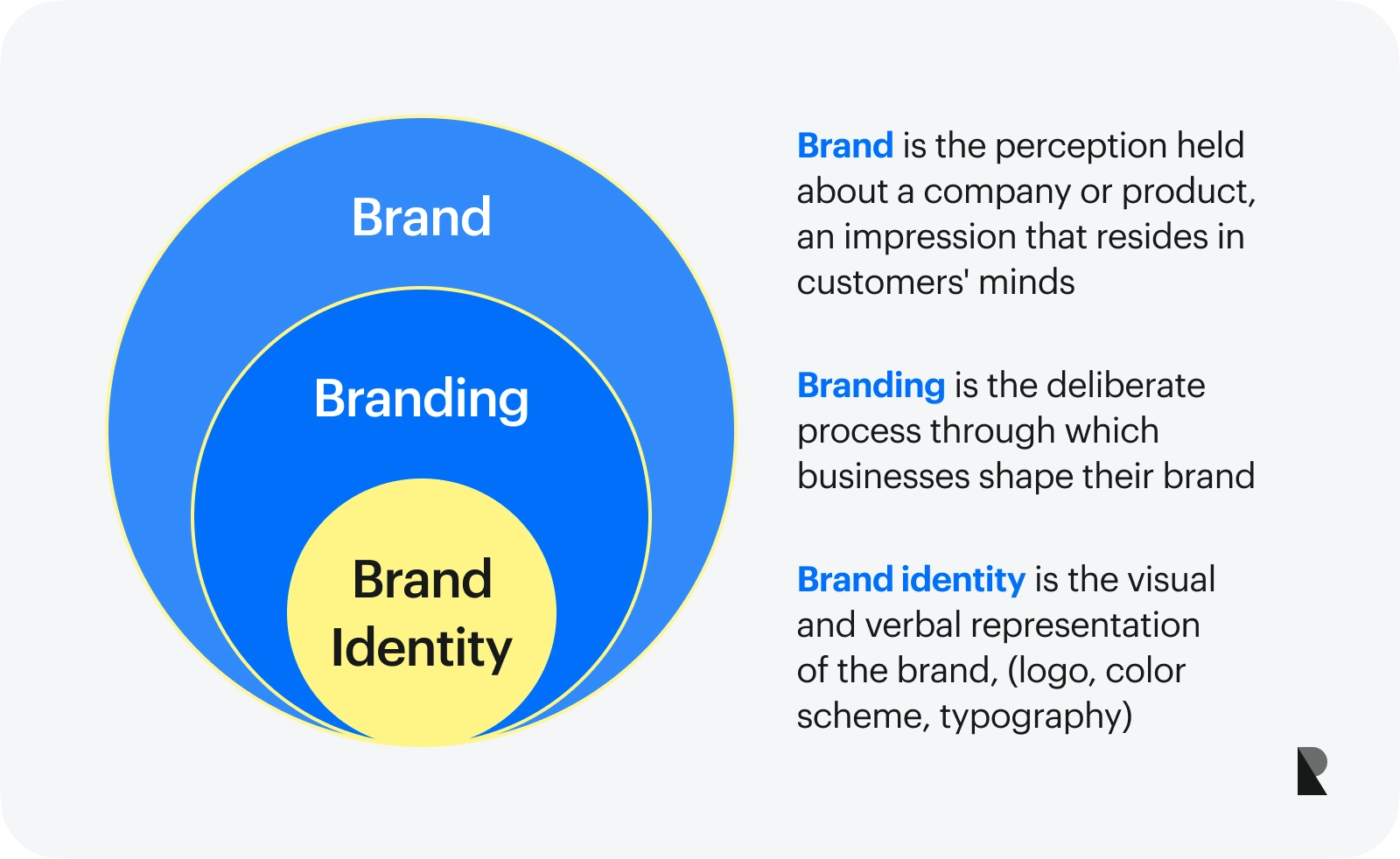
Branding is the deliberate work of shaping those impressions. It includes choices about whom to serve, what to emphasize, how to communicate, and whether the experience supports the promise. The distinction is between an intended impression and an impression actually held.
An Honest Guide to Brand Identity vs. Brand Image - Directive
Read Directive’s distinction between intended identity and audience perception, then its B2B software example of what happens when delivery conflicts with a claim.
Start with the introductory paragraph immediately before “Brand identity vs brand image: Make the distinction unambiguous,” and continue through that subsection’s first paragraph. Read the distinction, focusing on who defines identity and who forms the image. Then go to “Brand image: Outside-in perception you influence.” In its example, read the support gap, from the company’s advertising claim through the consequences of slow support and generic onboarding. You can stop before the later discussion of metrics. Notice that repeating a claim does not repair an experience that contradicts it.
The reading uses brand image for external perception and brand identity for intentional expression. Terminology varies: brand identity sometimes means the whole intended strategic and expressive system, while designers may use it more narrowly for visual and verbal elements. We’ll say visual identity when we mean the design system specifically. Neither usage changes the central question: What does the company intend people to believe, and what do they believe after encountering it?
Positioning chooses the ground; messaging makes the case
Suppose a fictional software company helps finance teams manage invoice exceptions: invoices that need investigation or approval rather than routine processing. Its product assigns an owner to each exception and records the approval history. Prospective customers might currently coordinate this work in spreadsheets and shared inboxes.
Positioning is the strategic choice about how this offering should be understood relative to alternatives, for a particular customer. The company might choose to position itself as an invoice-exception workflow for finance teams that have outgrown spreadsheet coordination, emphasizing traceable approvals. That choice identifies a customer, a problem, a competitive frame, and a reason the difference matters.
Positioning is not the brand itself. The team can decide on that position internally; buyers may not understand it, believe it, or associate the company with it. Nor is positioning merely a polished sentence. A sentence can record the choice, but the choice must be grounded in the product’s capabilities and the alternatives customers consider—including continuing their current workflow.
Messaging turns that strategic choice into language a buyer encounters: a homepage headline, sales explanation, email, or demo narrative. For example, the company might write: “Keep invoice exceptions from getting lost in a shared inbox. Give every approval a clear owner and history.” That is a message. It expresses a possible position, but its wording can change without changing the underlying strategic choice.
Listen to April Dunford distinguish the two in a B2B software context:
How to nail your product positioning | April Dunford (Obviously Awesome)
In “How to nail your product positioning,” on Lenny’s Podcast, April Dunford defines positioning through alternatives, differentiated value, customers, and category. Later, she explains why positioning and messaging should not be treated as the same task.
Watch the definition for the components of positioning; you do not need to watch the rest of that discussion. Then watch the distinction between positioning and messaging. Focus on why changing homepage copy cannot, by itself, answer whom an offering is for or how it wins against alternatives.
The direction matters. If a team cannot say which buyer values its difference and what that buyer would otherwise do, copywriting tends to produce broad claims such as “streamline your work.” Better wording might make the claim sound more appealing, but it cannot supply the missing strategic choice. Conversely, a sound position may be hidden behind confusing messages. In that case, the strategy need not be discarded merely because the homepage needs rewriting.
This does not mean buyers experience positioning and messaging separately. Buyers hear the message and infer a position from it. The distinction is useful because it tells the company which kind of decision it is making: deciding where to compete, or deciding how to explain that choice.
Visual identity makes a company recognizable, not necessarily believable
Visual identity is the repeatable design system through which a company presents itself: its logo, typography, colors, imagery, layout conventions, and their application across surfaces such as a website, sales deck, and product interface. Verbal conventions—such as a consistent name or tone—may be grouped with identity too, depending on how broadly the term is used.
The invoice-workflow company could adopt restrained colors, highly legible type, and uncluttered screens. Those choices might help a buyer recognize its materials and interpret its presentation as orderly. They cannot demonstrate that approvals are actually traceable. A design can signal reliability; the product and experience must give buyers reason to believe in it.
Directive’s discussion of translating identity into messaging and design is worth reading with that difference in mind:
An Honest Guide to Brand Identity vs. Brand Image - Directive
Return to Directive’s guide for its account of how an intended identity becomes messages and a design system that buyers encounter.
In “Turn platform into practice: Translate identity into design and messaging buyers experience,” read the opening paragraph. Under “Build a message architecture that proves your promises,” read the explanation of messages and proof; you can stop before its example and metrics. Finally, under “Systemize visual identity so it scales beyond campaigns,” read the opening paragraph. Look for the difference between making a claim recognizable and providing evidence for it.
A recognizable identity has value: it helps people connect encounters with the website, sales materials, and product to the same provider. But consistency alone is not a substitute for substance. A consistently presented promise that the experience repeatedly breaks may make the disappointment more memorable.
The product and reputation supply evidence
A product is the offering customers can use: its capabilities, limitations, usability, and performance. It is not the brand, because buyers can hold impressions that go beyond its feature set—and can form impressions before using it at all. Nevertheless, product experience is one of the strongest sources of brand perception in software.
In our example, the product may genuinely record who approved each invoice exception. That capability gives the company a basis for its claim about traceability. If the audit history is hard to find or unreliable, the same capability listed on a feature page will not produce the intended impression. The product is evidence; the brand is part of the meaning buyers take from that evidence.
Reputation is a company’s accumulated standing based on what others believe it has done or how it has behaved. A buyer might hear that a vendor handles implementation well, or that its support is slow. Those beliefs can spread through customer accounts, references, and professional conversations without appearing in the company’s own messages.
There is a genuine overlap here. People sometimes use brand as shorthand for reputation, and some definitions make them nearly synonymous. For this course, the more useful distinction is that brand is the broader set of associations and expectations, while reputation emphasizes earned judgments about conduct and results. A new provider can already evoke associations through its name, category, presentation, and pitch, yet have little established reputation. Over time, its track record can strongly reinforce—or overturn—those early impressions.
Consider what would happen if the fictional company redesigned its site while leaving the software unchanged. Buyers might find it easier to understand and remember; their initial impression could improve. But the redesign would not fix missing approval records. Now consider the reverse: the team improves approval history but does not explain the improvement to prospects. Existing users may notice and speak more favorably of the product, while new buyers may still struggle to see why it differs from a shared inbox. Brand perception is affected in both cases, through different routes.
Use the distinctions to diagnose the right problem
The six terms describe related things, not six sealed compartments. A buyer encounters product demonstrations, words, design, and other people’s accounts together. The vocabulary helps you avoid prescribing the wrong fix.
| If the problem is… | Look first at… |
|---|---|
| The team cannot say whom the offering is best for or what alternative it beats | Positioning |
| The team knows its advantage, but prospects cannot understand the explanation | Messaging |
| Materials are difficult to recognize as coming from the same provider | Visual identity |
| A promised capability fails or is difficult to use | Product |
| Buyers hear repeated accounts of disappointing delivery | Reputation |
| Buyers consistently associate the provider with an unintended quality | Brand perception, then the experiences producing it |
These are starting diagnoses, not automatic fixes. “Prospects don’t trust us,” for instance, could mean an unsupported message, a weak product demonstration, a poor track record, or some combination. Ask what buyers actually encountered before deciding whether the remedy is new copy, a design change, product work, or improved delivery.
One final distinction is between what a company sends and what a buyer concludes. The company sends a message; the buyer may or may not believe it. The company applies a visual identity; the buyer may or may not recognize it. The company chooses a position; the buyer may place it somewhere else entirely. Branding work becomes more precise when it tests those conclusions rather than judging only the assets the company produced.
Conclusion
A brand is the set of associations and expectations people hold. Positioning chooses how an offering should stand apart for a particular buyer; messaging communicates that choice; visual identity gives it a recognizable expression. The product provides an experience that can substantiate or contradict the promise, while reputation reflects accumulated judgments about delivery and conduct.
These distinctions are not merely vocabulary. They help identify whether a perceived “branding problem” calls for a clearer strategic choice, a better explanation, a more coherent design system, or a better experience. Next, we’ll examine how those buyer perceptions can create trust, preference, memorability, and pricing power—and where brand alone cannot protect a B2B software business.