Recommended resources
The freely available resources this lesson will direct you to.
- Components of Government Budget - Government Budget and the Economy | Class 12 Macroeconomicswww.youtube.com
- Y1 28) Government Spending and Taxation - Types and Reasonswww.youtube.com
- Government revenue - Wikipediaen.wikipedia.org
- 12.1 The Government of Canada and its Budgetecampusontario.pressbooks.pub
Introduction
Welcome to the first lesson of our module on Fiscal Policy. In the previous module, we concluded by examining the short-run Phillips Curve, which illustrates the trade-off between inflation and unemployment. This trade-off highlights the difficult choices governments face when trying to manage the economy. Fiscal policy, which involves the government's decisions about spending and taxation, is one of the primary tools used to influence economic outcomes like growth, unemployment, and inflation.
To understand how fiscal policy works, we first need to understand its fundamental components. Therefore, today's lesson will address the learning outcome: Describe the main components of government revenue and expenditure. We will break down the government's budget to see where it gets its money and where that money goes. This foundational knowledge is essential for analyzing how changes in government finances can impact the entire economy.
1. The Structure of a Government Budget
At its core, a government budget is a financial statement that outlines its expected revenue (income) and expenditure (spending) over a fiscal year. For a clear and analytical understanding, economists typically divide the budget into two main accounts: the Revenue Budget and the Capital Budget.
The key distinction lies in whether a transaction affects the government's assets or liabilities:
- Revenue Budget: Deals with recurring income and expenses that do not create new assets or reduce liabilities. Think of it as the government's operating account for day-to-day functions.
- Capital Budget: Deals with income and expenses that do create assets (e.g., infrastructure) or change liabilities (e.g., taking on or paying off debt). This is more like the government's investment and long-term financing account.
This flowchart provides an excellent overview of how these components fit together. We will use it as a map for our lesson today.
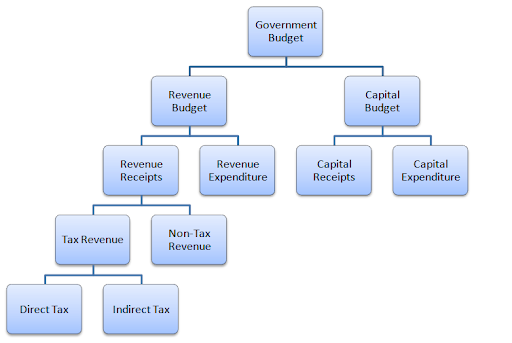
To get a more detailed explanation of this structure, let's watch a video that walks through this framework.
Components of Government Budget - Government Budget and the Economy | Class 12 Macroeconomics
This video introduces the structure of a government budget, clearly explaining the fundamental difference between the Revenue Budget and the Capital Budget.
Watch the first 4 minutes of the video (00:00 - 04:11). Focus on understanding the logic behind separating the budget into 'Revenue' and 'Capital' categories based on their impact on assets and liabilities.
2. Government Expenditure: Where the Money Goes
Following our flowchart, government expenditure is split into two types: Revenue Expenditure and Capital Expenditure.
Revenue Expenditure
This is the spending on the day-to-day running of the government and its various services. It is recurring in nature and does not create any assets. The main categories are:
- Current Spending: Paying public sector wages (e.g., for teachers, police officers), and maintaining public services (e.g., running government offices).
- Welfare Spending (Transfer Payments): Payments made to individuals without any good or service being received in return. This includes social security, unemployment benefits, and pensions.
- Interest Payments: The cost of servicing the government's accumulated debt.
Capital Expenditure
This is spending on long-term investments that create assets or reduce liabilities. This type of spending enhances the productive capacity of the economy. The main categories include:
- Infrastructure Projects: Building new roads, bridges, airports, schools, and hospitals.
- Investment: Purchasing new machinery or equipment.
- Repayment of Loans: Paying back the principal amount of government debt, which reduces its liabilities.
This short video provides a concise summary of these spending categories.
Y1 28) Government Spending and Taxation - Types and Reasons
This video from EconplusDal clearly breaks down the main types of government spending.
Watch the segment from 00:10 to 00:48. Note the examples given for current spending, capital spending, welfare spending, and debt interest.
Real-World Example: US Federal Spending
To see what this looks like in practice, here is a breakdown of the proposed US federal budget for 2024. Notice the distinction between "Mandatory" and "Discretionary" spending.
- Mandatory Spending: Similar to revenue expenditure like welfare and debt interest. It's spending that is required by existing laws (e.g., Social Security, Medicare).
- Discretionary Spending: This is the portion of the budget that the government decides on annually through appropriation bills. It includes defense spending and funding for many government agencies and programs. This aligns with both revenue expenditure (e.g., salaries) and capital expenditure (e.g., new projects).

3. Government Revenue: Where the Money Comes From
Now let's look at the other side of the budget: government revenue, also known as receipts.
Revenue Receipts
These are receipts that do not create a liability or reduce an asset. They are regular and recurring.
-
Tax Revenue: This is the primary source of income for most governments. Taxes can be broadly classified as direct or indirect.
- Direct Taxes: Levied on the income and wealth of individuals and companies. The burden of this tax cannot be shifted to others. Examples include Personal Income Tax and Corporate Income Tax.
- Indirect Taxes: Levied on goods and services. The producer or seller pays the tax to the government but can shift the burden to the final consumer by including it in the price. Examples include Goods and Services Tax (GST), Value-Added Tax (VAT), and excise duties on fuel or cigarettes.
-
Non-Tax Revenue: This is income generated from sources other than taxes.
- Profits and Dividends: From public sector undertakings (PSUs) or other investments made by the government.
- Fees, Licenses, and Fines: Payments for government services (e.g., passport fees), permits, or penalties for breaking the law.
- Grants: Aid received from foreign governments or international organizations.
This next clip clearly explains the difference between direct and indirect taxes.
Y1 28) Government Spending and Taxation - Types and Reasons
Let's return to the EconplusDal video to get a clear definition and examples of direct and indirect taxes.
Watch the segment from 01:47 to 03:21. Focus on the key difference: who bears the final burden of the tax.
Capital Receipts
These are receipts that either create a liability for the government or reduce its assets.
- Borrowing (Debt Capital Receipts): When the government borrows money from the public (by selling bonds), from the central bank, or from international institutions like the World Bank. This creates a liability that must be repaid in the future.
- Disinvestment (Non-Debt Capital Receipts): The government raises money by selling its shares in public sector enterprises to the private sector. This reduces the government's assets (its ownership stake).
- Recovery of Loans: When the government recovers loans it had previously granted to states or other entities. This also reduces the government's financial assets.
Looking back at the US budget chart, you can see the dominance of tax revenue, with Individual and Payroll taxes making up the vast majority of government income.
4. A National Budget in Numbers
To tie these concepts together, let's examine the components of a real government budget with specific figures. The resource below details the revenue and expenditure of the Canadian government for the 2019-20 fiscal year.
The Government of Canada and its Budget
This reading provides a practical example using data from the Canadian federal budget. It allows you to see the relative importance of the different revenue and expenditure categories we've discussed.
Read the text accompanying the tables 'Composition of expenses for 2019-20' and 'Composition of Revenues for 2019–20'. Compare the percentages. For example, what is the largest source of revenue? What is the largest category of expense?
As you can see from the Canadian example, transfer payments (welfare) and direct program expenses make up the bulk of spending, while personal income tax is the single largest source of revenue. This pattern is common in many developed economies.
Conclusion
Today, we have dissected the government budget into its core components. By understanding this structure, you are now equipped to analyze the mechanics of fiscal policy.
Key Takeaways:
- A government's budget is divided into a Revenue Budget (for recurring, day-to-day items) and a Capital Budget (for long-term investments and financing).
- Government Expenditure includes revenue spending (salaries, welfare, interest) and capital spending (infrastructure). In practice, this is often categorized as mandatory vs. discretionary spending.
- Government Revenue consists of revenue receipts (tax and non-tax income) and capital receipts (borrowing, disinvestment).
- For most modern governments, tax revenue (especially from personal income) is the largest source of funds, and transfer payments and operational costs are the largest expenses.
Preview of the Next Lesson:
Now that we know the "what" of government spending and revenue, we can move on to the "how" and "why." In our next lesson, we will explore how expansionary and contractionary fiscal policy affect aggregate demand. We will see how policymakers use the levers of government spending and taxation to try to steer the economy out of recessions or cool it down during inflationary periods.