Recommended resources
The freely available resources this lesson will direct you to.
Introduction
Welcome to your second lesson on fiscal policy. In our last session, we broke down the government budget, identifying the main components of revenue (like taxes) and expenditure (like government spending on services and infrastructure). These components are the fundamental tools of fiscal policy.
Today, we will build directly on that foundation to address the learning outcome: Explain how expansionary and contractionary fiscal policy affect aggregate demand. You'll learn how the government can actively use changes in spending and taxation to influence the overall level of economic activity. We will explore how these policies are used to combat recessions and control inflation, visualizing their impact using the Aggregate Demand-Aggregate Supply (AD-AS) model that you're familiar with.
1. The Two Stances of Fiscal Policy
Fiscal policy is the deliberate use of government spending and taxation to manage the economy. Depending on the economic situation, the government can adopt one of two stances: expansionary or contractionary.
- Expansionary Fiscal Policy: This is used to stimulate a sluggish economy or one in a recession. The goal is to increase aggregate demand.
- Contractionary Fiscal Policy: This is used to slow down an economy that is "overheating" and experiencing high inflation. The goal is to decrease aggregate demand.
To start, let's get a clear and concise definition of these two approaches.
Y1 30) Fiscal Policy - Government Spending and Taxation
This short clip from EconplusDal introduces fiscal policy and clearly defines its expansionary and contractionary forms.
Watch the first 25 seconds of the video. Focus on the core definition: fiscal policy involves changes in government spending (G) and taxation (T) to influence aggregate demand (AD).
As the video states, these policies are all about shifting the aggregate demand curve. Let's now examine how each one works in detail.
2. Expansionary Fiscal Policy: Boosting a Sluggish Economy
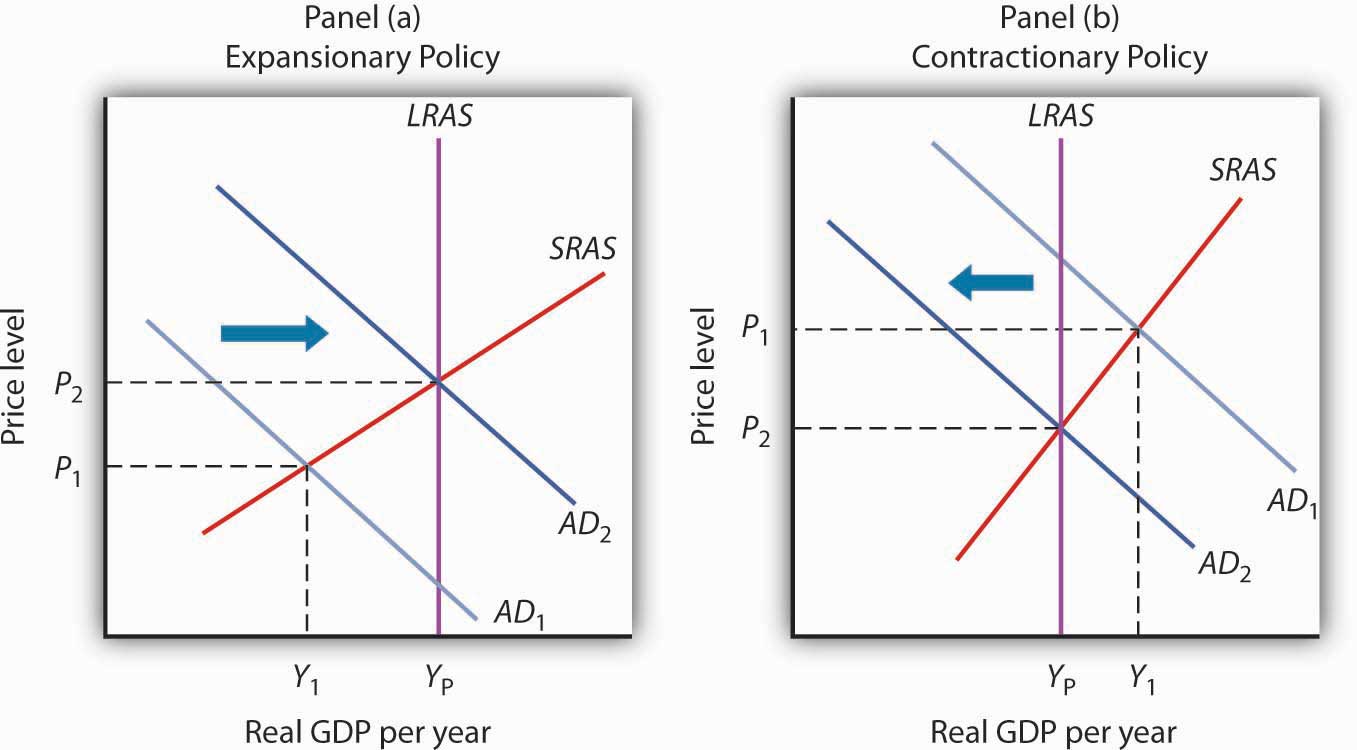
Imagine an economy is in a recession. This means its actual output (Real GDP) is below its potential output, resulting in high unemployment. In this scenario, the government can implement expansionary fiscal policy to boost economic activity.
There are two primary tools for this:
- Increase Government Spending (↑G): The government can increase its spending on goods and services, such as funding new infrastructure projects (roads, bridges) or increasing defense spending. Since government spending (G) is a direct component of aggregate demand (AD = C + I + G + NX), an increase in G directly shifts the AD curve to the right.
- Decrease Taxes (↓T): The government can cut personal income taxes or corporate taxes.
- A cut in personal income taxes increases households' disposable income, leading to higher consumption (C).
- A cut in corporate taxes increases firms' after-tax profits, which can incentivize more investment (I).
Since C and I are components of AD, a tax cut indirectly shifts the AD curve to the right.
The following reading explains this process and illustrates it using the AD-AS model.
Expansionary and Contractionary Fiscal Policy
This reading from Lumen Learning, titled 'Expansionary and Contractionary Fiscal Policy,' details how expansionary policy tools shift aggregate demand to combat a recession.
Read the section titled 'Expansionary Fiscal Policy.' Pay close attention to Figure 2, which shows how the AD curve shifts to the right, moving the economy from a recessionary equilibrium (E0) toward the full-employment level of output (Potential GDP).
The Multiplier Effect
The initial increase in aggregate demand from an expansionary policy is just the beginning. The final impact on GDP is actually larger due to the multiplier effect.
Think about it: when the government spends $1 billion on a new highway, that money becomes income for engineers, construction workers, and materials suppliers. These individuals will then save some of this new income and spend the rest. Their spending, in turn, becomes income for others (grocers, retailers, etc.), who also save some and spend the rest. This chain reaction means the initial $1 billion in spending leads to a total increase in GDP that is a multiple of the original amount.
The same logic applies to a tax cut, although the effect is slightly different. When people receive a tax cut, they save a portion of it. Only the portion that is spent enters the economy to start the multiplier process. For this reason, a $1 change in government spending has a larger impact on GDP than a $1 change in taxes.
This video provides a great overview of the mechanisms of expansionary policy and the multiplier effect.
Y1 30) Fiscal Policy - Government Spending and Taxation
Let's return to the EconplusDal video for a more detailed look at specific expansionary policies and how the multiplier amplifies their effects.
Watch the segment from 03:22 to 05:59. Notice the concrete examples given (e.g., different types of tax cuts) and how the video illustrates the multiplier pushing AD even further to the right.
Given your analytical background, you might appreciate seeing this algebraically. The size of the multiplier depends on the Marginal Propensity to Consume (MPC), which is the fraction of each extra dollar of income that is spent.
The change in GDP () can be calculated as:
- For a change in government spending ():
- For a change in taxes ():
The resource "Using Fiscal Policy to Fight Recession..." provides a clear algebraic example of how this works. You don't need to read the whole text, but looking at the calculation can solidify your understanding. Specifically, in section 3 (under the heading "The Keynesian Cross Model"), the text shows how a $500 increase in government spending can close a $1,000 recessionary gap if the multiplier is 2.
3. Contractionary Fiscal Policy: Cooling Down an Overheating Economy
Now, consider the opposite problem: the economy is "overheating." Aggregate demand is so high that output is temporarily pushed beyond its potential, leading to high inflation (a rapid increase in the price level). This is often called an "inflationary gap."
To address this, the government can use contractionary fiscal policy. The tools are the reverse of what we just discussed:
- Decrease Government Spending (↓G): The government can cut back on its spending, which directly reduces aggregate demand.
- Increase Taxes (↑T): The government can raise personal or corporate taxes, which reduces disposable income and after-tax profits, thereby lowering consumption (C) and investment (I).
Both actions shift the AD curve to the left, moving the economy back toward potential GDP and relieving the upward pressure on prices.
Let's complete our reading to see how this is illustrated.
Expansionary and Contractionary Fiscal Policy
We'll now read the second half of the Lumen Learning article to understand the mechanics of contractionary policy.
Read the section titled 'Contractionary Fiscal Policy.' Focus on Figure 3, which shows the AD curve shifting to the left to close an inflationary gap, reducing the price level.
To quickly review both policy stances side-by-side, this clip is very effective.
Macro Unit 3 Summary- Aggregate Demand/Supply and Fiscal Policy
Jacob Clifford's summary video provides a fast-paced but clear explanation of when and how to use both expansionary and contractionary fiscal policy to close economic gaps.
Watch the segment from 08:32 to 09:47. Note how he connects a specific economic problem (a negative or positive output gap) to a specific policy solution.
Conclusion
In this lesson, we have moved from identifying the tools of fiscal policy to understanding how they are actively used to manage the macroeconomy. By manipulating government spending and taxation, policymakers can shift the aggregate demand curve to address major economic challenges like recessions and inflation.
Key Takeaways:
- Fiscal policy has two main stances: expansionary (to boost AD) and contractionary (to reduce AD).
- Expansionary fiscal policy uses increased government spending (↑G) or tax cuts (↓T) to shift AD to the right. It is used to fight recessions and reduce unemployment.
- Contractionary fiscal policy uses decreased government spending (↓G) or tax increases (↑T) to shift AD to the left. It is used to fight inflation.
- The impact of fiscal policy is magnified by the multiplier effect, where an initial change in spending or taxes leads to a larger overall change in GDP.
Preview of the Next Lesson:
The policies we discussed today—a government passing a law to cut taxes or increase spending—are known as discretionary fiscal policy because they require deliberate, active decisions. However, some fiscal policy happens automatically. In our next lesson, we will explore these automatic stabilizers, such as unemployment benefits and progressive income taxes, which help cushion the economy without any new government action.