Recommended resources
The freely available resources this lesson will direct you to.
- Automatic Stabilizers- Macro Topic 3.9www.youtube.com
- Automatic stabilizers | National income and price determination | AP Macroeconomics | Khan Academywww.youtube.com
- 7.5: Automatic and discretionary fiscal policysocialsci.libretexts.org
- The Keynesian School – Introduction to Macroeconomicspsu.pb.unizin.org
Introduction
Welcome to your third lesson on fiscal policy. In our previous session, we explored how governments use expansionary and contractionary fiscal policy—deliberate changes in government spending and taxation—to manage aggregate demand, fight recessions, and control inflation. These actions require conscious decisions and new legislation from policymakers.
Today, we will address the learning outcome: Distinguish between automatic stabilizers and discretionary fiscal policy. You will learn that the policies we discussed last time are a form of discretionary policy. We will contrast this with automatic stabilizers—mechanisms built into the economic system that help cushion booms and busts without any new government action. Understanding this distinction is crucial for appreciating the full scope of fiscal policy's role in the economy.
1. Discretionary Policy vs. Automatic Stabilizers
Fiscal policy can be broadly divided into two categories based on how it is implemented.
- Discretionary Fiscal Policy: This is the intentional manipulation of government spending or tax rates by policymakers to influence the economy. When you hear news about Congress passing a "stimulus package" to fight a recession or raising taxes to cool down inflation, that is discretionary policy in action. The policies we studied in the last lesson fall into this category.
- Automatic Stabilizers (or Non-Discretionary Policy): These are features of the tax and transfer systems that are already law. They work automatically to reduce the fluctuations of the business cycle by stimulating aggregate demand during recessions and dampening it during expansions.
To get a quick overview of this distinction, please watch the first minute of this video.
Automatic Stabilizers- Macro Topic 3.9
This clip from Jacob Clifford provides a concise introduction, clearly defining and separating fiscal policy into its discretionary and non-discretionary (automatic) components.
Watch the video from the beginning until 01:23. Focus on how he categorizes fiscal policy and gives initial examples for each type.
Now, let's solidify these definitions with a short reading. This text provides a more formal explanation, emphasizing that discretionary policy is often a response to persistent economic shocks, while automatic stabilizers are always at work, moderating transitory fluctuations.
7.5: Automatic and discretionary fiscal policy
This reading from Social Sci LibreTexts, 'Automatic and discretionary fiscal policy,' offers clear definitions for both concepts.
Read the two short sections titled 'Automatic fiscal policy' and 'Discretionary fiscal policy.' Pay attention to the keywords used to describe each: 'automatic' stabilizers for 'transitory' fluctuations, and 'discretionary' policy for 'persistent' shocks.
2. How Automatic Stabilizers Work
So, how do these stabilizers function automatically? They primarily work through the tax system and government transfer payments. Let's explore the two most common examples.
The following video from Khan Academy explains these mechanisms clearly in the context of the business cycle.
Automatic stabilizers | National income and price determination | AP Macroeconomics | Khan Academy
This video walks through how taxes and welfare payments act as automatic stabilizers, explaining their effects during both economic expansions and recessions.
Watch the video from 01:32 to 04:52. As you watch, focus on answering two key questions: How do progressive income taxes automatically take more from the economy during a boom and less during a bust? How do programs like unemployment insurance automatically inject more spending into the economy during a recession and less during an expansion?
Let's summarize the key mechanisms from the video:
During a Recession:
- Taxes: As incomes and corporate profits fall, the amount of tax collected by the government automatically decreases. In a progressive tax system, this effect is stronger because households fall into lower tax brackets. This drop in tax payments cushions the fall in disposable income and consumption (C), thus propping up aggregate demand.
- Transfer Payments: As unemployment rises, more people become eligible for and claim unemployment benefits, welfare, and food stamps. This automatically increases government spending (G), providing an income floor for affected households and supporting consumption.
During an Expansion (Boom):
- Taxes: As incomes and profits rise, tax revenue automatically increases. People move into higher tax brackets, and a larger share of their income goes to taxes. This restrains the growth of disposable income and consumption, helping to cool down the economy and prevent high inflation.
- Transfer Payments: As unemployment falls, fewer people need unemployment benefits or other welfare payments. Government spending on these programs automatically decreases, which helps to dampen aggregate demand.
In short, automatic stabilizers act as a form of "economic shock absorber," making downturns less severe and upturns less inflationary without any new intervention.
3. A Direct Comparison
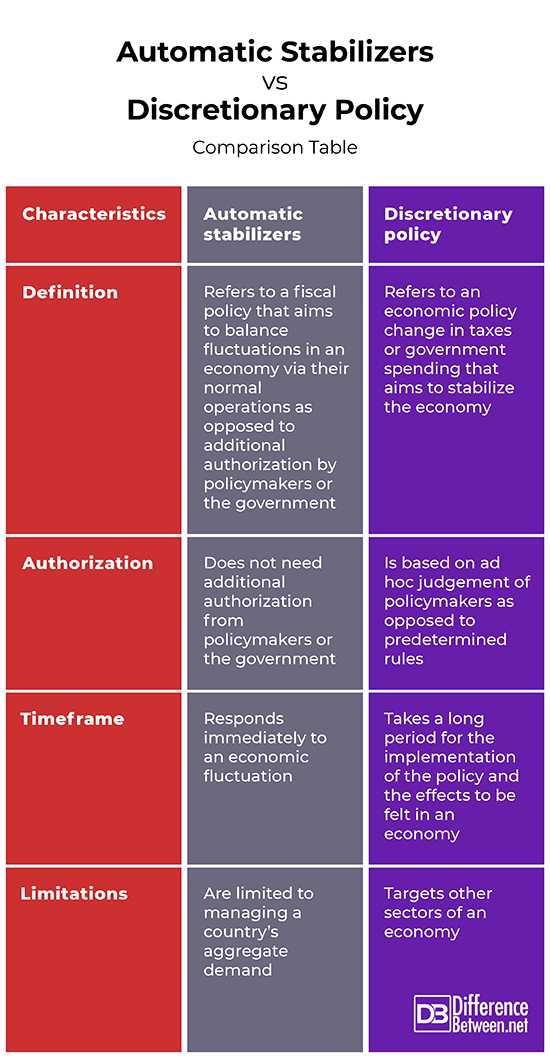
The key difference between the two types of policy comes down to action and timing. Discretionary policy requires a new law, whereas automatic stabilizers are pre-existing. This has significant implications for how quickly they can respond to economic changes.
This table provides an excellent side-by-side comparison.
The Problem of Time Lags
The "Timeframe" row in the table highlights a critical weakness of discretionary policy: time lags. Even after economists recognize a problem, it takes time for policymakers to agree on, implement, and see the effects of a new policy.
7.5: Automatic and discretionary fiscal policy
Let's revisit the LibreTexts article to understand the specific lags that delay discretionary policy.
Find and read the paragraph that begins 'The timelines involved are frequently defined in terms of...'. As you read, identify the four distinct types of lags mentioned.
The four lags are:
- Recognition lag: The time it takes to realize an economic problem exists.
- Decision lag: The time it takes for policymakers (e.g., Congress) to debate and pass a new law.
- Implementation lag: The time it takes to enact the new policy (e.g., send out stimulus checks, start a new infrastructure project).
- Impact lag: The time it takes for the policy to have its full effect on the economy.
Automatic stabilizers completely bypass the first three lags, making them a more immediate and reliable first line of defense against economic fluctuations.
Real-World Interplay
Countries with stronger automatic stabilizers (e.g., more progressive tax systems and more generous unemployment benefits) often need smaller discretionary stimulus packages during a crisis. The data from the 2008-2009 global financial crisis illustrates this relationship well.
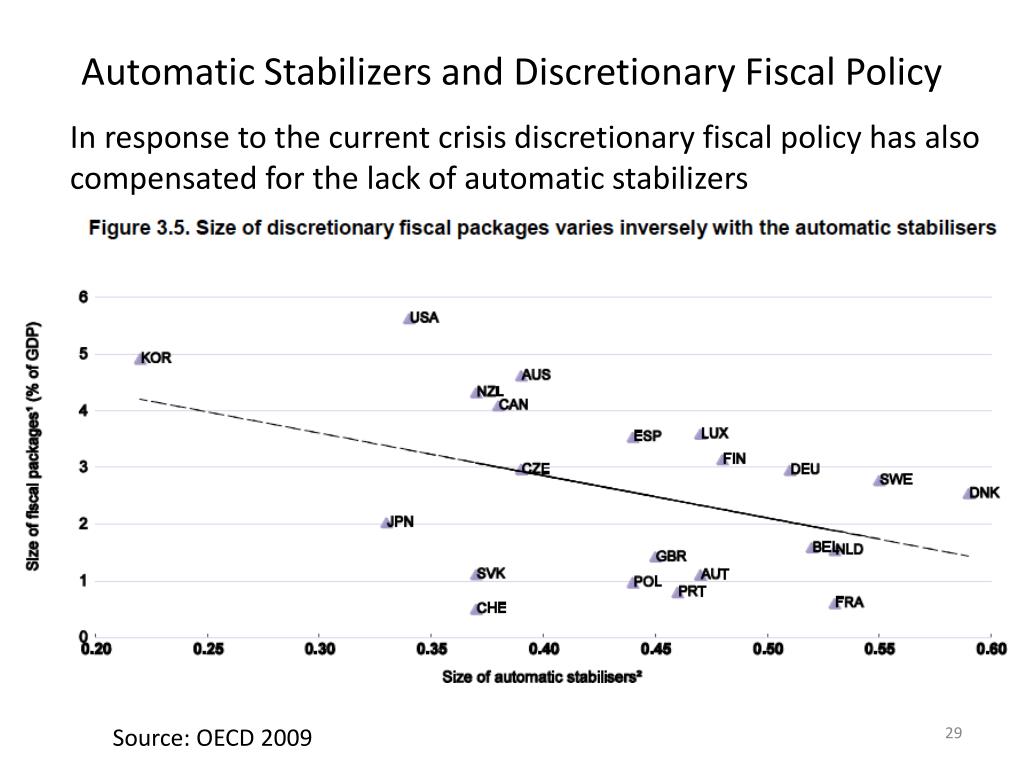
This chart shows that the two types of policy are substitutes to some degree. A lack of automatic stabilization often forces a government to rely more heavily on slower, more politically difficult discretionary action.
Conclusion
In this lesson, we have differentiated between the two primary modes of fiscal policy. You now understand that while politicians debate stimulus packages and tax reforms (discretionary policy), a powerful and automatic system is constantly at work behind the scenes to keep the economy on a more stable path.
Key Takeaways:
- Discretionary fiscal policy involves deliberate, new actions by the government to change spending or taxes to achieve macroeconomic goals.
- Automatic stabilizers are existing laws and programs that automatically adjust government revenue and spending as the economy fluctuates, without any new action.
- Key stabilizers include progressive income taxes (which collect proportionally more during booms and less during busts) and transfer payments like unemployment benefits (which increase during busts and decrease during booms).
- The primary advantage of automatic stabilizers is that they work immediately, avoiding the significant recognition, decision, and implementation lags that hinder discretionary policy.
Preview of the Next Lesson:
The time lags we discussed today are just one of the challenges facing discretionary fiscal policy. In our next lesson, we will dive deeper into the limitations of fiscal policy, exploring other issues such as political constraints and the potential for government borrowing to "crowd out" private investment.