Recommended resources
The freely available resources this lesson will direct you to.
- Y1 33) Rising Budget Deficits and National Debt - Pros, Cons and Evaluationwww.youtube.com
- Does Government Debt Matter Anymore? | Perspectives On Policywww.youtube.com
- [PDF] Chapter 6 Long-run aspects of fiscal policy and public debtweb.econ.ku.dk
- The Impact of Public Debt on Economic Growthwww.mercatus.org
Introduction
In our last lesson, we explored the short-run effects of government debt, focusing on how borrowing to finance deficits can lead to "crowding out" by raising interest rates and reducing private investment. We concluded that this effect is most pronounced when the economy is operating near its full capacity.
Today, we extend that analysis to a much longer time horizon. Our learning outcome is to analyze the long-run implications of persistent government debt. While short-run deficits can be a useful tool for managing recessions, an ever-growing national debt poses a different set of challenges. We will investigate how persistent debt can affect a country's economic growth, its financial stability, and the economic well-being of future generations. We will move from the conceptual to the analytical, introducing a key framework that economists use to assess whether a country's debt path is sustainable.
1. The Long-Run Drag on Economic Growth
The crowding out effect we discussed in the short run becomes a more serious problem when deficits are persistent. A continuous need for government borrowing keeps upward pressure on interest rates over the long term, which systematically discourages private investment.
This has a direct impact on long-run economic growth. Recall that investment in new machinery, technology, and infrastructure increases the economy's capital stock. A larger and more modern capital stock makes workers more productive, which is the ultimate driver of rising living standards.
Therefore, a key long-run implication of persistent debt is a slower rate of economic growth due to the sustained crowding out of private investment.
To understand the various ways this can happen, please read the following sections from a policy brief that summarizes the economic literature on this topic.
The Impact of Public Debt on Economic Growth
This article from the Mercatus Center provides an excellent overview of the channels through which public debt affects economic growth. It synthesizes findings from a large number of empirical studies.
Please read the sections titled 'One such channel is Ricardian Equivalence', 'Another channel through which growing public debt crowds out economic growth is higher long-term interest rates', and 'A third channel through which a growing public debt burden crowds out economic growth is through the inflation and credit risk premium'. Focus on understanding these three distinct mechanisms.
The reading highlights three critical channels:
- Ricardian Equivalence and Savings: Even if crowding out through interest rates isn't perfect, the anticipation of future taxes to pay off the debt can cause households to save more, reducing national saving available for investment.
- Higher Long-Term Interest Rates: This is the classic crowding-out mechanism we've discussed. Persistent government borrowing directly competes with private firms for a limited pool of savings, making investment more expensive.
- Inflation and Risk Premiums: A large debt burden may lead investors to fear that the government will eventually resort to printing money to pay it off, causing inflation. This fear leads them to demand higher interest rates to compensate for both inflation risk and the general risk of default.
All three channels point to the same outcome: less private investment and a smaller capital stock, which translates to lower long-term growth.
2. Debt Sustainability: The Arithmetic of r versus g
Is a country's debt destined to grow forever? Not necessarily. The most important analytical tool for understanding the long-run path of debt is the relationship between the real interest rate (r) paid on the debt and the real growth rate of the economy (g).
Let's break down the logic. Think of the debt-to-GDP ratio as the key metric for sustainability. If this ratio is stable or falling, the debt is manageable. If it's rising uncontrollably, the country is on an unsustainable path.
The change in the debt-to-GDP ratio depends on two main forces:
- The existing debt is growing at the rate of interest,
r. - The denominator, GDP, is growing at the rate
g.
This leads to a critical insight which is explored in the following text.
Chapter 6 Long-run aspects of fiscal policy and public debt
This academic text provides the formal mathematical foundation for analyzing debt dynamics. It can be a bit dense, but we will focus on the core logic.
Please read Section 6.3.1, 'The critical role of the growth-corrected interest factor'. Focus on understanding the contrasting outcomes in Case 1 (r > gY), Case 2 (r = gY), and Case 3 (r < gY). Don't worry about the advanced notations; focus on the core intuition of what happens to the debt-to-income ratio in each case.
This leads to three scenarios, assuming for a moment that the government's budget is balanced excluding interest payments (i.e., tax revenue equals non-interest spending):
-
Case 1:
r > g(The "unstable" case)
If the interest rate on debt is higher than the economy's growth rate, the debt will grow faster than the income available to pay it off. The debt-to-GDP ratio will rise explosively over time, even without any new deficit spending. To stabilize the debt, the government must run a primary budget surplus (tax revenues > non-interest spending). -
Case 2 & 3:
r ≤ g(The "stable" case)
If the economy grows faster than or equal to the interest rate, the country can "grow its way out" of its debt. The debt-to-GDP ratio can be stable or even fall over time, even if the government runs a primary budget deficit.
This r vs g relationship is at the heart of modern debates about government debt. The following video discusses this very issue in the context of the U.S. economy.
Does Government Debt Matter Anymore? | Perspectives On Policy
This video from PolicyEd provides a sharp, real-world perspective on the r vs. g debate, arguing that while it's theoretically possible to roll over debt when r < g, the reality for many countries with large, persistent deficits is far more complicated.
Watch the video from the beginning to 02:38, and then from 03:33 to 04:18. Pay attention to why the speaker argues that the simple 'r < g' story doesn't apply to the U.S. situation and what the potential dramatic consequences of an exploding debt ratio are.
As the video argues, even if r < g, a country cannot run unlimited deficits. If deficits are too large, they will still cause the debt-to-GDP ratio to rise. The condition r < g simply makes the problem more manageable.
3. The Risk of a Debt Crisis
When does a high level of debt transform from a slow drag on growth into an acute crisis? This often happens when investor confidence collapses.
As a country's debt-to-GDP ratio climbs, investors (who buy the government bonds) may start to worry about the government's ability to repay.
- They begin demanding a risk premium—a higher interest rate to compensate for the perceived risk of default.
- This rise in
rworsens the debt arithmetic (r - g), making the debt path even more unsustainable. - This can become a self-fulfilling prophecy: the fear of default raises interest rates, which in turn makes default more likely. This can lead to a sudden stop in lending and a full-blown financial crisis.
This is why many economists worry about debt levels crossing certain thresholds. While there is no single magic number, the empirical evidence suggests the risks increase significantly once debt surpasses a certain percentage of GDP.
This chart shows the wide variation in debt levels across major economies. Countries with very high debt, like Japan, are often watched closely by investors.

The following reading summarizes the empirical findings on these debt thresholds.
The Impact of Public Debt on Economic Growth
Let's return to the Mercatus Center article to see what the data says about the point at which debt becomes particularly harmful.
Read the sections 'Survey Sample Scope' (just the first paragraph), 'Synthesizing the Findings of the Literature', and the 'Conclusion'. Focus on the estimated threshold for advanced economies and the quantitative impact of debt on growth.
The key finding is that for advanced economies, the negative effects of debt on growth tend to accelerate when the debt-to-GDP ratio rises above 75-80%. The meta-analysis suggests each percentage point increase in the debt ratio above this threshold reduces real annual GDP growth by about 0.033 percentage points. While this sounds small, it compounds over time, leading to substantially lower living standards for future generations.
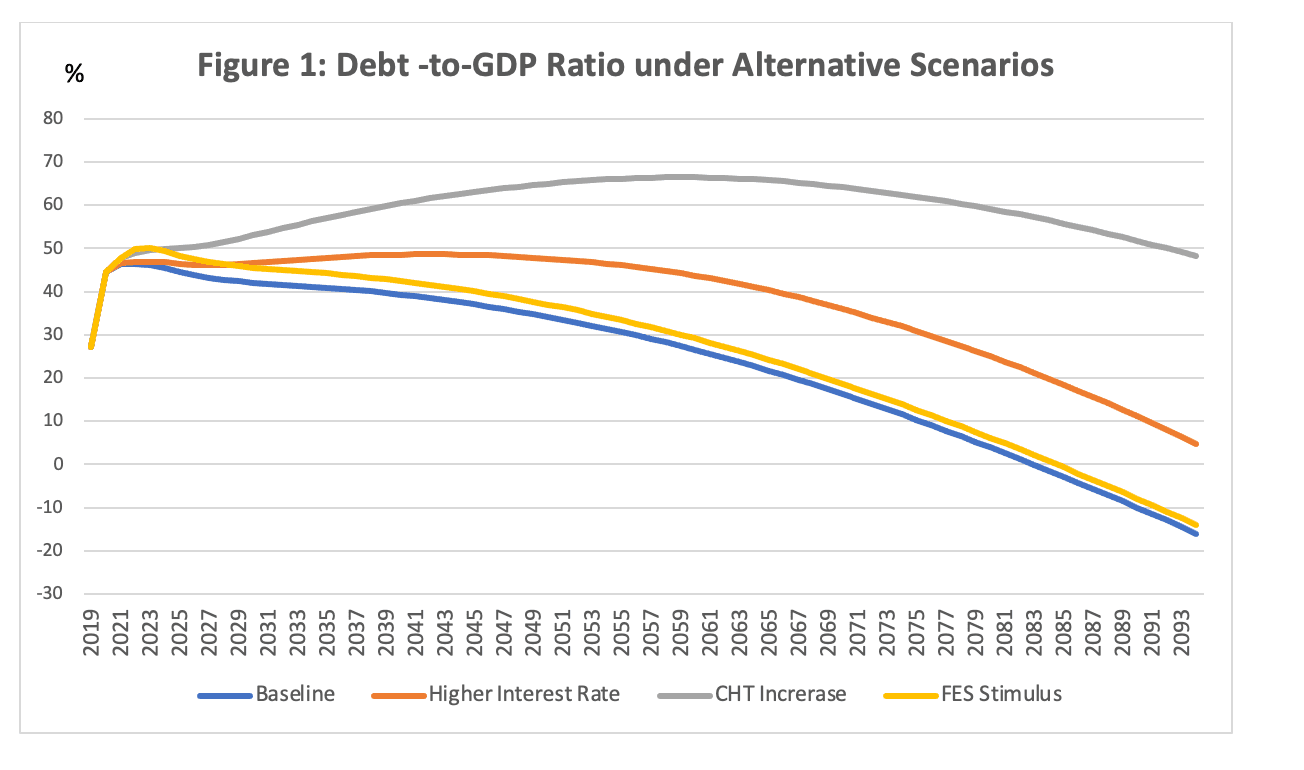
This final chart illustrates how different assumptions about interest rates and government policy can lead to dramatically different long-run debt paths, underscoring the importance of the r vs. g dynamic.
Conclusion
Today we have moved beyond the short-run effects of government borrowing to analyze its long-term consequences. The picture that emerges is one of significant trade-offs.
Key Takeaways:
- Slower Economic Growth: Persistent government debt leads to a long-run "growth drag" by crowding out private investment, which reduces the capital stock and slows productivity growth.
- Debt Sustainability depends on
rvs.g: The relationship between the real interest rate (r) and the real GDP growth rate (g) is the central factor in determining a country's debt trajectory. Ifr > g, the debt-to-GDP ratio will explode unless the government runs a primary surplus. - Risk of Crisis: High levels of debt can trigger a crisis of confidence, leading to soaring interest rates in a self-fulfilling prophecy that can end in default.
- Empirical Thresholds: The negative impact of debt on growth appears to be non-linear, becoming much more severe as the debt-to-GDP ratio for advanced economies surpasses the 75-80% range.
Ultimately, the long-run cost of high and rising public debt is a tangible reduction in future prosperity and an increased risk of financial instability.
Preview of the Next Lesson:
Having spent several lessons on the role of government in macroeconomic stabilization (fiscal policy), we will now pivot to the microeconomic reasons for government intervention. In the next module, we will begin exploring the concepts of market failures—situations where the free market fails to allocate resources efficiently—starting with externalities.