Recommended resources
The freely available resources this lesson will direct you to.
Introduction
Welcome to today's lesson. In our previous session, we established a clear understanding of budget deficits, surpluses, and the national debt. We saw that when a government runs a deficit, it must borrow money to cover the shortfall. This act of borrowing is not without consequences.
Today, we will delve into one of the most significant short-run effects of government borrowing. Our goal is to analyze the short-run effects of government debt, including the concept of crowding out. We will explore the mechanism through which government borrowing can "crowd out" private investment, reducing the effectiveness of fiscal policy. By the end of this lesson, you will be able to explain this process using the loanable funds market model and understand the conditions that make it more or less severe.
1. What is Crowding Out?
At its core, crowding out is the decrease in private investment that occurs as a result of increased government borrowing. When the government runs a budget deficit, it finances this by borrowing money from the same pool of savings that private firms use to finance their own investments (like building new factories or buying new equipment).
Imagine the pool of national savings as a limited resource. When the government increases its demand for this resource, it can make it more expensive for everyone else to access. This "expense" is the interest rate.
Let's begin with a short video that introduces the concept and illustrates it using the loanable funds market.
This video from Marginal Revolution University provides a concise and intuitive explanation of crowding out, including a numerical example that clearly illustrates the mechanism.
Watch the video from the beginning until 02:10. Pay close attention to how government borrowing is represented on the loanable funds market graph and how it affects the interest rate, private consumption, and private investment.
As the video explained, the chain of events is as follows:
- Expansionary fiscal policy (e.g., increased government spending) leads to a budget deficit.
- The government must borrow to finance this deficit.
- This increased government borrowing increases the total demand for loanable funds.
- The increased demand for funds pushes up the equilibrium interest rate.
- The higher interest rate makes it more expensive for private firms to borrow, causing them to reduce their investment spending.
This reduction in private investment is the "crowding out" effect.
2. Visualizing Crowding Out
The loanable funds market graph is the standard tool for analyzing this process. Let's formalize our understanding with a brief reading.
This reading from Lumen Learning formally defines the crowding out effect and explains the process using the market for financial capital.
Read the first two sections, 'Fiscal Policy and Interest Rates' and the main section defining crowding out. Focus on how an increase in government borrowing is depicted as a shift in the demand for financial capital and how this leads to higher interest rates that discourage private spending.
The reading confirms the mechanism we saw in the video. When the government enters the market as a major borrower, it shifts the demand curve for loanable funds to the right, leading to a higher equilibrium interest rate.
This process is visualized in the multi-part diagram below. It connects the government's action to the loanable funds market, and then to the resulting impact on investment and overall aggregate demand.
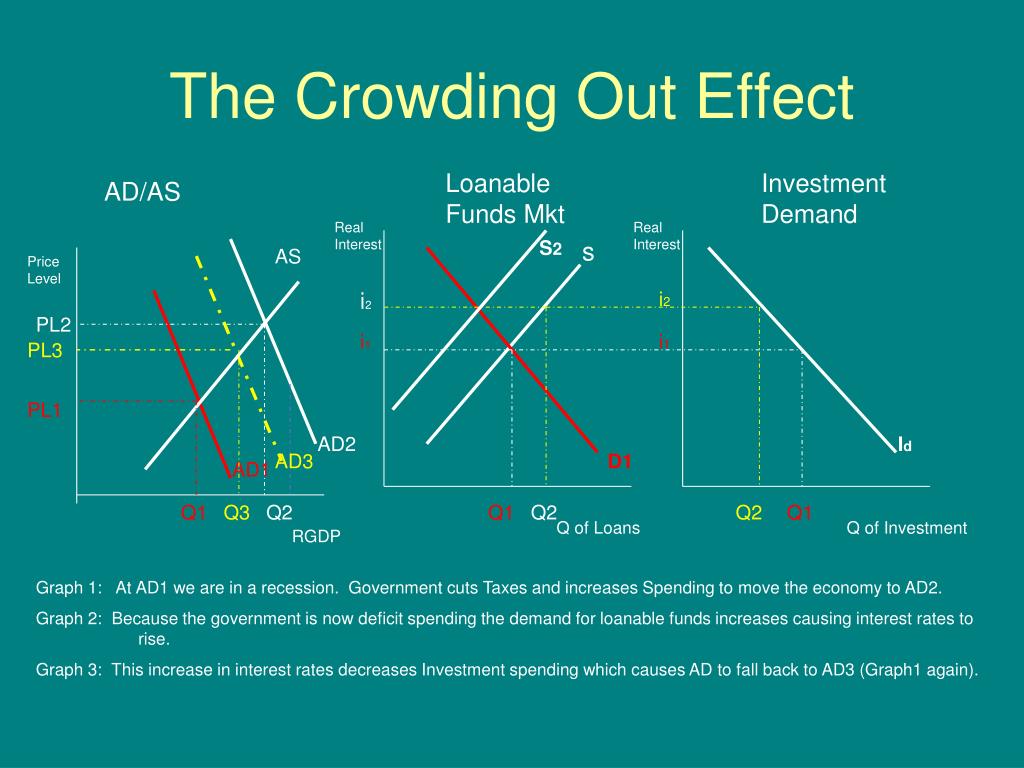
As an IT analyst, you can think of the market for loanable funds as being analogous to a network's bandwidth. If a large government process starts a massive, continuous data transfer (borrowing), it consumes a significant portion of the available bandwidth. This can lead to slower speeds (higher interest rates) for all other users (private firms), causing their own processes (investments) to be delayed or cancelled.
3. Alternative View & Net Effect on the Economy
As you may have noticed, there are slightly different ways to illustrate crowding out on the loanable funds graph. The core result—a higher interest rate and less private investment—remains the same. Let's watch another video that clarifies this and shows the final impact on the AD-AS model.
Macro 5.4 & 5.5 Deficits, Debt, and Crowding Out
This video from ReviewEcon explains the two common ways to model crowding out on the loanable funds graph and then demonstrates its net effect on Aggregate Demand.
Watch from 04:13 to 05:40 to see the two graphical approaches (shifting supply vs. shifting demand). Then, watch from 06:42 to 07:38 to see how crowding out partially offsets an expansionary fiscal policy in the AD-AS model.
The key takeaway is that crowding out does not typically eliminate the impact of expansionary fiscal policy. It only dampens it.
- The initial increase in government spending () shifts Aggregate Demand to the right.
- The subsequent decrease in private investment () due to higher interest rates shifts Aggregate Demand back to the left.
- The net effect is still an increase in aggregate demand, but it is smaller than the government initially intended. The fiscal stimulus has "less punch," as the Lumen reading puts it.
4. When is Crowding Out a Major Concern?
The extent of crowding out is not constant; it depends heavily on the state of the economy.
Economy at Full Employment vs. in a Recession
Crowding out is most significant when the economy is operating at or near full employment. In this state, resources (labor, capital) are already fully utilized. For the government to build a new road, it must pull workers and machinery away from building a private factory. Government spending directly displaces private spending.
However, in a deep recession, the situation is different.
Let's revisit the Marginal Revolution University video to hear the crucial distinction about why crowding out is less of a concern during a recession.
Please watch from 02:10 to the end (02:44).
In a recession, there are idle resources—unemployed workers and unused factory capacity. Banks may also have excess reserves they are hesitant to lend. In this environment, government spending can put these idle resources to work without necessarily taking them away from the private sector. The increase in economic activity can even encourage more private investment, a phenomenon known as "crowding in."
Other Factors
The degree of crowding out also depends on:
- Sensitivity of investment to interest rates: If firms' investment decisions are not very sensitive to changes in interest rates, then even a significant rate hike won't cause much crowding out.
- The role of monetary policy: If the central bank simultaneously engages in expansionary monetary policy, it can work to lower interest rates (or prevent them from rising), thereby counteracting the crowding out effect. This highlights the important interplay between fiscal and monetary policy, which we will explore further in the next module.
Conclusion
Today we dissected the important short-run consequence of government borrowing known as crowding out. We moved from a simple definition to a graphical analysis using the loanable funds market, and finally to an evaluation of its real-world significance.
Key Takeaways:
- Crowding out occurs when government borrowing to finance deficits raises interest rates, leading to a reduction in private investment spending.
- The loanable funds market model shows this as an increase in the demand for funds (or a decrease in the supply available to private borrowers), which increases the equilibrium interest rate.
- Crowding out weakens the effect of expansionary fiscal policy. The final increase in aggregate demand is smaller than it would be otherwise.
- The severity of crowding out is greatest when the economy is near full employment and less of a concern during a deep recession when resources are idle.
Preview of the Next Lesson:
Our focus today has been on the short-run effects of government debt. But what happens when debt accumulates year after year? In our next lesson, we will shift our perspective to analyze the long-run implications of persistent government debt, including its impact on economic growth and the potential burdens on future generations.