Recommended resources
The freely available resources this lesson will direct you to.
Introduction
In our last lesson, we explored the limitations of fiscal policy, noting that expansionary actions like increased government spending or tax cuts often require the government to borrow money. This process of borrowing to cover the gap between spending and revenue is a fundamental aspect of modern fiscal policy and leads directly to our topic for today.
This lesson addresses the learning outcome: Explain the concepts of a budget deficit, a budget surplus, and the national debt. We will formally define these crucial terms, clarify the relationship between them, and explore some important nuances in how they are measured and understood. Mastering these definitions is essential, as they form the bedrock for analyzing the economic consequences of government borrowing, which we will tackle in upcoming lessons.
1. The Core Concepts: Deficit, Surplus, and Debt
At its simplest, a government's budget is like a household's: it has income (revenue) and expenses (spending). The balance of these two determines whether there is a shortfall or a surplus.
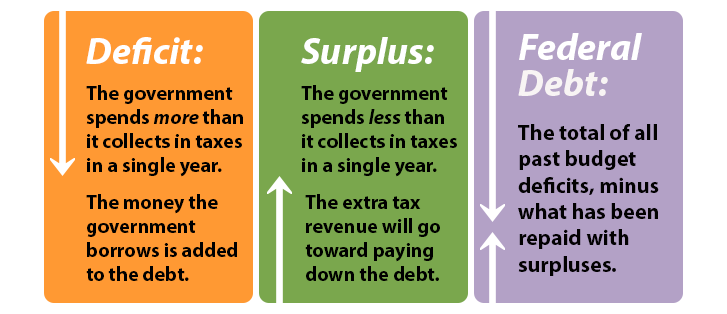
- A budget deficit occurs when government spending is greater than its revenue in a given year.
- A budget surplus occurs when government revenue is greater than its spending in a given year.
- The national debt is the total accumulated amount the government has borrowed over its entire history to cover all past deficits, minus any surpluses used to pay back debt.
This infographic provides a clear visual summary of these definitions.
A crucial distinction to make is between a flow and a stock.
- A deficit or surplus is a flow concept. It is measured over a period of time, typically one year. For example, the deficit in 2024 was $X trillion.
- The national debt is a stock concept. It is a cumulative total measured at a single point in time. For example, the debt as of today is $Y trillion.
To see how this works in practice, let's watch a short video that uses a simple year-by-year example.
Deficits and debt | AP Macroeconomics | Khan Academy
The Khan Academy video, 'Deficits and debt,' provides an excellent, clear explanation of how annual deficits add to the total national debt, and how a surplus can reduce it.
Watch the video from the beginning to 03:11. Pay close attention to the table tracking the deficit and debt year by year. Notice how a 'negative deficit' is simply another name for a surplus.
The relationship demonstrated in the video gives rise to a powerful visual analogy: the iceberg.

This distinction between the annual flow (deficit) and the cumulative stock (debt) is fundamental. It's similar to how in IT, you might track the flow of data traffic over a network per second, versus the total stock of data stored on a server.
2. A More Nuanced Look at Deficits and Debt
While the basic definitions are straightforward, economists and policymakers use more specific terms to analyze the budget with greater precision.
Cyclical vs. Structural Deficits
Not all deficits are created equal. Their cause matters. In our previous module on the AD-AS model, we saw that the economy naturally goes through business cycles. These cycles automatically affect the government's budget.
- Cyclical Deficit: This is the part of the deficit that exists because the economy is in a recession. During a downturn, tax revenues automatically fall (as incomes and profits decline) and government spending on automatic stabilizers like unemployment benefits automatically rises. This type of deficit shrinks or disappears as the economy recovers.
- Structural Deficit: This is the part of the deficit that would still exist even if the economy were operating at its full potential (full employment). It is caused by a long-term mismatch between government spending commitments and tax revenues.
To solidify this distinction, please watch this brief segment.
Y1 33) Rising Budget Deficits and National Debt - Pros, Cons and Evaluation
This clip from EconplusDal clearly explains the difference between structural and cyclical deficits, linking them to the state of the economy.
Watch the video from 00:19 to 00:55. Focus on how a cyclical deficit is tied to recessions, while a structural deficit is a more persistent feature of the government's budget.
Understanding this difference is crucial for policy. A cyclical deficit can be seen as a healthy, automatic response to a recession. A persistent structural deficit, however, is often a greater cause for concern among economists as it implies a long-term imbalance.
How is Debt Measured?
Just as there are nuances to deficits, there are different ways to measure the national debt. The following reading explains the three main measures. It's a slightly more detailed text, but your technical background will help you appreciate the precision of these definitions.
This article from the Center on Budget and Policy Priorities provides detailed, clear definitions of the different ways to measure government debt.
Read the section titled 'Debt.' Focus on understanding the distinction between the three measures presented: 'Debt held by the public,' 'Net debt,' and 'Gross debt.' Pay special attention to why 'Debt held by the public' is considered the most relevant measure for the economy.
Let's summarize the key takeaways from that reading:
- Gross Debt: This is the total of all government borrowing, including the money the government owes to itself. For instance, the Treasury borrows from the Social Security trust fund. While this is an internal accounting liability, it doesn't represent borrowing from the private economy.
- Debt Held by the Public: This is the gross debt minus the debt held by other government agencies. It measures how much the government has borrowed from individuals, banks, businesses, and foreign governments. This is the most important figure for economic analysis because it represents the government's demand on private credit markets and is directly related to the "crowding out" effect we discussed in the last lesson.
- Net Debt: This is debt held by the public minus the government's financial assets (like student loans it has issued). It provides the most comprehensive picture of the government's net financial position.
For most economic discussions, when you hear about "the national debt," it usually refers to debt held by the public.
3. Putting Debt in Context: The Debt-to-GDP Ratio
Is a $30 trillion national debt large? The absolute number is so big it's hard to comprehend. To make sense of it, we need to compare it to the size of the economy. The most common way to do this is by using the debt-to-GDP ratio.
Debt-to-GDP Ratio = (Debt Held by the Public / Gross Domestic Product) x 100%
This ratio provides context. A large debt is more manageable for a large economy, just as a $500,000 mortgage is more manageable for someone earning $200,000 a year than for someone earning $50,000 a year. It measures the country's ability to produce and sell goods and services, which is the ultimate source of funds to pay back the debt.
The Khan Academy video and the CBPP article both show charts of the historical U.S. debt-to-GDP ratio, illustrating how it has changed over time, often spiking during wars and major recessions. Watching the economy grow faster than the debt can cause this ratio to fall, even if the government is still running small deficits.
Conclusion
In this lesson, we have established the precise definitions needed to discuss government finances. You can now confidently distinguish between the key concepts of deficits, surpluses, and the national debt.
Key Takeaways:
- A budget deficit is an annual flow where spending exceeds revenue. A surplus is the opposite.
- The national debt is a cumulative stock representing the total of all past net borrowing.
- Deficits can be broken down into cyclical (due to the business cycle) and structural (a long-term imbalance) components.
- The most economically relevant measure of debt is debt held by the public, as it reflects borrowing from private credit markets.
- The debt-to-GDP ratio is the critical metric for placing the national debt in the context of the economy's ability to support it.
Preview of the Next Lesson:
Now that we have a solid definitional foundation, we can move on to the analytical questions. In the next lesson, we will analyze the short-run economic effects of government debt, focusing specifically on how it impacts interest rates and private investment—a deeper dive into the crowding-out effect.