Recommended resources
The freely available resources this lesson will direct you to.
Introduction
Welcome to our final lesson in the module on Fiscal Policy and Public Debt. In our previous lessons, we've focused on government spending and borrowing, culminating in our analysis of the long-run implications of national debt. Today, we turn our attention to the other side of the government's ledger: revenue. Specifically, we'll explore the world of taxation.
This lesson is designed to help you describe the principles of taxation (equity and efficiency) and distinguish between progressive, regressive, and proportional taxes. We will start by establishing the core criteria economists use to evaluate a tax system. Then, we will use these criteria to define and classify the main types of taxes you'll encounter in economic discussions. Understanding how taxes are designed and their effects on different groups is crucial for analyzing almost any government policy.
1. The Core Principles of a "Good" Tax System
When designing a tax system, policymakers face a fundamental challenge: how to raise the necessary revenue while minimizing negative economic side effects and distributing the burden in a way that society considers fair. This balancing act rests on two major principles: efficiency and equity.
However, these two goals are often in conflict. Making a tax system more equitable can sometimes make it less efficient, and vice versa. The famous economist Arthur Okun described this as the "leaky bucket" problem of redistribution.
To get an intuitive grasp of this core trade-off, let's watch a segment from an MIT lecture by Professor Jonathan Gruber.
In this video, Professor Gruber introduces the concepts of equity and efficiency and uses the powerful 'leaky bucket' analogy to illustrate the costs associated with redistributing resources.
Please watch from the beginning until the 03:50 mark. Focus on understanding why there is often a trade-off between equity (fairness) and efficiency (the size of the economic pie).
As the video explains, the "leakage" in the bucket represents the efficiency lost when we transfer resources. This loss arises because taxes can change people's behavior in ways that are economically unproductive. Now, let's formalize these principles.
[PDF] Chapter 2: Tax Principles
This document from the Washington Department of Revenue provides clear, standard definitions for the principles of a well-designed tax system. It's a great reference for the formal terminology.
Please read the sections titled 'Equity/Fairness' and 'Economic Neutrality and Efficiency'. Pay close attention to the definitions of vertical equity, horizontal equity, and the benefits-received principle.
Let's break down these key principles from the reading:
A. Equity (Fairness)
The principle of equity deals with how the tax burden is distributed. It's typically broken down into two sub-principles:
- Vertical Equity: This is the idea that taxpayers with a greater ability to pay should contribute a larger amount of tax. This is the most common notion of fairness in taxation. As we will see, this principle is the basis for classifying taxes.
- Horizontal Equity: This principle states that taxpayers in similar financial situations should pay similar amounts of tax. It's about treating equals equally. For example, two individuals with the same income and family size should face the same tax bill.
A less common but still relevant concept of fairness is the Benefits Received Principle, which suggests that individuals should pay taxes in proportion to the benefits they receive from government services. A tax on gasoline used to fund road maintenance is a classic example.
B. Efficiency (or Economic Neutrality)
An efficient tax system is one that minimizes its interference with economic decisions. Taxes create a "wedge" between the price a buyer pays and the price a seller receives, which can distort the choices people make about what to buy, how much to work, and where to invest. These distortions create a deadweight loss, which is the "leakage" in Okun's bucket. The goal of an efficient tax system is to raise the necessary revenue with the smallest possible deadweight loss.
To connect this back to the "leaky bucket," the sources of leakage are the efficiency costs of taxation. Professor Gruber's lecture explains these costs clearly.
Let's return to the MIT lecture to see exactly what causes the 'leaks' in the bucket.
Watch the segment from 35:03 to 38:31. Focus on the three sources of leakage: administrative costs, efficiency costs of taxation (disincentives), and efficiency costs of transfers.
2. Classifying Taxes: Progressive, Proportional, and Regressive
Now we can use the principle of vertical equity to categorize taxes. The classification depends entirely on how the average tax rate changes as a person's income changes. The average tax rate is simply the total tax paid divided by total income.
A fantastic and clear explanation of these three tax systems is provided in the following video.
Y1 29) Progressive, Proportional and Regressive Tax Systems
This video from EconplusDal clearly defines and provides examples for progressive, proportional, and regressive taxes. The numerical example for the regressive tax is particularly helpful.
Watch from 00:29 to 03:27. Pay close attention to how the average tax rate behaves in each of the three systems.
Based on the video, we can define the three systems:
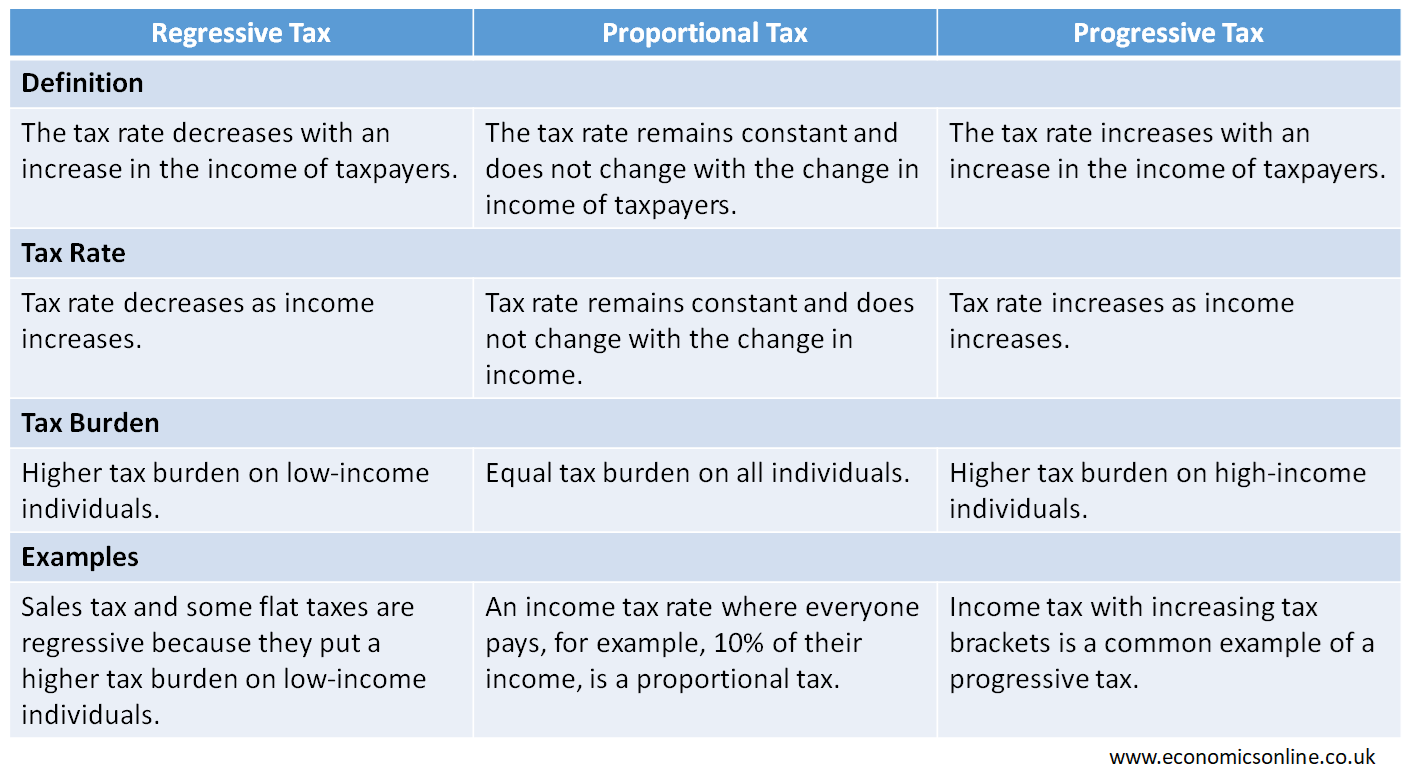
- Progressive Tax: The average tax rate increases as income increases. Higher-income individuals pay a larger percentage of their income in taxes.
- Example: The federal income tax in the United States, where income is taxed at higher rates in successive "brackets".
- Proportional Tax (or Flat Tax): The average tax rate is constant, regardless of income. Everyone pays the same percentage of their income in taxes.
- Example: A hypothetical 15% flat income tax for all income levels.
- Regressive Tax: The average tax rate decreases as income increases. Lower-income individuals pay a larger percentage of their income in taxes.
- Example: A general sales tax. As the video explained with fuel duty, a lower-income person and a higher-income person might pay the same dollar amount in tax on a purchase, but that dollar amount represents a much larger fraction of the lower-income person's total income.
The following graph provides a clear visual summary of these definitions.

And here is a table that summarizes the key characteristics of each system.
3. The Equity-Efficiency Trade-off in Practice
As we've seen, designing a tax system involves balancing competing goals. A policy that promotes equity might harm efficiency, and vice versa.
Consider a sales tax. We know it's regressive, which many would argue is vertically inequitable. A common policy to make it less regressive is to exempt necessities like groceries.
Let's analyze this using our principles:
- Equity: Exempting groceries improves vertical equity. Since lower-income households spend a larger proportion of their income on food, this exemption reduces their overall tax burden relative to higher-income households.
- Efficiency: However, this exemption reduces the efficiency of the tax. The tax system is no longer "neutral" because it treats spending on groceries differently from spending on, say, clothing or electronics. It encourages people to consume more groceries relative to other goods, distorting their natural consumption choices and creating a small deadweight loss.
This is a classic example of the trade-off. In this case, most societies have decided that the gain in equity is worth the small loss in efficiency.
Conclusion
In this lesson, we have laid out the fundamental framework for analyzing taxation. We've moved from the abstract principles of what makes a tax system "good" to the practical classification of taxes based on how they affect different income groups.
Key Takeaways:
- Tax systems are primarily evaluated based on the principles of equity (fairness) and efficiency (minimizing economic distortions).
- Equity can be viewed through the lens of vertical equity (ability to pay), horizontal equity (treating equals equally), and the benefits-received principle.
- Efficiency is about creating a "neutral" tax system that doesn't significantly alter the economic decisions of individuals and firms, thereby minimizing deadweight loss.
- Based on vertical equity, taxes are classified by how their average tax rate changes with income:
- Progressive: Average tax rate rises with income.
- Proportional: Average tax rate is constant.
- Regressive: Average tax rate falls with income.
- Policymakers constantly face a trade-off between equity and efficiency, as policies designed to make the tax system fairer can often make it less efficient.
Preview of the Next Lesson:
We have now concluded our two modules on macroeconomic policy (Fiscal Policy and, before that, Aggregate Demand and Supply). In our next module, we will pivot to the other major branch of macroeconomic policy: Monetary Policy. To do that, we must first understand the foundation of the financial system itself. Our next lesson will address a very fundamental question: What is money? We will define it and explain its three crucial functions in a modern economy.