Recommended resources
The freely available resources this lesson will direct you to.
Introduction
Welcome to a new module! We've just concluded our deep dive into fiscal policy, where we explored how governments use spending and taxation to influence the economy. Now, we pivot to the other major pillar of macroeconomic management: monetary policy.
But before we can analyze how a central bank conducts monetary policy, we need to answer a more fundamental question: What exactly is money? It might seem obvious, but in economics, "money" has a very specific definition that goes beyond the coins and banknotes in your wallet.
This lesson is designed to help you define money and explain its three crucial functions: as a medium of exchange, a unit of account, and a store of value. Understanding these functions is the essential first step to comprehending how money is created, how the banking system operates, and how monetary policy is transmitted through the economy.
1. A World Without Money: Barter and Its Problems
To appreciate the role of money, let's first imagine an economy without it. This is known as a barter system, where goods and services are traded directly for other goods and services.
While simple in concept, bartering is highly inefficient in a complex, modern economy. The biggest hurdle is what economists call the double coincidence of wants. For a trade to occur, you not only have to find someone who has what you want, but that person must also want what you have to offer.
To see why this is such a major obstacle, let's start with a short video that illustrates the problem.
Functions of money | Financial sector | AP Macroeconomics | Khan Academy
This video from Khan Academy provides an excellent narrative to help you understand the core problem of a barter economy.
Watch the first 2 minutes and 34 seconds of the video. Focus on the example of the lawyer and the chair maker, and make sure you understand the term 'double coincidence of wants'.
As the video explains, the search for a trading partner in a barter system consumes a huge amount of time and energy—resources that could otherwise be used for producing goods and services. An IT analyst who wants a new bicycle would have to find a bicycle maker in need of IT services. This is clearly impractical and severely limits economic activity and specialization.
To solidify this concept, let's turn to a brief reading.
14.1 Defining Money by Its Functions - OpenStax
This text from OpenStax provides a formal definition and further examples of the inefficiencies of barter.
Please read the first two paragraphs, under the heading 'Barter and the Double Coincidence of Wants'.
Money, therefore, is not just a convenience; it's a crucial social invention that solves the problems of the barter system and allows for complex economies to exist.
2. The Three Functions of Money
For something to be considered "money," it must perform three essential functions. Anything that successfully fulfills these three roles can be used as money—whether it's a seashell, a digital entry in a ledger, or a piece of paper.
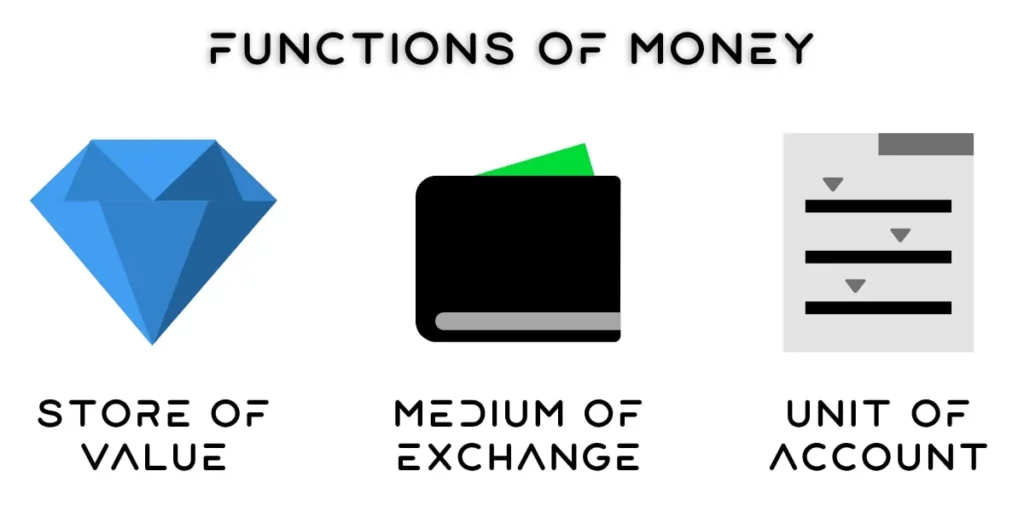
Let's watch the remainder of the Khan Academy video, which explains each of these functions in turn.
Functions of money | Financial sector | AP Macroeconomics | Khan Academy
The rest of this video walks through each of the three functions, continuing the lawyer and chair maker example.
Watch from 2:34 to the end. As you watch, try to define each of the three functions in your own words.
Now, let's formalize these definitions with a reading and add more detail.
14.1 Defining Money by Its Functions - OpenStax
This section from the OpenStax textbook provides clear, concise definitions for each of the three functions of money.
Read the section titled 'Functions for Money'. Pay attention to how each function directly solves a problem associated with barter.
Let's break down and synthesize the information from the video and the reading.
| Function | What It Means | Problem It Solves |
|---|---|---|
| Medium of Exchange | It is an item that buyers give to sellers when they want to purchase goods and services. | Solves the double coincidence of wants. You don't need to find someone who wants what you have; you just need to find someone who accepts money. |
| Unit of Account | It is the "yardstick" people use to post prices and record debts. It provides a common measure of value. | Solves the problem of relative prices. In a barter economy, you'd need to know the price of every good in terms of every other good (e.g., how many apples for a chair, how many legal hours for a car). Money simplifies this immensely. |
| Store of Value | It is an item that people can use to transfer purchasing power from the present to the future. | Solves the problem of saving. In a barter system, it is difficult to save value if your goods are perishable (like food) or go out of style (like clothes). Money allows you to store the value of your work. |
A Note on "Store of Value"
As the reading points out, money doesn't have to be a perfect store of value. During periods of inflation, money loses purchasing power—the amount of goods and services you can buy with a dollar decreases. However, as long as its value is relatively stable, it can still function as money. If inflation becomes too high (hyperinflation), people may lose faith in money and stop accepting it, at which point it ceases to fulfill its functions.
To get a final, quick-fire summary of these concepts, the following video is very effective.
This short video by Jacob Clifford offers a very energetic and concise recap of the three functions.
Watch the entire video (it's only about a minute long). It's a great way to reinforce the key definitions.
3. A Fourth Function: Standard of Deferred Payment
Some economists, including the author of the OpenStax text you read, identify a fourth function of money: being a standard of deferred payment.
This means that money is a widely accepted way to value and settle a debt in the future. When you take out a loan to buy a car or a house, the loan agreement is specified in monetary terms (e.g., dollars, euros, yen), and you are legally obligated to pay it back in that same monetary unit.
This function is closely related to the other three. A debt contract is denominated using money as the unit of account, and the future payment is made using money as the medium of exchange. The lender is willing to accept future payment because they believe the money will still be a reasonable store of value. This function is fundamental to the existence of credit and lending markets.
Conclusion
In this lesson, we established the economic definition of money. Rather than being defined by its physical form, money is defined by what it does. We began by exploring the immense inefficiency of a barter economy, which is plagued by the "double coincidence of wants." We then saw how the invention of money solves this and other problems by serving three primary functions.
Key Takeaways:
- A barter system, where goods are traded for other goods, is highly inefficient because it requires a double coincidence of wants.
- Money is anything that is widely accepted in an economy and serves three key functions:
- Medium of Exchange: It acts as an intermediary for transactions.
- Unit of Account: It provides a common measure of value, simplifying pricing and economic calculation.
- Store of Value: It allows purchasing power to be transferred from the present to the future.
- Money does not need to be a perfect store of value, but high inflation can undermine its usefulness.
- A related function is the standard of deferred payment, which is crucial for loans and other contracts that involve future payments.
Preview of the Next Lesson:
Now that we have a solid definition of what money is, we can explore a fascinating question: Where does it come from? While central banks print currency, most of the "money" in a modern economy is actually created by commercial banks. In our next lesson, we will investigate the fractional-reserve banking system and learn how the simple act of a bank making a loan can create new money.