Recommended resources
The freely available resources this lesson will direct you to.
- Oligopolies, duopolies, collusion, and cartels | Microeconomics | Khan Academywww.youtube.com
- Game Theory and Oligopoly: Crash Course Economics #26www.youtube.com
- Cartels - Econlib - The Library of Economics and Libertywww.econlib.org
- 13.2: Oligopoly in Practice - Social Sci LibreTextssocialsci.libretexts.org
Introduction
Welcome back! In our last lesson, we established a powerful tool for analyzing strategic situations: the Nash Equilibrium. We saw how the Prisoner's Dilemma illustrates a key insight—that individually rational decisions can lead to a collectively suboptimal outcome.
Today, we will apply this game theory framework directly to the behavior of firms in an oligopoly. This lesson will explore why firms might be tempted to cooperate, a practice known as collusion, and why these cooperative arrangements, called cartels, are inherently unstable.
By the end of this lesson, you will be able to define collusion and cartels and, more importantly, use the principles of game theory to explain the powerful economic incentives that cause these agreements to break down. This is a crucial step in understanding the complex dynamics of imperfectly competitive markets.
What are Collusion and Cartels?
In an oligopoly, a few firms dominate the market. They are caught in a web of strategic interdependence: each firm's profit depends not only on its own decisions but also on the decisions of its rivals. This creates a fundamental tension between competition and cooperation.
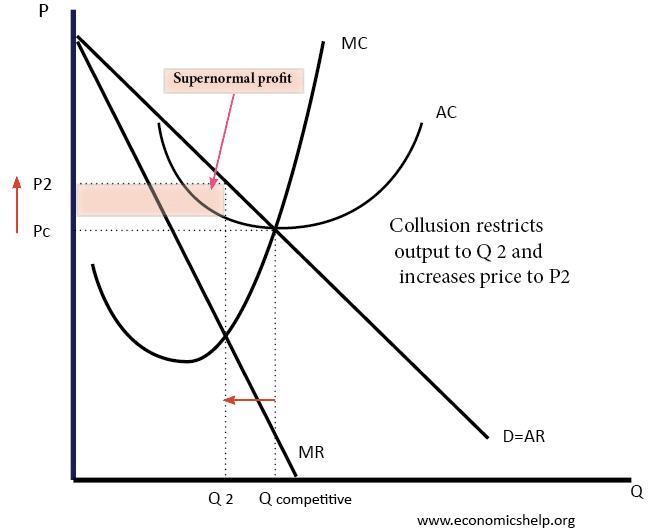
- Collusion is an agreement among firms in a market about quantities to produce or prices to charge. It is an attempt to reduce competition and act more like a monopolist.
- A cartel is a group of firms acting in unison through a formal, explicit agreement to collude.
The primary goal of a cartel is to increase profits for its members. By coordinating to restrict output and raise prices, the firms can achieve monopoly-like profits, which are significantly higher than what they would earn under intense competition.
To get a clearer picture of these concepts and see some real-world examples, please watch the following video.
Game Theory and Oligopoly: Crash Course Economics #26
This segment from Crash Course Economics provides a great introduction to collusion and cartels, explaining their purpose and providing the classic example of OPEC.
Please watch the segment from 05:54 to 07:12. Focus on the definitions of collusion and cartel, and how they benefit firms at the expense of consumers.
As the video mentions, explicit price-fixing agreements like cartels are illegal in many countries, including the United States, due to antitrust laws. However, the incentive to cooperate remains, and the most famous international example, OPEC (Organization of the Petroleum Exporting Countries), operates legally as an agreement between sovereign nations.
The Cartel's Dilemma: The Incentive to Cheat
If cartels can lead to monopoly profits, why don't they always form and persist? The answer lies in the same logic we explored in the Prisoner's Dilemma. While firms in a cartel have a collective incentive to cooperate, each individual firm has a powerful private incentive to cheat.
Let's formalize this using a payoff matrix, just as we did in the previous lesson.

Now, let's analyze this game using the best response method you learned previously:
-
Analyze Firm A's best responses:
- If Firm B decides to Hold to Agreement, what is Firm A's best move? Firm A can also hold and earn $100M, or break the agreement and earn $150M. Its best response is to Break Agreement.
- If Firm B decides to Break Agreement, what is Firm A's best move? Firm A can hold and earn $20M, or break the agreement and earn $40M. Its best response is again to Break Agreement.
-
Analyze Firm B's best responses:
- Because the matrix is symmetrical, the logic is identical. In both scenarios—whether Firm A holds or breaks the agreement—Firm B's best response is to Break Agreement.
The Nash Equilibrium is the outcome where both firms play their best response, which is (Break Agreement, Break Agreement). In this equilibrium, both firms earn $40M. Notice that this is a worse outcome for both of them compared to the $100M they each would have earned if they had both held to the agreement.
This demonstrates the core problem:
- The collusive outcome (Hold, Hold) is the best for the group.
- However, it is not a stable Nash Equilibrium because each firm has a dominant strategy to cheat.
- The pursuit of individual self-interest leads the cartel to collapse, and the firms end up worse off.
To reinforce this crucial point, please watch the next segment of the Crash Course video.
Game Theory and Oligopoly: Crash Course Economics #26
This segment uses a payoff matrix to demonstrate exactly why collusion is so unstable. It connects the concepts of game theory directly to the incentive to cheat in a cartel.
Watch from 07:12 to 08:32. Pay close attention to how the presenter identifies the dominant strategy for each company, leading to a suboptimal outcome for the group.
Real-World Challenges to Maintaining a Cartel
The Prisoner's Dilemma provides the theoretical foundation for why cartels are unstable. In the real world, several practical challenges make successful, long-term collusion even more difficult.
For a deeper dive into these practical hurdles, please read the following article from Econlib. It builds on the game theory model by introducing the real-world problems of forming and enforcing a collusive agreement.
The article 'Cartels' by Andrew R. Dick provides an excellent overview of the practical difficulties cartels face. It moves beyond the simple 2-player model to discuss the broader challenges of coordination, monitoring, and punishment.
Please read the article from the beginning down to the list of numbered points under the heading 'Economists have identified a range of conditions...'. Focus on understanding the two main hurdles identified by George Stigler: (1) reaching a consensus and (2) detecting and punishing cheating.
As the article explains, a successful cartel must overcome two major obstacles:
-
Reaching a Consensus: It's not just about agreeing on a price. Members must agree on output quotas, quality levels, marketing strategies, and how to handle new product introductions. The more firms and the more complex the product, the harder it is to reach an agreement.
-
Deterring Cheating: A cartel must have mechanisms to:
- Monitor its members to detect cheating (e.g., secret price cuts or exceeding production quotas).
- Punish cheaters effectively. Punishment, such as starting a price war, is costly for the punishing firms as well, which can make them reluctant to enforce the agreement.
Furthermore, even a well-functioning cartel is threatened by external competition. The high profits earned by the cartel act as a powerful magnet, attracting new firms to enter the market. These new entrants, not being part of the agreement, will likely price below the cartel price, eroding the cartel's market share and profits, and often leading to its collapse.
Conclusion
In this lesson, we connected the abstract principles of game theory to the concrete behavior of firms in an oligopoly. We've seen that while the potential for monopoly profits creates a strong incentive to collude, the logic of the Prisoner's Dilemma creates an even stronger incentive for individual firms to cheat.
Here are your key takeaways:
- Collusion is an agreement among firms to limit competition, and a cartel is a formal organization to facilitate it. Their goal is to restrict output and raise prices to earn monopoly-like profits.
- The strategic situation faced by cartel members is a Prisoner's Dilemma.
- Each firm has a dominant strategy to cheat on the agreement (e.g., by lowering its price or increasing output) to capture a larger share of the market, regardless of what other firms do.
- The Nash Equilibrium of this game is for all firms to cheat, leading to the collapse of the cartel and lower profits for everyone than if they had successfully colluded.
- Beyond the game-theoretic instability, cartels fail due to practical challenges like agreeing on terms, monitoring behavior, effectively punishing cheaters, and preventing new firms from entering the market.
In our next lesson, we will step back and synthesize our knowledge. We will compare the four main market structures—perfect competition, monopolistic competition, oligopoly, and monopoly—across key dimensions like price, output, and economic efficiency.