Recommended resources
The freely available resources this lesson will direct you to.
Introduction
Welcome back. In our last lesson, we explored the Prisoner's Dilemma, where we saw how individually rational choices can lead to a collectively poor outcome. We identified the Nash Equilibrium in that specific context as the result of both players choosing their dominant strategies.
Today, we will generalize this powerful concept. The goal of this lesson is to define Nash equilibrium more broadly and learn a systematic method to find it in any simple two-player game, even when dominant strategies don't exist. This will deepen your understanding of strategic interdependence and equip you to analyze a much wider variety of economic and social interactions.
By the end of this lesson, you will be able to explain what a Nash equilibrium is in terms of "best responses" and confidently apply a step-by-step method to identify the equilibrium outcome(s) in a payoff matrix.
Defining Nash Equilibrium: The "Best Response"
In the Prisoner's Dilemma, the outcome was easy to predict because both players had a dominant strategy—an action that was best regardless of the other player's choice. But what happens when a player's best move depends on the other's choice?
This brings us to the general definition of a Nash Equilibrium, named after the mathematician John Nash.
A Nash Equilibrium is an outcome in a game where each player is choosing the best possible strategy, given the strategies chosen by all other players.
In this state, no single player can get a better payoff by unilaterally (i.e., on their own) changing their strategy. It's a stable outcome because everyone is doing the best they can, conditional on what everyone else is doing. Think of it as a point of mutual best response.
For a more formal and detailed definition, please read the following brief section from the provided text.
Nash Equilibrium: Strategy Across Games and Markets
This resource provides a concise, formal definition of Nash Equilibrium. It explains the core idea that in an equilibrium, no player has an incentive to deviate from their chosen strategy.
Please read Section 2.1, titled 'Definition' (it appears on page 4). Focus on understanding the statement: 'A Nash Equilibrium occurs when no player can unilaterally change their strategy to improve their outcome, assuming all other players keep their strategies unchanged.'
A Method for Finding Nash Equilibrium
So, how do we find this stable point in a payoff matrix? We can use a systematic procedure called the "best response" method. This is the underlining technique you saw in the previous lesson, but now we will apply it more broadly.
The steps are:
- Analyze Player 1's best responses:
- Assume Player 2 chooses their first strategy. Look at Player 1's possible payoffs and identify their best outcome. Mark this payoff.
- Assume Player 2 chooses their second strategy. Again, identify and mark Player 1's best outcome.
- Analyze Player 2's best responses:
- Assume Player 1 chooses their first strategy. Look at Player 2's payoffs and mark their best outcome.
- Assume Player 1 chooses their second strategy. Identify and mark Player 2's best outcome.
- Identify the Nash Equilibrium:
- Look for any cell in the matrix where both payoffs are marked. This cell represents a Nash Equilibrium.
Let's watch a video that demonstrates this method clearly. The game in this video does have dominant strategies, which makes it a great bridge from our last lesson to this more general technique.
Dominant Strategy, Nash Equilibrium & Dominant Strategy Equilibrium in Simultaneous Move Games
This video from econhelp provides an excellent walkthrough of the best response method using underlining to mark the payoffs. It will help solidify the process in your mind.
Watch the video from the beginning until 04:37, and then from 04:49 to 06:00. Pay close attention to how the presenter goes column by column to find Mary's best responses, and then row by row to find Harley's best responses. Notice that the Nash Equilibrium is the cell where both players are playing a best response (i.e., the cell with two underlines).
Applying the Method: Games With and Without Dominant Strategies
The true power of the best response method is that it works even when no dominant strategies exist. Let's apply it to a couple of examples.
Example 1: The Stag Hunt
Consider two hunters who can choose to either hunt a stag together or hunt a hare alone.
- Hunting a stag requires cooperation. If successful, they both get a large payoff (payoff = 4). But if one hunts the stag and the other hunts a hare, the stag hunter gets nothing (payoff = 0), while the hare hunter gets a small but guaranteed payoff (payoff = 3).
- If both hunt hares, they both get the small payoff (payoff = 3).
Here is the payoff matrix (Hunter 1's payoff, Hunter 2's payoff):
| Hunter 2: Hunt Stag | Hunter 2: Hunt Hare | |
|---|---|---|
| Hunter 1: Hunt Stag | (4, 4) | (0, 3) |
| Hunter 1: Hunt Hare | (3, 0) | (3, 3) |
Let's find the Nash Equilibrium using the best response method:
-
Hunter 1's best responses:
- If Hunter 2 hunts Stag, Hunter 1's best response is to also Hunt Stag (4 > 3). Let's mark the
4. - If Hunter 2 hunts Hare, Hunter 1's best response is to Hunt Hare (3 > 0). Let's mark the
3.
- If Hunter 2 hunts Stag, Hunter 1's best response is to also Hunt Stag (4 > 3). Let's mark the
-
Hunter 2's best responses:
- If Hunter 1 hunts Stag, Hunter 2's best response is to Hunt Stag (4 > 3). Let's mark the
4. - If Hunter 1 hunts Hare, Hunter 2's best response is to Hunt Hare (3 > 0). Let's mark the
3.
- If Hunter 1 hunts Stag, Hunter 2's best response is to Hunt Stag (4 > 3). Let's mark the
Our marked-up matrix looks like this:
| Hunter 2: Hunt Stag | Hunter 2: Hunt Hare | |
|---|---|---|
| Hunter 1: Hunt Stag | (4, 4) | (0, 3) |
| Hunter 1: Hunt Hare | (3, 0) | (3, 3) |
We have two cells where both payoffs are marked: (Stag, Stag) and (Hare, Hare). This game has two Nash Equilibria. One is a high-payoff, cooperative equilibrium, and the other is a low-payoff, safe equilibrium. This is a common feature of "coordination games."
Example 2: Your Turn
Now it's your turn to apply the method. Consider the following pricing game between two competing firms, Best Lights and Bright Lights.
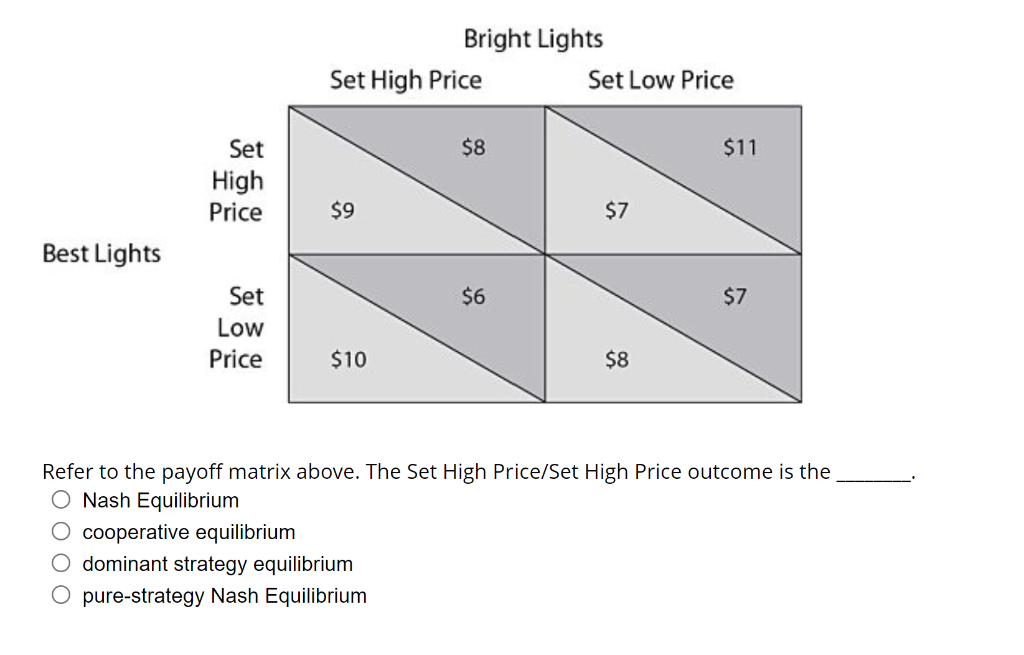
Use the best response method to analyze this game.
- First, find Best Lights' best response for each of Bright Lights' strategies.
- Then, find Bright Lights' best response for each of Best Lights' strategies.
- Identify the cell(s) where both players are playing a best response. Is there a Nash Equilibrium? If so, what is it?
Click here to see the solution
Let's break it down step-by-step:
-
Best Lights' best responses:
- If Bright Lights sets a High Price, Best Lights can earn $9 (High Price) or $12 (Low Price). Their best response is to set a Low Price.
- If Bright Lights sets a Low Price, Best Lights can earn $5 (High Price) or $6 (Low Price). Their best response is to set a Low Price.
Notice that setting a Low Price is a dominant strategy for Best Lights.
-
Bright Lights' best responses:
- If Best Lights sets a High Price, Bright Lights can earn $8 (High Price) or $11 (Low Price). Their best response is to set a Low Price.
- If Best Lights sets a Low Price, Bright Lights can earn $4 (High Price) or $7 (Low Price). Their best response is to set a Low Price.
Setting a Low Price is also a dominant strategy for Bright Lights.
-
Identify the Nash Equilibrium:
The only cell where both firms are playing their best response is where both Set Low Price. The outcome is profits of ($6, $7).Therefore, the Nash Equilibrium is (Low Price, Low Price). This is another example of a Prisoner's Dilemma, where both firms would be better off if they could coordinate to set high prices, but the individual incentive to undercut leads them to a worse joint outcome.
Multiple Equilibria and Mixed Strategies
As we saw in the Stag Hunt game, some games have more than one Nash Equilibrium. Other games, like Rock-Paper-Scissors, have no pure strategy Nash Equilibrium at all. If you analyze Rock-Paper-Scissors with the best response method, you'll find that no cell ever gets both marks. There is always an incentive for one player to change their move.
So what happens in a game like that? Players use a mixed strategy, meaning they randomly choose among their different actions with a certain probability. For example, the optimal strategy in Rock-Paper-Scissors is to play each option with a 1/3 probability. The calculation of these probabilities is a more advanced topic in game theory, but it's important to know that a Nash Equilibrium (in mixed strategies) is proven to exist in all finite games.
Conclusion
In this lesson, we broadened our understanding of strategic outcomes by focusing on the general concept of Nash Equilibrium. This provides a more robust framework than just looking for dominant strategies.
Here are the key takeaways:
- A Nash Equilibrium is a stable outcome where each player is playing their best response to the other players' strategies, and no one has a unilateral incentive to deviate.
- We can find Nash Equilibria systematically by analyzing each player's best response to every possible move by the other player and looking for outcomes of mutual best response.
- Games can have a single Nash Equilibrium, multiple Nash Equilibria (creating a coordination problem), or no Nash Equilibrium in pure strategies.
In our next lesson, we will apply these game theory concepts to the real-world behavior of oligopolies. We will discuss collusion and cartels, and use our understanding of the Prisoner's Dilemma and Nash Equilibrium to explain the powerful economic incentives that cause these cooperative agreements to be so unstable and often break down.