Recommended resources
The freely available resources this lesson will direct you to.
Hello! Welcome back to our module on Management Accounting and Decision Making.
In our last lesson, we established the fundamental difference between financial accounting (Comptabilité Générale), which reports to outsiders, and management accounting (Comptabilité de Gestion), which provides information for internal decision-makers. We learned that to make effective decisions, managers need information tailored to their specific questions.
Today, we'll dive into one of the most essential concepts in management accounting. To plan, control, and make decisions, a manager must understand how costs behave. This lesson will teach you how to classify costs based on two different criteria, directly addressing the learning outcome: Classify costs by behavior (variable, fixed, mixed) and by function (production, admin, sales).
Mastering this skill is the bedrock for everything that follows in management accounting, from setting budgets to deciding product prices.
1. Classification by Behavior: How Costs React to Activity
The first and most critical way to understand a cost is by its behavior. This means looking at how a cost changes when the company's level of activity changes. "Activity" can be the number of units produced, the number of clients served, or the number of hours worked.
There are three main patterns of cost behavior: variable, fixed, and mixed.
To get a solid introduction to these three types, please watch the following video. It provides clear definitions and lays the groundwork for our discussion.
This video from FOG Accountancy Tutorials will introduce you to the three fundamental cost behaviors: fixed, variable, and mixed.
Watch from the beginning (00:07) to 04:01. Focus on the core definitions of fixed costs, variable costs, and mixed costs.
Now, let's explore each of these concepts in more detail, using the context of a Moroccan Small or Medium-sized Enterprise (SME).
a) Fixed Costs (Coûts Fixes)
As the name suggests, a fixed cost is a cost that does not change in total over a certain period, regardless of the level of activity.
- Example: Imagine a small textile company in Casablanca that rents its workshop for 10,000 MAD per month. Whether the company produces 100
caftansor 1,000caftans, the rent remains 10,000 MAD. Other examples include the monthly salary of the administrative manager or the annual insurance premium for the factory.
A crucial concept here is the relevant range (intervalle de pertinence). A fixed cost is only fixed within a certain range of activity. If the textile company becomes so successful that it needs to rent a second workshop, the total rent cost will "step up" to a new, higher level.
This video segment explains the concept of the relevant range and "stepped costs" very clearly.
Let's revisit the FOG Accountancy Tutorials video to understand the important nuance of the 'relevant range' for fixed costs.
Watch the segments from 08:22 to 11:31 and from 14:49 to 17:32. Pay attention to how the rent cost changes only when production exceeds the capacity of the first room, creating a 'step' in the cost graph.
Key Characteristics of Fixed Costs:
- Total Cost: Remains constant as activity changes (within the relevant range).
- Cost Per Unit: Decreases as activity increases. (If the rent is 10,000 MAD, the rent cost per
caftanis 100 MAD if 100 are made, but only 10 MAD if 1,000 are made).
b) Variable Costs (Coûts Variables)
A variable cost is a cost whose total amount varies in direct proportion to changes in the level of activity.
- Example: For our textile company, the fabric required for each
caftanis a variable cost. If onecaftanrequires 200 MAD worth of fabric, then producing 10caftanswill cost 2,000 MAD in fabric. The cost varies proportionately. Other examples include the direct labor paid per piece produced or sales commissions based on the number of units sold.
Key Characteristics of Variable Costs:
- Total Cost: Changes in direct proportion to activity.
- Cost Per Unit: Remains constant as activity changes. (The cost of fabric per caftan is always 200 MAD).
c) Mixed Costs (Coûts Mixtes or Semi-variables)
A mixed cost has both a fixed and a variable component. It has a baseline cost that is incurred even with zero activity, and an additional cost that is driven by activity.
- Example: The company's electricity bill. There might be a fixed monthly connection fee of 300 MAD (the fixed part), plus a charge of 1.50 MAD for every kilowatt-hour used (the variable part). Another classic example is the compensation for a salesperson: a fixed monthly salary of 5,000 MAD plus a 2% commission on all sales.
These costs are often expressed with a simple linear equation:
Where:
- = Total Mixed Cost (
Coût Total Mixte) - = Total Fixed Cost component (
Partie Fixe) - = Variable cost per unit of activity (
Coût Variable par unité) - = The level of activity (
Niveau d'activité)
This image provides a great visual summary of these behaviors, using the French terminology you will encounter professionally.

Test your understanding!
A delivery company in Rabat has the following costs. Classify each one as Fixed, Variable, or Mixed.
- Fuel for the delivery vans.
- The annual license fee for the company's accounting software.
- The drivers' compensation, which is a fixed salary of 4,000 MAD/month plus 5 MAD per delivery.
- Rent for the company's parking garage.
- Cost of packaging boxes (one box per delivery).
Show answer
- Variable. The total fuel cost increases with the number of kilometers driven (activity).
- Fixed. The software fee is the same regardless of how many deliveries are made.
- Mixed. It has a fixed salary component and a variable per-delivery component.
- Fixed. The rent is constant each month within the relevant range (the capacity of the garage).
- Variable. The total cost of boxes is directly proportional to the number of deliveries.
2. Classification by Function: Where Costs are Incurred
The second way to classify costs is by their business function. This helps managers understand where money is being spent in the value chain of the business. This classification is essential for preparing financial statements like the income statement and for internal performance evaluation.
To understand this classification, let's study the following text.
Types of Costs: Cost Classifications
This article from Accountingverse clearly defines the main functional cost categories.
Please read the section titled 'According to Function'. It distinguishes between manufacturing and non-manufacturing costs, providing clear examples for each.
Based on this reading, we can identify three main functional categories:
a) Production Costs (Coûts de Production)
Also called Manufacturing Costs, these are all costs associated with the process of making a product. They are incurred inside the factory.
- Examples:
- Raw materials (fabric, wood, flour).
- Wages of factory workers (
main d'oeuvre directe). - Factory rent, factory electricity, depreciation of factory machines (
frais généraux de fabricationor overhead).
b) Selling Costs (Frais Commerciaux or de Distribution)
These are costs incurred to market the product, secure customer orders, and deliver the product to the customer. They happen after the product is finished.
- Examples: Advertising campaigns, salaries and commissions of the sales team, shipping costs to customers, rent for a showroom.
c) Administrative Costs (Frais Administratifs)
These are all costs associated with the general management of the organization. They are not related to manufacturing or selling.
- Examples: Salary of the CEO and accountants, rent for the head office (not the factory), legal fees, general IT support.
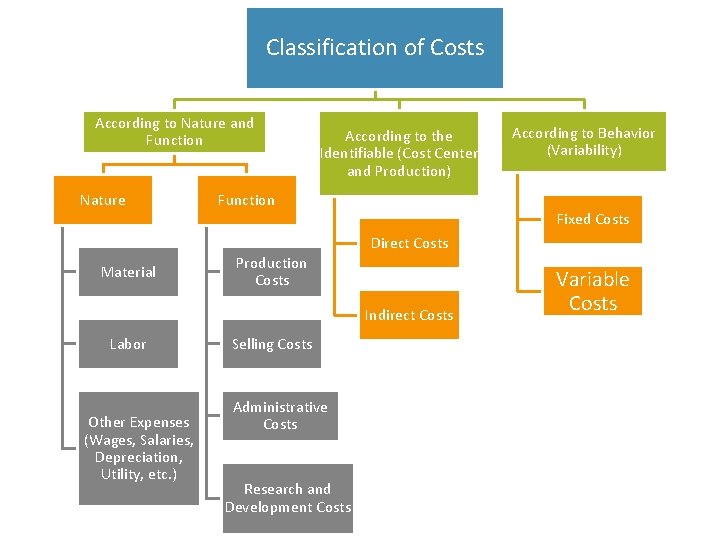
This flowchart provides a helpful overview of the different ways costs can be classified, including by function and behavior.
3. Combining the Classifications
These two classification methods are not mutually exclusive. Every cost has both a behavior and a function. A manager needs to understand both aspects to make good decisions.
Let's look at some examples for our Moroccan textile company:
| Cost Item | Classification by Behavior | Classification by Function |
|---|---|---|
Fabric for caftans |
Variable | Production |
| Salary of the factory supervisor | Fixed | Production |
| Commission for salespeople | Variable | Selling |
| Salary of the head accountant | Fixed | Administrative |
| Rent for the factory building | Fixed | Production |
| Advertising on social media | Fixed | Selling |
Understanding this two-dimensional view of costs is a key skill. It allows you to analyze questions like, "If we increase production by 10%, how will our production costs change?" To answer this, you need to know which production costs are variable and will increase, and which are fixed and will stay the same.
Conclusion
In this lesson, we have established two fundamental frameworks for analyzing costs, which are essential tools for any accountant involved in management.
Key Takeaways:
- Classification by Behavior focuses on how a cost total changes with activity.
- Fixed Costs (
Coûts Fixes): Constant in total within a relevant range. - Variable Costs (
Coûts Variables): Vary in total, in direct proportion to activity. - Mixed Costs (
Coûts Mixtes): Have both a fixed and a variable component.
- Fixed Costs (
- Classification by Function focuses on where in the business a cost is incurred.
- Production Costs (
Coûts de Production): Costs to make the product. - Selling Costs (
Frais Commerciaux): Costs to market and sell the product. - Administrative Costs (
Frais Administratifs): Costs to run the overall organization.
- Production Costs (
- Every cost can be classified using both methods simultaneously.
Preview of the Next Lesson:
We will continue to refine our understanding of costs. Our next lesson will introduce another critical classification: differentiating between direct and indirect costs. This will allow us to start answering one of the most important questions in management accounting: "What is the exact cost of a single product?" This concept builds directly on our understanding of production costs.