Recommended resources
The freely available resources this lesson will direct you to.
Welcome back to our module on Management Accounting and Decision Making.
In our previous lesson, we learned how to classify costs by their behavior (fixed, variable, mixed) and by their function (production, selling, administrative). This gave us two important lenses through which to view a company's expenses.
Today, we will add a third, equally crucial classification. We will explore how costs are categorized based on their traceability to a specific product or activity. This directly addresses our learning outcome for this lesson: Differentiate between direct and indirect costs, providing practical examples.
Understanding this distinction is not just an academic exercise; it is the cornerstone of determining the true cost of a product or service. This skill is essential for making sound pricing decisions, evaluating product profitability, and managing departmental budgets effectively.
1. The "Cost Object": The Starting Point for Classification
Before we can label a cost as "direct" or "indirect," we must first answer the question: "direct or indirect to what?" In management accounting, this "what" is called the cost object (objet de coût).
A cost object is any item for which costs are separately measured. It can be:
- A product (e.g., one specific
djellabamodel) - A service (e.g., a tax consultation for a client)
- A project (e.g., building a new website)
- A department (e.g., the marketing department)
- A customer (e.g., all costs associated with serving a major client)
The classification of any cost as direct or indirect is entirely dependent on the chosen cost object. This is a fundamental point to remember.
To introduce the core difference between direct and indirect costs, let's start with a short, clear video.
This video from Edspira provides a concise explanation of the fundamental difference between direct and indirect costs using the concept of traceability.
Watch the entire video (00:00 to 02:32). Focus on how the costs of wood and steel are 'traceable' to specific products, while the factory manager's salary is not.
2. Defining Direct and Indirect Costs
As the video explained, the key distinction is traceability.
a) Direct Costs (Charges Directes)
A direct cost is a cost that can be easily and conveniently traced to a specific cost object. The term "easily and conveniently" is important; it implies that the cost is clearly and economically worth tracing.
The most common direct costs for a physical product are:
- Direct Materials (
Matières Premières Directes): These are the raw materials that become an integral part of the finished product and whose costs can be practicably traced to it.- Example: The leather used to make a pair of
babouches; the argan oil in a bottle of cosmetic oil.
- Example: The leather used to make a pair of
- Direct Labor (
Main-d'œuvre Directe): These are the labor costs that can be easily traced to individual units of product.- Example: The wages of an artisan who is paid based on the number of carpets they weave.
The sum of Direct Materials and Direct Labor is often called Prime Cost (Coût Primaire).
b) Indirect Costs (Charges Indirectes)
An indirect cost is a cost that cannot be easily and conveniently traced to a specific cost object. These costs are incurred to support the overall operation, benefiting multiple cost objects simultaneously.
- Example (Cost Object = one
babouche): The salary of the workshop supervisor, the rent for the entire workshop, or the electricity bill. You cannot say exactly how much of the supervisor's salary or the factory rent went into making just one shoe.
These indirect costs must be allocated to cost objects in a rational and systematic manner, a topic we will cover in detail later.
When the cost object is a product being manufactured, all indirect production costs are grouped together under one essential term: Manufacturing Overhead (Frais Généraux de Fabrication).
This next video provides excellent examples to solidify your understanding of these categories.
Direct and Indirect Costs, What's the Difference?
This video from Two Teachers uses a pizza example to break down direct and indirect costs into more detailed categories like indirect materials and indirect labor.
Watch from the beginning to 02:40. Pay close attention to the examples given for direct materials, direct labor, indirect materials (lubricants), indirect labor (supervisors), and indirect expenses (rent).
This table, using French terminology, provides a clear summary.
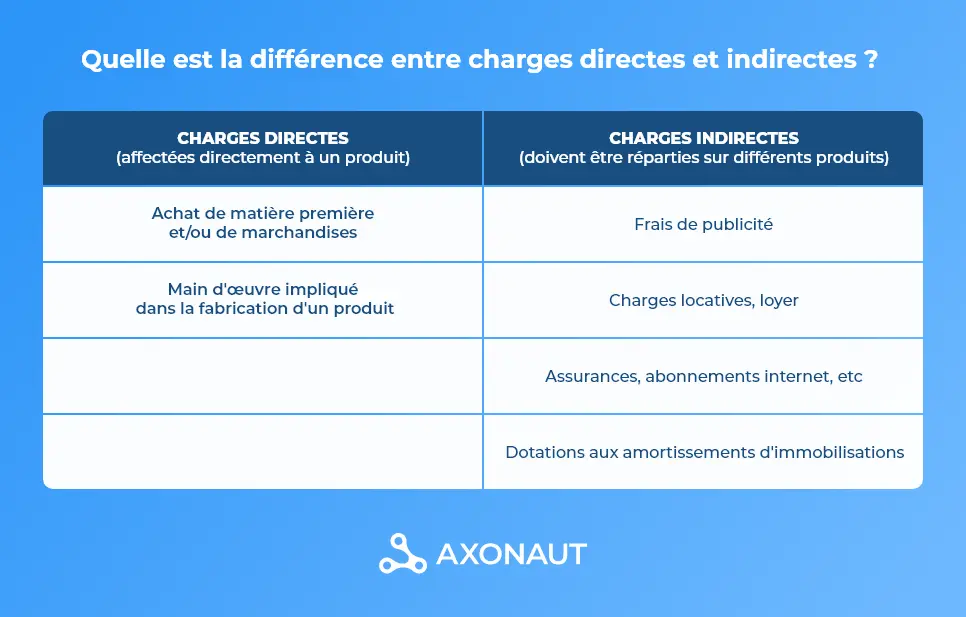
3. Manufacturing Costs: A Summary
Let's bring these concepts together in the context of a manufacturing company. All costs incurred inside the factory to make a product can be classified into one of three categories:
- Direct Materials
- Direct Labor
- Manufacturing Overhead (all other factory costs, which are by definition indirect)
Costs that happen outside the factory, such as selling and administrative costs from our previous lesson, are considered non-manufacturing costs or period costs. They are treated as expenses in the period they are incurred.
The following document provides a concise summary and a very useful practice exercise.
Managerial Accounting Chapter Review
This PDF from Harper College clearly outlines the categories of manufacturing costs and differentiates them from period costs. It also includes an excellent practice problem.
On page 2 of the PDF, please read the sections 'MANUFACTURING COSTS' and the definitions for 'PRODUCT COSTS' and 'PERIOD COSTS'. Note how Manufacturing Overhead is defined as encompassing all indirect costs.
Test your understanding!
Let's consider a small Moroccan SME that manufactures high-quality tajines for export. The cost object is one tajine. Classify the following costs as Direct Material, Direct Labor, or Manufacturing Overhead (Indirect Cost).
- The clay used to form the
tajine. - The wages of the potter who shapes the clay on a wheel.
- The salary of the workshop manager who oversees all production.
- The electricity used to power the kiln, which bakes hundreds of
tajinesat once. - Depreciation on the kiln.
- The glaze applied to the finished
tajine. - The rent for the workshop building.
Show answer
- Direct Material. The clay is the primary component of the final product.
- Direct Labor. The potter's work is directly applied to creating the specific product.
- Manufacturing Overhead (Indirect Cost). The manager's salary is a general production cost that cannot be traced to a single
tajine. - Manufacturing Overhead (Indirect Cost). It's impossible to trace the exact amount of electricity used for just one
tajinewhen many are baked together. - Manufacturing Overhead (Indirect Cost). The depreciation is a cost of the factory equipment, not traceable to a single unit.
- Direct Material. The glaze is part of the final product.
- Manufacturing Overhead (Indirect Cost). The rent benefits the production of all
tajines, not just one.
4. Synthesis: Combining Cost Classifications
A cost does not have just one classification. A single cost item has both a behavior (fixed or variable) and a traceability (direct or indirect). Understanding this matrix is key to advanced cost analysis.

Let's apply this to our tajine manufacturer:
- Clay: This is a Direct and Variable cost. It's directly traceable to a
tajine, and the total cost of clay increases with eachtajineproduced. - Wages of the potter (if paid per piece): This is a Direct and Variable cost.
- Rent for the workshop: This is an Indirect and Fixed cost. It's not traceable to a single
tajine, and the cost remains the same each month regardless of production volume (within the relevant range). - Salary of the workshop manager: This is an Indirect and Fixed cost.
- Electricity for the kiln: This is an Indirect and Mixed (or variable) cost. It's not directly traceable, and it has a variable component that increases with the number of batches baked.
This combined understanding is what empowers managers to forecast costs accurately. For example, to predict the cost of increasing production by 100 tajines, you need to know which costs are variable and will increase, and which are fixed and will not.
Conclusion
In this lesson, we introduced the vital distinction between direct and indirect costs, a classification that hinges on traceability to a specific cost object.
Key Takeaways:
- A cost object (
objet de coût) is anything for which a separate measurement of cost is desired. - Direct costs (
charges directes) can be easily and conveniently traced to a cost object. They typically consist of Direct Materials and Direct Labor. - Indirect costs (
charges indirectes) cannot be easily traced and must be allocated. All indirect manufacturing costs are collectively known as Manufacturing Overhead (frais généraux de fabrication). - The classification of a cost depends entirely on the chosen cost object.
- Every cost can be classified by both its behavior (fixed/variable) and its traceability (direct/indirect).
Preview of the Next Lesson:
Now that we can distinguish between cost types, we are ready to perform one of the most powerful analyses in management accounting. In our next lesson, we will use our knowledge of fixed and variable costs to calculate the contribution margin. This metric is the foundation for Cost-Volume-Profit (CVP) analysis, which allows us to determine a company's break-even point and plan for target profits.