Recommended resources
The freely available resources this lesson will direct you to.
Hello! Welcome to the first lesson of our new module, "Management Accounting and Decision Making."
In our previous modules, we built a strong foundation in Financial Accounting (Comptabilité Générale). We learned how to record transactions, prepare adjusting entries, and ultimately produce the key financial statements: the Bilan (Balance Sheet), the CPC (Income Statement), and the Tableau des Flux de Trésorerie (Statement of Cash Flows). The primary purpose of this process, as we've seen, is to report the company's performance to external parties like investors, banks, and tax authorities.
Now, we are shifting our focus inward. This module is about Management Accounting (Comptabilité de Gestion), which is the accounting done for the people inside the business—the managers who make strategic decisions every day.
Today's lesson directly addresses this shift by focusing on the learning outcome: Distinguish between financial accounting and management accounting. Understanding this distinction is the essential first step into the world of internal analysis, budgeting, and strategic planning.
1. Two Branches of the Same Tree
While both are rooted in the same transaction data, financial and management accounting serve fundamentally different purposes. Think of them as two major branches of the accounting discipline, each with its own audience and objectives.
To get an overview of these two areas, let's watch the beginning of this introductory video.
FINANCIAL vs MANAGERIAL Accounting
This video from Accounting Stuff provides clear, concise definitions for both financial and managerial accounting and establishes their relationship as two distinct practices.
Watch from 01:51 to 03:14. Focus on the formal definitions provided for each type of accounting and the idea that both involve collecting and presenting financial information.
As the video highlighted:
- Financial Accounting is the process of recording, summarizing, and reporting transactions to external stakeholders.
- Managerial Accounting is the process of providing information to internal management to help with planning, decision-making, and control.
This difference in the target audience is the single most important distinction, from which all other differences flow.
2. The Core Distinction: Who is it for?
The primary question that separates the two disciplines is: "Who are we preparing this information for?"
-
Financial Accounting serves outsiders. These are external parties who have a financial interest in the company but are not involved in its day-to-day operations. This includes:
- Investors (current and potential) who need to decide whether to buy, hold, or sell shares.
- Lenders (like banks) who need to assess the company's ability to repay loans.
- Government agencies (like the tax administration) to ensure compliance with regulations.
-
Management Accounting serves insiders. This information is for the company's own managers at all levels to help them run the business more effectively. The focus is on making decisions for the company.
This next video explains this user-centric difference with practical examples.
MA1 – Managerial Accounting Basics for Beginners
In this video, Tony Bell clearly contrasts the external users of financial accounting with the internal users of managerial accounting, using a relatable example to show the different types of decisions each group makes.
Watch from 00:26 to 06:18. Pay close attention to the distinction between making decisions 'about' the company (outsiders) versus making decisions 'for' the company (insiders). The Apple Store example is particularly useful for understanding the needs of an internal manager.
3. Key Differences Explained
Because they serve different audiences, the two types of accounting differ in almost every aspect. Let's break down the most important distinctions. A great way to see these side-by-side is in a table.
The difference between financial and management accounting
This article from BPP includes an excellent table that summarises the key differences between financial and management accounting. We will use it as a reference point.
Review the summary table under the heading 'Key differences between financial and management accounting'. This table clearly lays out the contrasts we are about to discuss.
Let's explore the key points from that table:
| Aspect | Financial Accounting | Management Accounting |
|---|---|---|
| Focus | Historical. Reports on what has already happened (e.g., last year's profit). | Forward-looking. Focuses on future planning (e.g., next year's budget) and current performance. |
| Regulation | Highly regulated. Must follow standards like Moroccan GAAP (CGNC) or IFRS. This ensures information is reliable and comparable for outsiders. |
Unregulated. There are no mandatory rules. Reports are flexible and customized to what managers find most useful. |
| Scope | Aggregated. Looks at the company as a whole (e.g., total company revenue). | Detailed/Segmented. Breaks the company down into smaller parts (e.g., profit per product, cost per department). |
| Frequency | Periodic. Reports are issued on a fixed schedule (e.g., quarterly or annually). | As needed. Reports can be generated whenever a manager needs them (e.g., daily, weekly, or for a specific project). |
| Nature | Objective and precise. Information must be verifiable and accurate. | Relevant and timely. Estimates and approximations are acceptable if they help a manager make a quick decision. |
4. The Moroccan Perspective: Comptabilité Générale vs. Comptabilité Analytique
In the Moroccan professional environment, you will constantly hear these two terms:
Comptabilité Générale: Financial Accounting.Comptabilité Analytique d'Exploitation (CAE)orComptabilité de Gestion: Management Accounting.
The following images summarize the distinctions using this standard French terminology. They perfectly mirror what we've just learned and will help you internalize the concepts in the language used in your daily work.

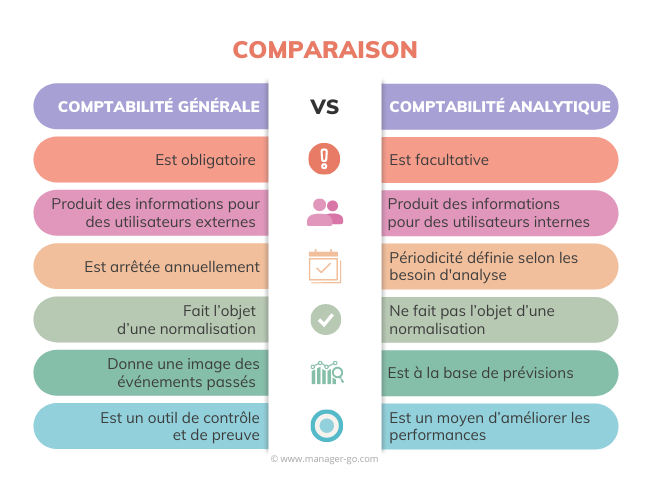
Test your understanding!
For each of the following accounting tasks, determine whether it belongs to Financial Accounting (Comptabilité Générale) or Management Accounting (Comptabilité de Gestion).
- Creating a budget for the sales department for the upcoming quarter.
- Preparing the annual
BilanandCPCto be filed with the tax authorities (Direction Générale des Impôts). - Analyzing the cost of raw materials for three different products to decide which is most profitable.
- Submitting a set of audited financial statements to a bank to apply for a loan.
- Calculating the break-even point for a new service the company plans to launch.
Show answer
- Management Accounting. Budgeting is a key planning activity for internal management.
- Financial Accounting. These are official, regulated statements for an external party (the government).
- Management Accounting. This is a detailed internal analysis to support a strategic decision about products.
- Financial Accounting. The statements are prepared according to strict rules for an external stakeholder (the bank).
- Management Accounting. Break-even analysis is a forward-looking tool used for internal planning and decision-making.
Conclusion
Congratulations on completing your first step into management accounting! You now understand the fundamental differences between reporting to outsiders and providing information for internal decision-makers.
Key Takeaways:
- Financial Accounting (
Comptabilité Générale) is for external users (investors, banks, government). It is historical, highly regulated, and looks at the company as a whole. Its main outputs are the official financial statements. - Management Accounting (
Comptabilité de Gestion) is for internal managers. It is forward-looking, flexible (no rules), and focuses on detailed segments of the business. Its main purpose is to aid in planning, control, and decision-making. - While they are different, they are connected. Management accounting often uses data that originates from the financial accounting system.
Preview of the Next Lesson:
Now that we understand the purpose of management accounting, we will begin exploring its core techniques. In our next lesson, we will learn how to classify costs by behavior (variable, fixed, mixed) and by function (production, admin, sales). This is a foundational skill for almost all management accounting analysis, from calculating product costs to making pricing decisions.