Recommended resources
The freely available resources this lesson will direct you to.
Welcome back to our module on Management Accounting and Decision Making.
In our last lesson, we mastered how to use CVP analysis to determine the sales needed to achieve a specific target profit. This tool is incredibly powerful for businesses that produce and sell standardized products, where each unit is identical. However, many businesses, especially SMEs in Morocco, thrive on customization—think of an artisan furniture maker (menuisier), a digital agency building websites, or a small construction firm. For these companies, averaging costs across all products doesn't make sense. The key question is not "What is our break-even point overall?" but rather, "What is the cost and profitability of this specific job or client project?"
This brings us to today's topic. We will explore the system designed to answer that exact question. Your learning outcome for this lesson is to: Describe a job order costing system and trace direct costs to a specific job.
We will cover what a job order costing system is, when it's used, and how it uses a job cost sheet to track the two major direct costs—materials and labor—for each unique job.
1. What is Job Order Costing?
Imagine a company that makes custom leather goods in Fez. One order might be for 100 simple wallets, while the next is for a single, intricately designed travel bag. The materials, labor, and complexity are completely different. A system is needed to track the costs for each order separately. This system is called job order costing (or comptabilité par commande).
It's a method used by companies that produce unique, distinct products or services, which are referred to as jobs. The goal is to accumulate manufacturing costs for each job individually to determine its specific cost and profitability.
To learn the fundamentals, please start with this reading.
Job Order Costing: Definition, Formula, and Examples
The article 'Job order costing done right' from Katana MRP provides a clear and concise definition of job order costing and contrasts it with process costing, which we've implicitly been using in our CVP analysis.
Read the first two sections, 'What is job order costing?' and 'Job order costing vs. process costing'. Focus on understanding why a custom furniture business would use job order costing while a mass-producer like IKEA would not.
As the reading highlights, there are three categories of manufacturing costs that we need to track for each job:
- Direct Materials: Raw materials that become an integral part of the finished product and whose costs can be conveniently traced to it (e.g., the wood for a table, the leather for a bag).
- Direct Labor: Labor costs that can be easily traced to individual units of product (e.g., the wages of the carpenter building the table).
- Manufacturing Overhead: All other manufacturing costs that cannot be easily traced to specific jobs (e.g., factory rent, electricity, supervisor's salary).
This flowchart provides a simple visual of how these costs relate to individual jobs.
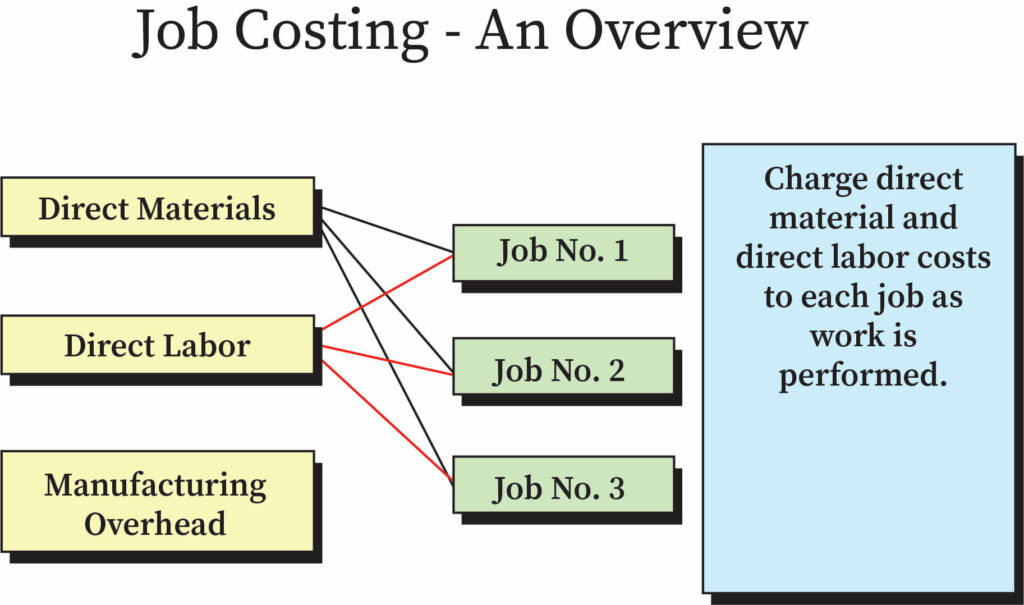
In this lesson, we will focus on the two direct costs. We will tackle the challenge of Manufacturing Overhead in our next session.
2. The Job Cost Sheet: The Heart of the System
The central document in a job order costing system is the job cost sheet (fiche de coût de revient par commande). This is a form that records the materials, labor, and manufacturing overhead costs charged to a specific job. Each job has its own sheet, creating a detailed record of its costs as it moves through production.
The job cost sheet acts as a subsidiary ledger for the Work-in-Process (Encours de production) account. The sum of all costs on the job cost sheets for unfinished jobs should equal the balance in the Work-in-Process account.
Job Order Costing: Definition, Formula, and Examples
Let's return to the Katana MRP article to formally define the job cost sheet and its components.
Read the sections 'Cost accumulation in job order costing' and 'What is a job cost sheet?'. This will solidify your understanding of the three cost components and the role of the job cost sheet.
In a Moroccan business context, this might not always be a formal, pre-printed document but could be a detailed Excel spreadsheet, often called a calcul de prix de revient.
Look at the following image. Although it's for a batch of 1000 items, the principle is identical to a job cost sheet for a single job. It meticulously lists all direct costs to arrive at a total cost.

3. How to Trace Direct Costs to a Job
"Tracing" costs means associating them with a specific job. This requires clear documentation that links a cost to a job number.
a) Tracing Direct Materials
How do we know that a specific piece of leather was used for Job #A-42 and not Job #B-15? Through a materials requisition form (bon de sortie matière).
When a production department needs materials, it fills out a requisition form that specifies the job number. This form authorizes the storeroom to release the materials. The accounting department then uses this form to record the cost of the materials on the corresponding job cost sheet.
b) Tracing Direct Labor
Similarly, how do we track a worker's time? Through a time ticket or timesheet (feuille de temps).
This is a document that identifies the employee, the hours spent, and the specific job on which the work was performed. These time tickets are collected, and the accounting department uses them to charge the labor costs to the correct jobs on their respective job cost sheets.
To see how these traced costs flow through the accounting system as journal entries, the following video provides an excellent, structured explanation.
The Flow of Costs: Job Order Costing + Journal Entries.
The video 'The Flow of Costs' by Farhat Lectures explains the entire cost flow in a job order system, from raw materials to the final sale. We will focus on the specific journal entries for direct costs.
Please watch the following two segments: Direct Materials (03:08 - 04:43): Pay close attention to the journal entry that moves costs from 'Raw Material' inventory to 'Work in Process' inventory. This is the accounting record of the materials requisition. Direct Labor (05:36 - 06:13): Note how the cost of direct labor is debited directly to the 'Work in Process' inventory account.
Let's recap the flow for direct costs:
- Direct Materials:
Raw Materials(Asset) ->Work in Process(Asset) - Direct Labor:
Salaries and Wages Payable(Liability) ->Work in Process(Asset)
Notice that both direct costs are accumulated in the Work in Process (WIP) inventory account.
4. Example: Calculating the Cost of a Job
Now, let's walk through a simple, practical example to see how a job cost sheet is built.
The video 'Job order Costing Example' from Edspira provides a very clear and simple walkthrough of calculating the total cost for a job of building two custom treehouses.
Watch the video from the beginning to 01:08 and then from 02:21 to the end (04:54). The video will show you how to: Identify the direct materials used on the job. Calculate the direct labor cost for the job. Sum the costs on the job cost sheet to find the total job cost and the cost per unit.
The video also briefly mentions applying manufacturing overhead using a predetermined rate (the section you skipped). This is the critical next step in determining the full cost of a job, and it is the subject of our next lesson. For today, our focus remains on correctly tracing the direct costs.
Test your understanding!
A small Casablanca-based workshop, "Artisanat Design," receives an order (Job #K-24) to create a custom-made cedar wood bookshelf.
The following costs are incurred:
- Direct Materials:
- 10 meters of cedar wood requisitioned from the storeroom. The purchase cost was 350 MAD per meter.
- Hardware (screws, brackets) requisitioned: 150 MAD.
- Direct Labor:
- The master craftsman worked for 12 hours on Job #K-24. His hourly wage is 75 MAD.
Your task:
- Calculate the total direct material cost for Job #K-24.
- Calculate the total direct labor cost for Job #K-24.
- What is the total direct cost accumulated on the job cost sheet for Job #K-24 so far?
- What is the primary source document used to trace the cost of the cedar wood to Job #K-24?
Show answer
-
Total Direct Material Cost:
- Cedar Wood: 10 meters * 350 MAD/meter = 3,500 MAD
- Hardware: 150 MAD
- Total = 3,500 + 150 = 3,650 MAD
-
Total Direct Labor Cost:
- 12 hours * 75 MAD/hour = 900 MAD
-
Total Direct Cost on Job Cost Sheet:
- Direct Materials + Direct Labor = 3,650 MAD + 900 MAD = 4,550 MAD
-
The primary source document is the materials requisition form (
bon de sortie matière).
Conclusion
In this lesson, we transitioned from the broad perspective of CVP analysis to the specific, detailed view of job order costing. This system is essential for any business that produces unique products or services, allowing for precise cost control and pricing on a per-job basis.
Key Takeaways:
- Job order costing is a system for tracking manufacturing costs for distinct jobs or projects.
- The central document is the job cost sheet, which accumulates costs for a single job.
- Direct materials are traced to a job using a materials requisition form. The cost is transferred from Raw Materials inventory to Work-in-Process inventory.
- Direct labor is traced to a job using a time ticket. The cost is added directly to the Work-in-Process inventory.
- The total direct cost of a job is the sum of its direct materials and direct labor.
Preview of the Next Lesson:
We have successfully traced the direct costs to our job. However, we cannot ignore the indirect costs—the manufacturing overhead. How do we fairly assign a portion of the factory's rent, electricity, and supervisor's salary to the custom bookshelf in our example? This process is called overhead application.
In our next lesson, we will address the final component of product costing: Calculate a predetermined overhead rate and apply it to allocate indirect costs. This will complete our understanding of how to determine the total cost of a job.