Recommended resources
The freely available resources this lesson will direct you to.
- Predetermined Overhead Rate (what it is and how to calculate it)www.youtube.com
- MA10 - Predetermined Overhead Rate - Sample problem - Management Accountingwww.youtube.com
- How to Calculate a Predetermined Overhead Rate (OH)flxpoint.com
- Job-order Costing – Principles of Managerial Accountingucincinnatipress.pressbooks.pub
Welcome back. In our previous lesson, we established how to use a job order costing system to trace direct materials and direct labor to a specific job. We saw that the cost of a job is the sum of these two direct costs plus a third component: manufacturing overhead.
We successfully accumulated the direct costs for the custom bookshelf from "Artisanat Design," but a critical question remains unanswered: How do we account for the indirect costs like the workshop's rent, electricity, and the supervisor's salary? We can't trace these costs to a single job, yet they are real costs of production that must be included to determine the job's true cost and set a profitable price.
Today, we will solve this final piece of the puzzle. Your learning outcome is to: Calculate a predetermined overhead rate and apply it to allocate indirect costs. We will learn why we use an estimated rate, how to calculate it before the year begins, and how to apply it to find the total cost of any job.
1. Why We Need a Predetermined Overhead Rate
You might wonder, "Why not wait until the end of the month or year, add up all the actual overhead costs, and then divide them among the jobs?" This seems more accurate. However, there are two major problems with this approach:
- Timeliness: Businesses need cost information now to quote prices for new customers and make decisions. Waiting until the end of the period to determine costs is often too late. A customer asking for a quote on a custom table won't wait a month for the electricity bill to arrive.
- Fluctuations: Actual overhead costs can fluctuate significantly from month to month (e.g., higher heating bills in winter). If we allocate these actual costs, identical jobs would appear to have different costs depending on when they were produced. This distorts pricing and performance evaluation.
To address these issues, we use a predetermined overhead rate (POHR). This rate is calculated at the beginning of the period based on estimates, allowing us to apply overhead costs to jobs in a timely and consistent manner throughout the period.
The following video provides an excellent summary of this rationale.
Predetermined Overhead Rate (what it is and how to calculate it)
The video 'Predetermined Overhead Rate' from Edspira clearly explains why companies use an estimated rate for overhead instead of waiting for actual costs.
Watch the first part of the video (00:00 - 02:42). Focus on the two key business reasons for using a predetermined rate: the need for timely quotes and the problem of cost fluctuations.
2. The Formula for the Predetermined Overhead Rate
Calculating the POHR involves a simple formula that relies on two estimates made at the beginning of the accounting period:
Let's break this down.
Step 1: Estimate Total Manufacturing Overhead Costs
This is the numerator. The company forecasts all its indirect manufacturing costs for the upcoming period. These are the costs that cannot be traced directly to a specific job.
Examples include:
- Indirect materials (glue, nails, lubricants)
- Indirect labor (salaries of supervisors, maintenance staff, security guards for the factory)
- Factory utilities (electricity, water)
- Factory rent and property taxes
- Depreciation of factory equipment and buildings
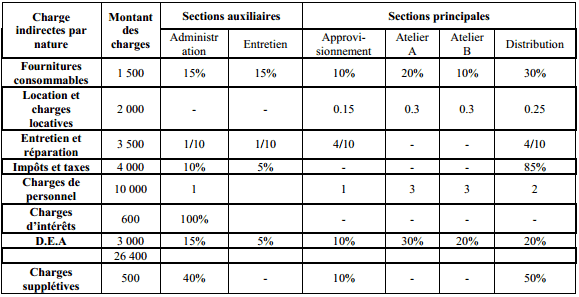
In French/Moroccan accounting, this process involves analyzing the charges indirectes. The table below is a classic example of a Tableau de répartition des charges indirectes (Indirect Cost Allocation Table) used to gather and allocate these costs to different departments before they are applied to products.
Step 2: Choose and Estimate the Allocation Base
This is the denominator, also known as the cost driver (unité d'œuvre). It's a measure of activity that is believed to cause or "drive" the overhead costs. The choice of base should have a logical cause-and-effect relationship with the overhead costs.
Common allocation bases:
- Direct Labor Hours (DLH): Good for companies where production is labor-intensive. More hours worked likely means more overhead consumed.
- Machine Hours (MH): Best for automated or machine-intensive environments. More machine usage drives up costs like electricity and maintenance.
- Direct Labor Cost: Similar to DLH, but uses the total wage cost as the base.
Once the base is chosen, the company must estimate the total amount of that base for the upcoming period (e.g., "we expect our workers to log a total of 20,000 direct labor hours this year").
The following resource provides a simple, step-by-step guide to this process.
How to Calculate a Predetermined Overhead Rate (OH): A Step-by-Step Guide
This guide from Flxpoint, 'How to Calculate a Predetermined Overhead Rate (OH)', breaks down the calculation into clear, manageable steps.
Read the sections from 'What Is a Predetermined Overhead Rate?' through 'Step 4: Do the Math'. This will walk you through identifying overhead costs, picking an allocation base, and performing the final calculation.
3. Applying Overhead to a Specific Job
Once you have your POHR, you can apply overhead to any job worked on during the period. The formula is:
Notice the critical difference:
- We use estimated numbers to calculate the rate before the period begins.
- We use the actual activity for a specific job to apply the overhead during the period.
Let's watch a clear, worked example that puts calculation and application together.
MA10 - Predetermined Overhead Rate - Sample problem - Management Accounting
The video 'MA10 - Predetermined Overhead Rate - Sample problem' by Tony Bell provides a concise, step-by-step walkthrough of both calculating a POHR and applying it to find a job's total cost.
Watch the video from 01:40 to 06:53. Pay close attention to: How the POHR is calculated using the company's annual estimates. How that rate is then multiplied by the actual labor hours for a specific job to find the applied overhead. How the applied overhead is added to the actual direct materials and actual direct labor to get the total job cost.
The final cost accumulated on the job cost sheet is therefore:
Total Job Cost = Actual Direct Materials + Actual Direct Labor + Applied Manufacturing Overhead
4. Practical Example in a Moroccan Context
In local practice, the POHR is referred to as the coût de l'unité d'œuvre. The exercises below show exactly how this is calculated and used. For each Section principale (main department, like an assembly workshop), a coût d'unité d'œuvre is calculated by dividing the department's total indirect costs by the nombre d'unités d'œuvre (the total amount of the allocation base, like labor hours).

Let's now complete the example from our previous lesson.
Test your understanding!
Recall the Casablanca workshop, "Artisanat Design," working on Job #K-24, the custom bookshelf. The direct costs were 3,650 MAD for materials and 900 MAD for labor.
At the beginning of the year, the workshop owner estimated the following for the entire year:
- Total manufacturing overhead costs (rent, utilities, supervisor salary, etc.): 180,000 MAD
- Total direct labor hours to be worked: 3,000 hours
The workshop uses direct labor hours to allocate overhead.
Your task:
- Calculate the predetermined overhead rate (the
coût de l'unité d'œuvre). - Calculate the amount of manufacturing overhead to apply to Job #K-24, which required 12 actual direct labor hours.
- Calculate the total cost of Job #K-24.
Show answer
-
Calculate the Predetermined Overhead Rate (POHR):
-
Apply Overhead to Job #K-24:
-
Calculate Total Job Cost:
- Direct Materials: 3,650 MAD
- Direct Labor: 900 MAD
- Applied Overhead: 720 MAD
- Total Cost = 3,650 + 900 + 720 = 5,270 MAD
5. A Note on Departmental Rates
For simplicity, we used a single, plant-wide overhead rate. However, many companies have multiple departments with very different cost structures. For example, one department might be highly automated (machine-intensive), while another relies on manual labor (labor-intensive).
In such cases, using a single rate can lead to inaccurate costing. A more accurate method is to calculate a separate predetermined overhead rate for each department, using the most appropriate allocation base for that department (e.g., machine hours for the automated department, direct labor hours for the manual one). This is the approach shown in the Moroccan exercises image (LINK). We will explore this refinement in more advanced topics.
Conclusion
Today, you have mastered the final and most complex component of job costing. You now understand how to systematically and logically allocate indirect manufacturing costs to individual jobs.
Key Takeaways:
- A predetermined overhead rate (POHR) is used to apply overhead costs to jobs for timely and consistent costing.
- The formula is: Estimated Total MOH / Estimated Total Allocation Base.
- The rate is calculated once, at the beginning of the period, using estimates.
- Overhead is applied to a specific job using the formula: POHR x Actual Allocation Base Used by the Job.
- The total cost of a job is the sum of actual direct materials, actual direct labor, and applied manufacturing overhead.
Preview of the Next Lesson:
Job order costing is perfect for unique products. But what about companies that produce thousands of identical items, like a soda bottling plant or a cement factory? For them, tracking costs for each individual bottle is impractical. They use a different system called process costing.
In our next lesson, we will explain the purpose of process costing and calculate the cost per equivalent unit, opening up the other major costing methodology in management accounting.