Recommended resources
The freely available resources this lesson will direct you to.
- #4 Process Costing - Equivalent Units Concept - B.COM / CMA / CA INTER - By Saheb Academywww.youtube.com
- #1 Process Costing - Concept & Format - B.COM / CMA / CA INTER - By Saheb Academywww.youtube.com
- Job Order Costing vs. Process Costingwww.netsuite.com
- 5.3: Explain and Compute Equivalent Units and Total Cost ...biz.libretexts.org
Welcome back. In our last lesson, we mastered the final component of job order costing by learning how to calculate and apply a predetermined overhead rate. This allowed us to find the total cost of a unique, specific job like the custom bookshelf from "Artisanat Design".
However, many businesses don't produce unique items. Think of a soda factory, a cement producer, or a textile mill in Morocco. They engage in mass production, creating thousands of identical units in a continuous flow. For these companies, tracking costs for each individual unit would be impossible. This requires a different costing system.
Today, we transition from the world of unique jobs to the world of mass production. Your learning outcome is to: Explain the purpose of process costing and calculate the cost per equivalent unit. We will explore how costs are accumulated in a production process and learn the crucial technique used to assign costs to both finished and partially finished goods.
1. From Job Order Costing to Process Costing
The fundamental difference between job order costing and process costing lies in the nature of the product and the production environment.
- Job Order Costing (Previous Lesson): Used for unique, distinct products or services (e.g., custom furniture, audit engagement, building construction). Costs are traced and allocated to a specific job.
- Process Costing (This Lesson): Used for large volumes of identical or very similar products (e.g., beverages, chemicals, flour). Costs are accumulated by a process or department for a given period and then averaged over all units produced.
To understand the purpose and mechanics of process costing, let's start with a clear definition and a comparison with what you already know.
Job Order Costing vs. Process Costing
The article 'Job Order Costing vs. Process Costing' from NetSuite provides an excellent overview. It defines process costing and directly contrasts it with the job order costing system we've just studied.
Please read the sections 'What Is Process Costing?', 'Job Order Costing vs. Process Costing: Key Differences Explained', and 'When to Use Process Costing'. Focus on understanding: How costs are accumulated by process rather than by job. The types of industries and products best suited for this system. The differences in cost tracking and inventory management compared to job costing.
As you read, you saw that in process costing, costs flow sequentially from one department to the next. For example, in a juice factory:
- Process 1: Washing and Crushing (Fruit is washed and crushed into pulp)
- Process 2: Pressing and Filtering (Pulp is pressed and filtered to extract juice)
- Process 3: Pasteurizing and Bottling (Juice is heated and bottled)
The costs of Process 1 become part of the input costs for Process 2, and so on. The goal is to determine the average cost per unit at each stage.
This next video explains this sequential flow and the basic format of a process account.
#1 Process Costing - Concept & Format - B.COM / CMA / CA INTER - By Saheb Academy
The video '#1 Process Costing - Concept & Format' from Saheb Academy introduces the core concept and illustrates the flow of costs through different processes.
Watch from the beginning to 05:13. Pay attention to: The definition of process costing as a method for industries with sequential stages. The idea that each process is a 'cost center' accumulating materials, labor, and overhead. The real-world examples given, which are very relevant to industrial activities.
2. The Challenge: Incomplete Units (Work in Process)
If every unit that started in a process was also finished within the same period, calculating the cost per unit would be simple:
However, production is a continuous flow. At the end of any accounting period (e.g., end of the month), there will almost certainly be units that are still in the production line—partially completed. This is the Work in Process (WIP) inventory, or en-cours in French.
These partially completed units pose a major costing problem:
- They haven't received the full amount of manufacturing costs. A unit that is only 50% through the process should not be assigned the same cost as a unit that is 100% complete.
- Therefore, simply dividing total costs by total units (both complete and incomplete) would be inaccurate and would understate the cost of finished goods while overstating the cost of WIP.
We need a way to account for the work done on these incomplete units.
3. The Solution: Equivalent Units of Production
To solve the WIP problem, we use the concept of equivalent units of production. This is the most critical concept in process costing.
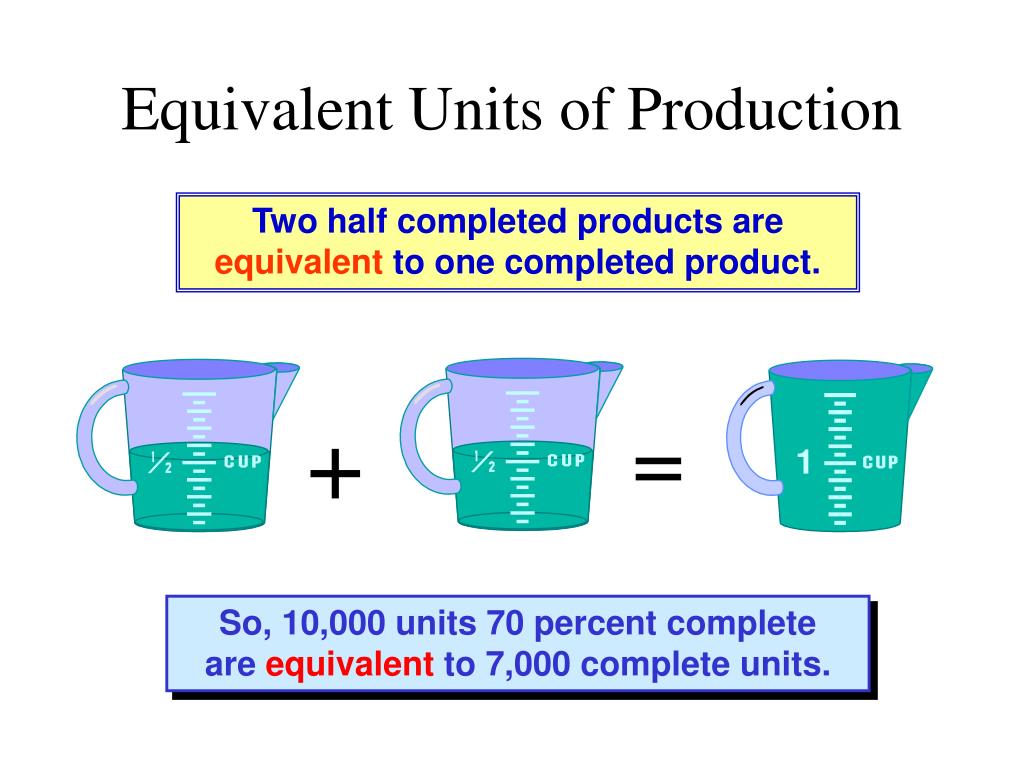
An equivalent unit is a measure of the amount of work done during a period, expressed in terms of fully completed units. It converts the quantity of incomplete units into an equivalent number of completed units.
Separating Costs: Materials vs. Conversion
We typically calculate equivalent units separately for two categories of costs:
- Direct Materials: The cost of the primary raw materials.
- Conversion Costs: The costs required to convert materials into a finished product. This is the sum of Direct Labor and Manufacturing Overhead.
Why separate them? Because they are often added at different points in the process. For example, in a bottling plant, all the material (the bottle) might be added at the very beginning of the process (100% complete for materials), but the conversion costs (labor to run the machines, electricity, etc.) are incurred evenly as the bottle moves down the line.
The following resource provides a clear, structured explanation of how to calculate equivalent units for both cost categories.
Explain and Compute Equivalent Units and Total Cost of Production in an Initial Processing Stage
The LibreTexts article, 'Explain and Compute Equivalent Units...', provides a step-by-step method for this crucial calculation.
Read the introductory section and 'Step Two: Computing the Equivalent Units of Production'. This will explain the logic and show you the standard calculation format for units completed and for units in ending WIP.
4. Calculating the Cost Per Equivalent Unit
Once we can express production in terms of equivalent units, we can accurately calculate the cost per unit. The calculation follows a standard four-step process (we will focus on the weighted-average method, which is the most common starting point).
Example Scenario:
A Moroccan fruit juice company, "Jus d'Agadir," had the following data for its Bottling Department in May:
- Production:
- Units started into production: 50,000 bottles
- Units completed and transferred out: 40,000 bottles
- Ending Work in Process (WIP): 10,000 bottles
- Ending WIP is 100% complete for materials (bottles were added at the start).
- Ending WIP is 60% complete for conversion (labor and overhead).
- Costs:
- Total material costs added in May: 15,000 MAD
- Total conversion costs added in May: 21,160 MAD
Let's calculate the cost per equivalent unit.
Step 1: Summarize the flow of physical units.
This is a simple reconciliation to ensure all units are accounted for.
- Units started: 50,000
- This must equal units completed + units in ending WIP.
- Units completed and transferred out: 40,000
- Units in ending WIP: 10,000
- Total accounted for: 40,000 + 10,000 = 50,000. It balances.
Step 2: Calculate equivalent units.
We need to do this for both materials and conversion costs.
| Category | Equivalent Units: Materials | Equivalent Units: Conversion |
|---|---|---|
| Units completed and transferred out | 40,000 | 40,000 |
| (These are 100% complete for both) | (40,000 x 100%) | (40,000 x 100%) |
| Ending Work in Process (WIP) | 10,000 | 6,000 |
| (Completion % applied to WIP units) | (10,000 x 100%) | (10,000 x 60%) |
| Total Equivalent Units | 50,000 | 46,000 |
This calculation shows that the work done in May was equivalent to producing 50,000 units' worth of materials and 46,000 units' worth of conversion effort.
Step 3: Summarize total costs to be accounted for.
For this simple example with no beginning inventory, the total costs are just the costs added during the month.
- Total Material Costs: 15,000 MAD
- Total Conversion Costs: 21,160 MAD
Step 4: Calculate the cost per equivalent unit.
Now we can find our accurate per-unit costs.
-
Cost per Equivalent Unit (Materials):
-
Cost per Equivalent Unit (Conversion):
The total cost to produce one complete unit is 0.30 + 0.46 = 0.76 MAD. This is the information management needs for pricing, inventory valuation, and cost control.
Test your understanding!
A textile company in Casablanca, "Tissage Royal," processes cotton in its Spinning Department. In June, the department reported the following:
- Production:
- Units started in process: 8,000 kg of cotton
- Units completed and transferred to the Weaving Dept: 6,500 kg
- Ending Work in Process (WIP): 1,500 kg
- Ending WIP is 100% complete for materials.
- Ending WIP is 40% complete for conversion.
- Costs for June:
- Direct Materials: 40,000 MAD
- Conversion Costs (Labor & Overhead): 35,500 MAD
Your Task:
Calculate the cost per equivalent unit for direct materials and for conversion costs for the Spinning Department in June.
Show answer
Step 1: Summarize physical units.
- Units to account for: 8,000 kg
- Units completed (6,500 kg) + Ending WIP (1,500 kg) = 8,000 kg. It balances.
Step 2: Calculate equivalent units.
| Category | Equivalent Units: Materials | Equivalent Units: Conversion |
|---|---|---|
| Units completed and transferred out | 6,500 | 6,500 |
| Ending Work in Process (WIP) | 1,500 | 600 |
| (1,500 kg x 100% Materials) | ||
| (1,500 kg x 40% Conversion) | ||
| Total Equivalent Units | 8,000 | 7,100 |
Step 3 & 4: Calculate cost per equivalent unit.
-
Cost per Equivalent Unit (Materials):
-
Cost per Equivalent Unit (Conversion):
The total cost per fully completed kilogram of spun cotton is 5.00 + 5.00 = 10.00 MAD.
Conclusion
Today we have explored process costing, the essential method for businesses engaged in mass production. You have learned how it differs from job order costing and, most importantly, how to use the concept of equivalent units to solve the problem of work in process inventory.
Key Takeaways:
- Process costing is used for high-volume, continuous production of identical items, accumulating costs by department.
- When units are partially complete at the end of a period, we cannot use a simple average cost.
- Equivalent units express the work done on incomplete units in terms of fully complete units.
- We calculate equivalent units separately for materials and conversion costs because they are often added at different points in the process.
- The cost per equivalent unit is found by dividing the total costs for a category (e.g., materials) by the total equivalent units for that category.
This cost per equivalent unit is the key to valuing both the inventory of finished goods transferred out and the inventory of work in process that remains in the department.
Preview of the Next Lesson:
We have now concluded our foundational module on Management Accounting, covering both job order and process costing systems. You are now equipped with the primary tools for determining product costs in different manufacturing environments.
Our journey now takes a significant and practical turn. We will move into Level 3: Moroccan Taxation. In the next lesson, you will be introduced to one of the most important taxes for any business in Morocco: the Value Added Tax (VAT). We will explain the legal framework of VAT in Morocco, identifying the different rates and scope of application. This is a critical area of knowledge for any operational accountant.