Recommended resources
The freely available resources this lesson will direct you to.
Welcome to your next lesson in management accounting. In our previous session, we mastered the fundamentals of break-even analysis, learning how to calculate the exact point where a business stops losing money and starts being profitable. We defined the seuil de rentabilité as the minimum sales volume required to cover all costs.
However, as you know from a business perspective, breaking even is a milestone, not the ultimate goal. The real objective is to generate profit. This lesson builds directly on our previous work to address a more strategic question: "How much do we need to sell to achieve a specific target profit?"
This directly corresponds to the learning outcome: Apply Cost-Volume-Profit (CVP) analysis to determine the sales required for a target profit. We will extend the break-even formulas to incorporate profit goals, first before tax, and then, for a more realistic scenario, after tax.
1. Beyond Break-Even: Planning for Profit
A manager's job isn't just to avoid losses but to achieve specific financial targets. CVP analysis is the tool they use to translate a profit goal into a concrete sales target.
Before we look at the formulas, let's consider the logic. In the last lesson, we saw that the contribution margin first covers fixed costs, and anything left over is profit. If we have a profit target, it means our total contribution margin must be large enough to cover both the fixed costs and this target profit.
The following video provides an excellent introduction to this concept, showing how a business idea that looks good at the break-even level might not be viable when you factor in the owner's profit expectations.
MA22 - Breakeven Point and CVP Analysis - Explained
The video 'MA22 - Breakeven Point and CVP Analysis' by Tony Bell uses a real-world Airbnb example to show why moving from break-even analysis to target profit analysis is a critical step in business planning.
Watch the segment from 06:59 to 09:22. Notice how the analysis shifts from 'how many nights to not lose money?' to 'how many nights to make my desired income?' This highlights the practical importance of today's topic.
2. Calculating Sales for a Target Operating Income
Let's formalize this. Operating Income (Résultat d'Exploitation) is the profit a business makes from its core operations, before deducting interest and income taxes. When we set a Target Operating Income (Résultat d'Exploitation Cible), we simply treat it as an additional cost to be covered.
a) Target Sales in Units
Recall the break-even formula in units:
To achieve a target profit, our contribution margin must cover both fixed costs and that profit. So, we add the target operating income to the numerator:
b) Target Sales in Sales Value
The same logic applies when calculating the target sales in currency (e.g., Moroccan Dirhams). We add the target operating income to the numerator of the break-even sales formula:
This next video walks through a clear example of calculating both of these figures.
Cost Volume Profit Analysis (CVP): Target Profit
The video 'Cost Volume Profit Analysis (CVP): Target Profit' by Edspira provides a step-by-step guide to calculating the sales needed to reach a target profit, both in units and in total sales revenue.
Watch from 01:35 to 06:34. This segment will show you exactly how to apply the formulas we just discussed. Pay attention to how the target profit is simply added to the fixed costs in the numerator of the formulas you already know.
For a more formal, text-based explanation that you can review at your own pace, the following resource is excellent.
Cost–Volume–Profit Analysis - Pearson
This chapter from a Pearson textbook, 'Cost–Volume–Profit Analysis', provides a formal explanation of how to use CVP to calculate a target operating income.
Read the section titled 'Using CVP to Calculate a Target Operating Income' (page 64). This section provides the equation and a worked example, reinforcing what you've seen in the video.
3. Incorporating Income Taxes for Realistic Planning
In the real world, businesses must pay income tax (Impôt sur les Sociétés or IS in Morocco). Therefore, managers often set their goals in terms of net income (résultat net)—the profit remaining after taxes.
To use our CVP formulas, we must first convert the target net income into the equivalent target operating income. The relationship is:
By rearranging this, we can find the pre-tax operating income needed to achieve our after-tax net income goal:
We can now substitute this expression into our target profit formulas:
Target Sales in Units (with tax):
This looks more complex, but the logic is straightforward: you're calculating the higher, pre-tax profit you need to earn so that after the government takes its share, you are left with your desired net income.
The Pearson resource you just reviewed has a dedicated section explaining this.
Cost–Volume–Profit Analysis - Pearson
Let's continue with the Pearson chapter to see how income taxes are integrated into CVP analysis.
Read the section titled 'Target Net Income and Income Taxes' (page 65). Focus on understanding how to 'gross up' the target net income to a target operating income before using the CVP formula. The worked example provides a clear proof of the calculation.
Test your understanding!
Let's return to our Casablanca-based company, "Artisanat Cuir SARL."
- Selling Price per wallet: 250 MAD
- Variable Costs per wallet: 100 MAD
- Total Monthly Fixed Costs: 30,000 MAD
First, let's quickly recalculate the key metrics from our last lesson:
- Contribution Margin per wallet = 250 - 100 = 150 MAD
- Contribution Margin Ratio = 150 / 250 = 0.60 or 60%
Now, answer the following:
- The owner wants to achieve a target operating income of 15,000 MAD per month. How many wallets must be sold?
- The company is subject to a corporate income tax (
IS) rate of 20%. The owner's ultimate goal is a target net income of 12,000 MAD per month.
a) What is the target operating income the company must achieve to net 12,000 MAD after tax?
b) How many wallets must be sold to achieve this target net income?
Show answer
-
Sales for Target Operating Income:
The company must sell 300 wallets to earn an operating profit of 15,000 MAD. -
Sales for Target Net Income:
a) Target Operating Income:
Notice that to achieve a net income of 12,000 MAD, the company needs the same operating income as in the first question. This sets up a direct comparison.b) Units to be Sold:
We use the target operating income calculated above.Verification:
- Sales (300 units * 250 MAD) = 75,000 MAD
- Variable Costs (300 units * 100 MAD) = 30,000 MAD
- Contribution Margin = 45,000 MAD
- Fixed Costs = 30,000 MAD
- Operating Income = 15,000 MAD
- Income Tax (15,000 * 20%) = 3,000 MAD
- Net Income = 15,000 - 3,000 = 12,000 MAD. The calculation is correct.
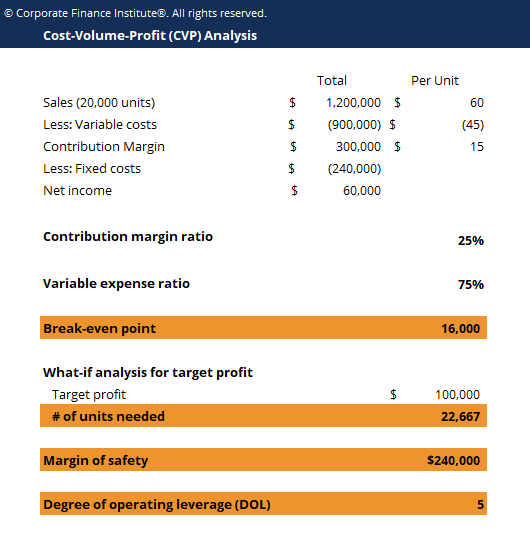
This image provides a great summary of the entire CVP analysis process, including target profit.
Conclusion
In this lesson, we have taken a significant step from basic cost analysis to strategic business planning. You have learned how to transform a desired profit target into a concrete sales objective, a skill that is fundamental to managerial decision-making.
Key Takeaways:
- CVP analysis can be extended beyond the break-even point to calculate the sales volume needed to achieve a target operating income.
- The formula is a simple extension of the break-even formula:
Sales Volume = (Fixed Costs + Target Operating Income) / Contribution Margin. - For more realistic planning, we must account for income taxes. This involves converting a target net income into its pre-tax equivalent (target operating income) before applying the CVP formula.
- The formula for target operating income is:
Target Net Income / (1 - Tax Rate).
Preview of the Next Lesson:
So far in this module, we have focused on CVP analysis, which is powerful for overall planning in businesses that sell uniform products. However, many companies produce unique, customized products or services for different clients (e.g., a construction company, a consulting firm, or a high-end furniture maker). For these businesses, it's crucial to track costs for each individual project.
In our next lesson, we will shift our focus to a different method of cost accounting by exploring the learning outcome: "Describe a job order costing system and trace direct costs to a specific job." This will introduce you to the techniques used to determine the profitability of individual jobs, projects, or client orders.