Recommended resources
The freely available resources this lesson will direct you to.
- Contest of the cathedrals – the Gothic period | DW Documentarywww.youtube.com
- Picturing salvation — Chora’s brilliant Byzantine mosaics and frescoeswww.youtube.com
- Byzantine Art and Architecture Overview | TheArtStorywww.theartstory.org
- Power and Hierarchy in Byzantine Art and Architecturewww.mcgill.ca
Hello! Welcome to your fourth lesson in our course on art, politics, and power.
Introduction
In our last lesson, we analyzed how ancient rulers—Narmer in Egypt and Augustus in Rome—used art to legitimize their authority and establish a new political order. We saw how patronage and ideology work to create powerful, strategic messages.
Today, we move forward in history to the Medieval period. This lesson addresses the learning outcome: Analyze how Medieval art (e.g., Byzantine mosaics, Gothic cathedrals) served as physical manifestations of religious and social hierarchies. We will explore how art and architecture were used not just to legitimize a single ruler, but to map out an entire social and divine universe, making everyone's place in the system visible and tangible.
For you, with your expertise in systems thinking and product design, this lesson is about understanding how an entire society's "operating system"—its religious beliefs, social structures, and power dynamics—is visualized and reinforced through its most ambitious creative projects.
Estimated time to complete: 60 minutes.
Recap from Last Lesson:
- We saw how art can be used for direct assertion of power (Narmer Palette) or subtle insinuation (Ara Pacis).
- The core concepts of patronage (who pays) and ideology (the message) are central to understanding political art.
1. The Byzantine System: A Universe in Gold
The Byzantine Empire (the Eastern Roman Empire) was a society defined by a rigid, dual hierarchy: the Emperor, who held earthly power by divine right, and the Church, which held spiritual authority. Byzantine art is the visual manifestation of this system. It is not meant to be realistic; it is a symbolic map of the cosmos, where every figure and every space has a designated place in a divine and imperial order.
For a brief overview of how Byzantine art was used to project power, please read the following summary.
Reading (5 minutes):
Byzantine Art and Architecture Overview | TheArtStory (Summary of Byzantine Art and Architecture; Key Ideas & Accomplishments)
Focus on the key ideas: how emperors used art to signal their strength by associating themselves with Christ, and how church interiors were designed to create a "heavenly realm here on earth."
Case Study: The Mosaics of San Vitale, Ravenna
The Basilica of San Vitale in Ravenna, Italy, is one of the most important surviving examples of Byzantine art and architecture. Consecrated in 547 CE, its mosaics are a masterclass in communicating power. Ravenna had just been reconquered by Emperor Justinian, and the artwork served to stamp imperial and religious authority onto the newly acquired territory.
The following reading delves into how the architecture and art of churches like San Vitale were meticulously designed to organize society.
Reading (10 minutes):
Power and Hierarchy in Byzantine Art and Architecture (Introduction to Power and Hierarchy in Byzantine Art; Commoners and the Church: Spatial and Visual Segregation; Emperor and Subjects: Legitimizing Imperial Power)
As you read, focus on these three hierarchical relationships:
- Commoners and the Church: How did the church's physical layout (segregated spaces for men and women, the chancel barrier hiding the clergy) reinforce the power of the clergy and the passive role of the laity?
- Emperor and Subjects: Why was it so significant for Justinian and Theodora to appear in mosaics in a city they never visited? How did this act as an assertion of control?
The most famous mosaics in San Vitale are the panels depicting Emperor Justinian and Empress Theodora. They face each other across the apse, forever participating in the church's liturgy.

This mosaic shows Emperor Justinian, centrally located and haloed, holding a bowl for the bread of the Eucharist. He is flanked by the clergy, led by Bishop Maximianus (his name inscribed above), and his administration and military. This composition visually merges state and church, placing the emperor as the pivot point between them. He is not just a ruler; he is God's representative on Earth.
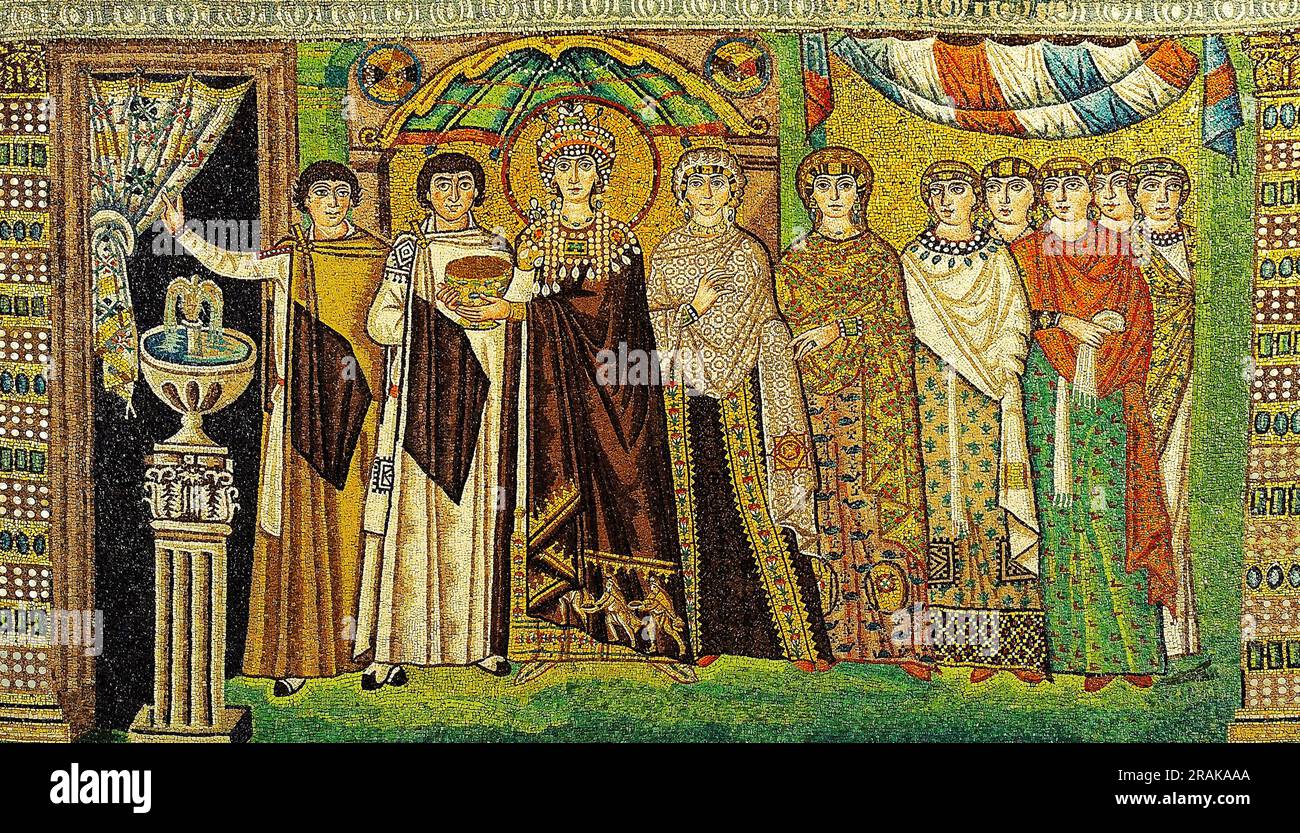
This mosaic shows Empress Theodora, equally lavishly dressed and also haloed, holding the chalice for the wine of the Eucharist. The curtain at the left suggests she is about to enter the sacred space of the church. The bottom of her robe depicts the Three Magi offering gifts, explicitly comparing her offering to those who honored the infant Christ. This reinforces her sacred and imperial status.
These mosaics are a perfect illustration of the Byzantine system:
- Hierarchy is Visual: The placement, halos, and regal attire clearly distinguish the imperial couple from all others.
- Power is Divine: The halos and their participation in the Eucharist visually equate them with saints, asserting that their power comes directly from God.
- Church and State are Fused: By placing these political portraits within the most sacred part of the church, the art declares that there is no separation between imperial rule and divine order.
2. The Gothic Shift: Building Civic Identity
Centuries later in Western Europe, a new style emerged: Gothic. While Byzantine art was about representing a static, eternal hierarchy, Gothic architecture introduced a sense of dynamism, aspiration, and, crucially, a new social dimension.
The technological innovations of Gothic architecture—pointed arches, ribbed vaults, and flying buttresses—allowed for buildings of unprecedented height and light. Cathedrals became shimmering cages of stone and stained glass. But the story of these buildings is not just technological; it's also political.
This documentary explores the "contest of the cathedrals," where cities vied to build the grandest structures. As you watch, notice the shift in who is funding and controlling these massive projects.
Watch (15 minutes):
Please focus on these key segments that illustrate the changing social hierarchy:
- The Birth of Gothic (00:06 - 03:00): Understand the architectural revolution that made these buildings possible and sparked a competition across Europe.
- Freiburg Minster (13:33 - 16:14): This is a critical section. Notice how the project begins as an aristocratic commission but is taken over by the citizens. The windows, sponsored by guilds (bakers, shoemakers), become a public ledger of economic power.
- Shifting Power in Strasbourg (17:38 - 20:15): Here, the city council takes control of the cathedral's construction from the bishop, viewing it as a "prestige object symbolizing the might of their city."
- Ulm Minster (25:07 - 26:51): This is the ultimate example—a church built entirely by the citizens, without the clergy or nobility, funded by their commercial wealth.
Analysis: From Divine Order to Civic Pride
The Gothic cathedral represents a significant evolution in the relationship between art, power, and society. Where Byzantine mosaics reflected a rigid, top-down hierarchy (God -> Emperor -> Clergy -> People), Gothic cathedrals show the emergence of new power centers.
| Feature | Byzantine Mosaics | Gothic Cathedrals |
|---|---|---|
| Primary Patronage | Emperor and high clergy. | Increasingly, city councils, guilds, and wealthy citizens. |
| Core Message | The eternal, divinely-ordained hierarchy of God and Empire. | The glory of God, but also the power, wealth, and pride of the city and its citizens. |
| Social Structure | Static & Top-Down: Art reinforces a fixed social order. | Dynamic & Distributed: Art reflects an evolving society with rising commercial and civic power. |
| Representation | Symbolic and hierarchical. Figures are placed according to spiritual rank. | Narrative and civic. Stained glass tells biblical stories alongside displaying the symbols of the guilds who paid for them. |
This shift is profound. The cathedral was still a house of God, but it was also a house of the people—a physical manifestation of their collective wealth, ambition, and identity.
Conclusion
Today, we have seen how Medieval art and architecture served as powerful physical manifestations of social and religious hierarchies. You can think of them as two different "design systems" for visualizing power.
Key Takeaways:
- Byzantine art used a rigid, symbolic visual language to represent a static, top-down hierarchy where the Emperor's power was fused with the divine authority of the Church.
- Gothic cathedrals, while deeply religious, became expressions of a more dynamic and distributed social structure. Their construction and decoration reflected the rising power of cities, citizen councils, and commercial guilds.
- The shift from Byzantine to Gothic demonstrates how art not only reflects but also shapes social reality, moving from a map of a divinely-ordered cosmos to a celebration of civic and economic power on earth.
Preview of the Next Lesson:
We've seen the rigid system of the Middle Ages and the first signs of emerging civic power in the Gothic era. In our next lesson, we will see how this shift accelerates in Renaissance Florence. We will explain the system of patronage in Renaissance Florence and analyze how the Medici family used art to exert political influence, mastering the art of patronage to navigate and dominate a complex new world of commerce, politics, and faith.