Recommended resources
The freely available resources this lesson will direct you to.
Hello! Welcome to the first lesson of our second module.
In our first module, we established a foundational framework for understanding the relationship between art and power. We discussed concepts like patronage and ideology, and saw how rulers in ancient and medieval times used art and architecture to legitimize their authority and structure their societies.
Today, we will apply that framework to one of the most dynamic periods in history: the Italian Renaissance. Our focus will be on the city of Florence and its most famous family, the Medici.
Learning Outcome: By the end of this lesson, you will be able to explain the system of patronage in Renaissance Florence and analyze how the Medici family used art to exert political influence.
We will explore how a family of bankers, with no noble title, managed to become the de facto rulers of a fiercely independent republic. As you'll see, their strategy relied less on armies and more on a sophisticated deployment of wealth and culture—a masterclass in what we might today call "soft power."
1. The Setting: Florence and the Rise of a New Order
To understand the Medici, we first need to understand their world. In the 12th to 14th centuries, Northern Italy saw the rise of powerful city-states like Florence, Milan, and Venice. These were centers of trade, finance, and manufacturing, with a new, wealthy middle class of merchants and bankers emerging. This new class challenged the old power structures of the landed aristocracy and the Church.
The Medici family of Florence were the ultimate example of this new class. They built an immense fortune through banking, becoming the most powerful financial institution in Europe. But wealth alone did not guarantee political power, especially in a republic like Florence with a complex, often volatile political scene. The Medici needed a way to translate their economic capital into political and social dominance.
To learn more about this context and the Medici's rise, please read the following introductory sections from the article "The Art of Rule: The Medici's Key to Power."
The Art of Rule: The Medici's Key to Power - Italian Culture
This reading provides an excellent overview of how the Medici family rose from bankers to the rulers of Florence, and how they began using art as a key part of their strategy.
Please read the 'Overview', 'The Rise of the Renaissance', and the unnamed section that follows it (ending just before 'With Power Comes Opposition'). Focus on how the changing social structure of Florence created an opportunity for the Medici and their initial motivations for funding the arts.
As the reading highlights, the Medici's patronage wasn't simply about a love for art; it was a calculated strategy to "obtain the love of the people" and create a new cultural identity for Florence—an identity inextricably linked to their family.
2. The Patronage System: A Strategic Investment
The Medici perfected a system of patronage that was far more than simple philanthropy. It was a strategic investment in cultural production that created a network of dependency and loyalty, enhanced their social status, and projected an image of power and sophistication.
This approach created what the article you just read calls a "symbiotic relationship." Artists received the financial security and creative freedom to produce masterpieces, which in turn brought fame and prestige not only to the artist but, crucially, to their patron.
The following reading elaborates on this strategic dimension of Medici patronage.
The Role of the Medici Family in the Italian Renaissance
This text, from 'The Role of the Medici Family in the Italian Renaissance,' frames their patronage as a deliberate investment designed to build cultural and political power.
Please read the section titled 'Patronage of the Arts: How the Medici Family Fostered Renaissance Creativity.' Pay attention to how the author describes patronage as a tool for political expression, projecting an image of 'wealth, sophistication, and cultural supremacy.'
Given your background in product strategy and design, you can think of the Medici's approach as a long-term investment in building a powerful brand for both their family and their city. They weren't just commissioning "products" (artworks); they were curating a cultural "user experience" for the citizens of Florence that generated immense loyalty and reinforced their leadership position.

3. The Methods of Influence: From Civic Pride to Propaganda
So, how exactly did this patronage translate into political influence? The Medici employed a spectrum of methods, ranging from subtle, indirect influence to overt, direct propaganda. The article "The Art of Rule" provides an excellent breakdown of these methods.
Method 1: Indirect Influence through Civic Projects
One of the most effective strategies was funding large-scale public works, particularly architectural and religious projects. While these works served the public and the church, the Medici name was inextricably linked to their creation.
The most famous example is the dome of the Florence Cathedral.
The Art of Rule: The Medici's Key to Power - Italian Culture
This section details the 'indirect' method of Medici influence, using the iconic example of Brunelleschi's Dome.
Please read the section titled 'Brunelleschi.' Notice how the funding of a religious building became a symbol of Florentine civic pride and human ingenuity, reflecting glory back onto the Medici.
By financing a project the city desperately needed but couldn't complete on its own, Cosimo de' Medici positioned his family not as tyrants, but as benevolent and essential civic leaders. The dome became a symbol of Florentine greatness, and by extension, Medici greatness.
Method 2: Direct Influence and Propaganda
As their power grew and became more formalized, the Medici's use of art became more direct. They began commissioning works that explicitly glorified their family, either by subtly inserting their portraits into religious scenes or by creating works that were unabashed political propaganda.
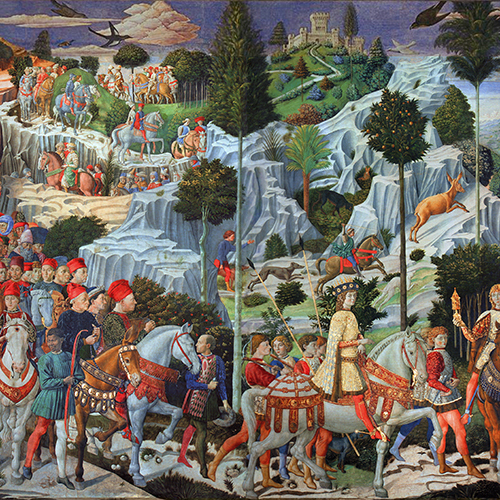
The following readings explore this shift towards more overt messaging, from glorifying the family's role in Florence's history to portraying the ruler as a new Roman emperor.
The Art of Rule: The Medici's Key to Power - Italian Culture
These two sections from 'The Art of Rule' show the evolution of Medici patronage towards more explicit forms of self-glorification and political propaganda.
Please read the sections titled 'Vasari' and 'Cellini.' Observe the shift in strategy: from funding a public religious mural ('The Last Judgment') that still carried political undertones, to commissioning a bust of Cosimo I that directly equates him with Roman emperors.
This evolution from funding public works to commissioning heroic busts of themselves marks a significant change. In the beginning, their power was unofficial, requiring a delicate touch. Later, as Dukes of Florence, their art could be much more direct—less about earning public love and more about demanding public obedience. It's a shift from influence to assertion, from soft power to a harder, more propagandistic message.
Conclusion
Today we've seen that in Renaissance Florence, art patronage was not a hobby but a central pillar of political strategy. The Medici family, more than any other, mastered this art of rule.
Here are the key takeaways:
- Patronage as a System: The Medici created a symbiotic system where their financial support for artists and thinkers generated cultural capital, which they then converted into political power and social legitimacy.
- A Spectrum of Influence: They used a range of methods, from indirect influence via funding magnificent public works that fostered civic pride, to direct propaganda that glorified their family and legitimized their dynastic rule.
- An Evolving Strategy: Their approach evolved with their political status. Early on, they cultivated an image of benevolent civic leadership. Later, as their power became absolute, their art became a more overt tool of state propaganda.
The Medici's story is a powerful case study in how art can be strategically deployed to build a brand, shape public perception, and ultimately, secure and maintain power.
In our next lesson, we will shift our focus from Florence to Rome. We'll see how the Popes, as patrons, used art in a different but equally powerful way during the turbulent period of the Reformation, focusing on one of the most famous and controversial artworks of all time: Michelangelo's The Last Judgment.