Recommended resources
The freely available resources this lesson will direct you to.
Hello! Welcome to your third lesson.
Introduction
In our last lesson, we explored how the system of patronage allows powerful individuals and institutions to embed their ideology in art, using the Medici in Renaissance Florence as our key example. We saw how they strategically used art and architecture to build and legitimize their power.
Today, we apply these concepts to even more foundational examples, going back to the dawn of great empires. This lesson directly addresses the learning outcome: Analyze how art and architecture were used to legitimize power in ancient empires, using examples from Egypt (Narmer Palette) and Rome (Ara Pacis).
We will examine two masterpieces of political art. Each served to justify a new political order, but they did so using remarkably different strategies tailored to their unique historical contexts. For you, with your background in systems thinking and product strategy, this is a lesson in how the "messaging" of power is designed and deployed, whether for a new kingdom 3,000 years ago or a new empire 2,000 years ago.
Estimated time to complete: 60 minutes.
Recap from Last Lesson:
- Patronage is the financial system linking power to artistic production.
- Ideology is the set of beliefs a power structure promotes to justify its dominance.
- The Medici strategically used patronage to project an ideology of legitimate rule, evolving their approach as their power grew.
1. The Blueprint: Unifying a Kingdom with the Narmer Palette
Our first case study is one of the oldest and most important artifacts in history: the Narmer Palette. It dates from approximately 3100 BCE and is considered a foundational document of the Egyptian state. Think of it not as a decorative object, but as a "product" designed with a clear strategic goal: to communicate the unification of Egypt under a single, divinely-sanctioned king.
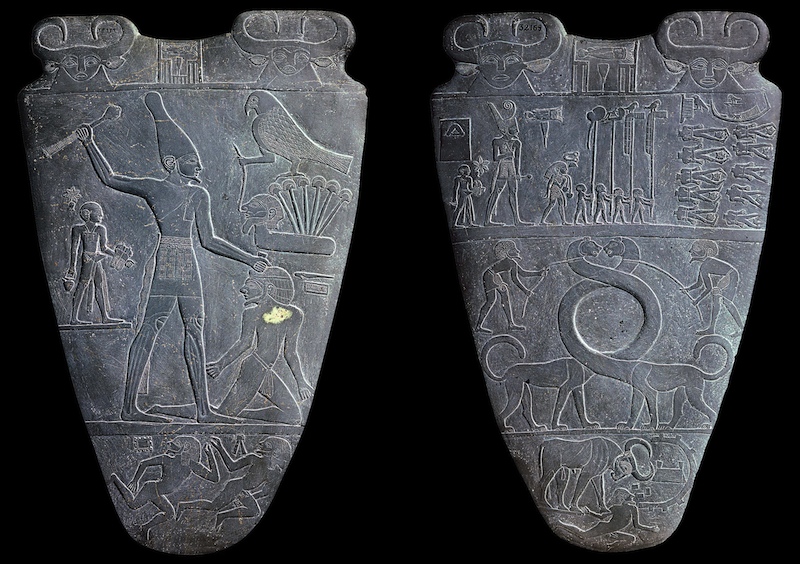
This image shows both sides of the Narmer Palette. Note the central figure's dominance, the different crowns he wears on each side, and the mix of human and divine figures.
To understand the powerful story this object tells, please read the following sections from the article "The Narmer Palette: History and Major Facts."
Reading (15 minutes):
The Narmer Palette: History and Major Facts (The Narmer Palette: History and Major Facts; Physical Description and Artistic Features; Symbolism and Interpretation; Function and Theories; Legacy and Impact: Political Symbolism; Legacy and Impact: Cultural Integration; Conclusion)
As you read, focus on these key points:
- The core narrative: The unification of Upper (Southern) and Lower (Northern) Egypt.
- Key symbols of power:
- The White and Red Crowns, worn by Narmer on opposite sides to signify his rule over both lands.
- The smiting pose, a classic image of pharaonic power and conquest.
- Hierarchical scale, where Narmer towers over his defeated enemies.
- The presence of the god Horus (as a falcon), signifying divine approval.
- Its function: The article suggests it was a votive object and a form of early propaganda to legitimize Narmer's rule.
Analysis: A Design System for Power
The Narmer Palette is a masterclass in establishing a visual language for power. It doesn't just record an event; it defines the ideology of Egyptian kingship for the next 3,000 years.
- The Patron: King Narmer.
- The Ideology: The pharaoh is a divine figure, chosen by the gods to bring order (
Ma'at) to the world by conquering chaos (his enemies) and unifying the two lands of Egypt under his singular, absolute authority. - The Artwork as Product: The Palette is a durable, visual charter for the new state. It uses a clear, unambiguous symbolic system to communicate the king's legitimacy. In your terms, it established the "design system" for pharaonic authority—the poses, symbols, and hierarchies seen here would be repeated for millennia to reinforce the same core message of divine kingship.
2. The Rebrand: Selling an Empire with the Ara Pacis
Nearly 3,000 years later, another leader faced the challenge of legitimizing a new political order. After decades of brutal civil war, Octavian (later Augustus) emerged as the sole ruler of Rome. However, he couldn't simply declare himself a divine king like Narmer. Rome had a deep-seated hatred of kings and a 500-year-old identity as a Republic.
Augustus's challenge was one of political "rebranding." He needed to exercise absolute power while maintaining the image of the restored Republic. His solution was to position himself not as a king, but as princeps, or "first citizen," the restorer of peace, tradition, and morality. The Ara Pacis Augustae, or Altar of Augustan Peace, is the primary "marketing asset" for this new brand.
To understand Augustus's strategy, let's start with a video that frames his political genius.
Watch (4 minutes):
Focus on the narrator's description of Augustus's strategy: grasping the "substance" while avoiding the "semblance" of absolute power. Note how the Ara Pacis is presented as the "capstone" of his moral and religious agenda, seamlessly connecting his rule with the favor of the gods and an idealized social order.
Now that you have the strategic context, let's examine the artwork itself in more detail. This next video walks through the monument's iconography.
Watch (10 minutes):
Pay attention to the specific visual messages:
- Peace and Abundance (03:10): The lower frieze is covered in lush, orderly vegetation from over 50 species. This isn't just decoration; it's a message that Augustus's peace has brought about a new Golden Age of fertility and prosperity.
- Mythological Foundation (04:53): The allegorical panel of a mother figure (Tellus/Pax/Venus) with two babies, surrounded by symbols of harmony, reinforces the idea of peace and the fruitfulness of the new era.
- Dynastic Succession (06:35): The processional friezes are crucial. Unlike idealized Greek figures, these are recognizable portraits of Augustus and his family, including children. This was a radical inclusion. It presents the imperial family as the center of the state and subtly points to a hereditary future, all within the context of a religious procession.
Analysis: The Art of Subtle Propaganda
The Ara Pacis is a far more complex piece of propaganda than the Narmer Palette. Its message is layered and indirect, designed for a more politically sophisticated audience.
- The Patron: The Roman Senate, at the behest of Emperor Augustus.
- The Ideology: Augustus is not a king, but the divinely favored first citizen who has ended civil war, restored the Republic, and brought about a new Golden Age of peace, piety, and prosperity (
Pax Romana). His family is the model for Roman virtue and the guarantor of this stability. - The Artwork as Product: The Ara Pacis is a public monument that sells the new imperial reality by wrapping it in the comforting visual language of tradition, nature, and religion. Every element is designed to reinforce the benefits of Augustus's rule without using the language of monarchy. The inclusion of his family introduces the idea of a dynasty as a natural and desirable continuation of this peace.
3. Comparative Analysis: Two Strategies for Legitimacy
Both rulers used art to legitimize a new political order, but their methods were tailored to their circumstances.
| Feature | Narmer Palette (Egypt, c. 3100 BCE) | Ara Pacis (Rome, 9 BCE) |
|---|---|---|
| Political Context | Unification of a new kingdom from disparate regions. | Transition from a Republic to an Empire after civil war. |
| Core Message | "I am the divine king, conqueror and unifier." | "I am the first citizen, restorer of peace and tradition." |
| Strategy | Direct Assertion. Use of force and divine right is explicit and celebrated. | Subtle Insinuation. Autocratic power is masked by republican and religious imagery. |
| Key Iconography | Smiting pose, dual crowns, hierarchical scale. | Lush nature, allegorical figures of peace, family portraits. |
| Audience & Tone | Unambiguous, declarative, and foundational. | Layered, persuasive, and reassuring. |
This comparison highlights a crucial point: the design of political art is not arbitrary. It is a strategic response to a specific political problem.
Conclusion
Today we've seen how two of history's most powerful empires used art and architecture at pivotal moments to establish and legitimize their rule. While separated by three millennia, both the Narmer Palette and the Ara Pacis served as sophisticated tools of statecraft.
Key Takeaways:
- Art and architecture are not merely decorative but are fundamental tools for legitimizing political power.
- The Narmer Palette established a direct and enduring visual language for divine kingship through symbols of unification, conquest, and divine sanction.
- The Ara Pacis employed a more subtle strategy, "rebranding" autocratic rule as a restoration of peace and republican tradition, using symbols of abundance, piety, and family to legitimize the new Augustan order.
- The effectiveness of political art lies in its ability to tailor its message and strategy to a specific historical and political context.
Preview of the Next Lesson:
We have now seen how individual rulers, from Narmer to Augustus to the Medici, used art to cement their personal and dynastic power. In our next lesson, we will shift focus to see how art can manifest the power of an entire societal system. We will "Analyze how Medieval art (e.g., Byzantine mosaics, Gothic cathedrals) served as physical manifestations of religious and social hierarchies," exploring how art was used to structure society in the service of God and king.